


Faced with increasingly fierce competition from Chinese and South Korean shipbuilders, Japan has launched a nationwide shipping industry plan aimed at securing orders for domestic shipbuilders and strengthening cooperation across Japan’s maritime value chain.
Recently, SOMEC, a ship trading subsidiary of the Japanese financial and trading company ORIX, has partnered with one of Japan’s most influential shipowners/shipbuilding groups to jointly establish a new joint venture shipowner company, Sakura Ocean Corporation.
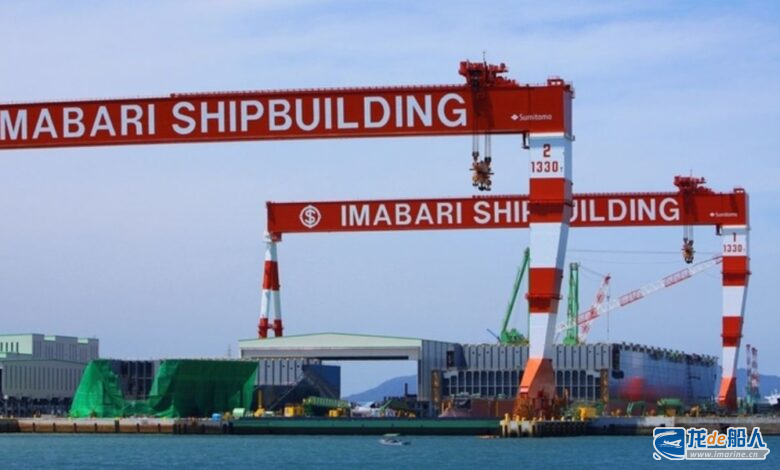
Specifically, the joint venture is jointly owned by SOMEC, Onomichi Shipbuilding, Shoei Kisen Kaisha (the most important shipowner platform within the Imabari Shipbuilding Group) under the Imabari Shipbuilding Group, and Kambara Kisen (the main shipping entity and founding company of the Tsuneishi Group) under the Tsuneishi Group, with respective equity stakes of 10%, 30%, 30%, and 30%.
Sakura Ocean, newly established, is Japan’s first industry platform integrating shipowners, shipbuilders and ship traders. It plans to order three new vessels, one each from Imabari Shipbuilding, Tsuneishi Shipbuilding and Onomichi Shipbuilding. All three vessels are slated for delivery by 2030 and will be chartered to Japanese operators through time charter contracts. ORIX’s subsidiary, Santoku Senpaku, will be responsible for vessel supervision and technical management, while ORIX will coordinate planning matters among the shareholders.
It is reported that against the backdrop of Chinese and South Korean shipyards dominating global new ship orders, Japan has positioned this joint venture’s cooperative model as a template for safeguarding the foundation of its shipbuilding and maritime industries. By integrating domestic orders, ownership, chartering, and management into a closed-loop system, Sakura Ocean Corporation aims to provide Japanese shipyards with a more stable order pipeline, keep ship financing and asset management within Japan, and strengthen Japan’s influence in decision-making regarding next-generation vessel tonnage.
Over the past two years, ORIX has been committed to building this ecosystem, acquiring Santoku Senpaku in 2024 and SOMEC—spun off from Sojitz’s shipping division—in 2025. SOMEC’s shareholders also include Shoei Kisen Kaisha, Kambara Kisen and Onomichi Shipbuilding. This joint venture represents a continuation of their collaborative efforts.
In the 1990s, Japanese shipyards accounted for nearly 50% of global shipbuilding capacity. Today, their market share has plummeted to about 10%, far behind China, which controls 70% of global new shipbuilding capacity and 90% of global maintenance capacity, as well as their long-term regional competitor, South Korea.
In 2025, Japan unveiled a shipbuilding industry revitalization plan, setting a target to double production capacity by 2030. As a key component of this initiative, Japan’s largest shipbuilding group, Imabari Shipbuilding, has completed its controlling acquisition of Japan Marine United (JMU), the nation’s second-largest shipbuilder, increasing its stake to 60%.
Not only that, in November 2025, Japan’s three major shipping giants—Nippon Yusen Kaisha (NYK), Mitsui O.S.K. Lines (MOL), and Kawasaki Kisen Kaisha (K Line)—announced a collaboration with Japan’s leading shipyards to revitalize the nation’s shipbuilding industry. These three companies have jointly invested in MILES, a Tokyo-based ship design firm. This marks the first time Japanese shipping companies and shipbuilders have jointly funded ship development.
MILES was established in 2013 and primarily engages in the design and sales of LNG carriers. It is jointly owned by Mitsubishi Heavy Industries (51% stake) and Imabari Shipbuilding (49% stake). Through this joint investment, the parties will advance the company’s development of multiple next-generation vessels, including commercial ships utilizing low-emission alternative fuels such as LNG, methanol, and ammonia, as well as liquid carbon dioxide carriers for carbon capture and storage.
Beyond promoting the development of new ship designs, another major objective of the three shipping companies’ investment in MILES is to establish a unified foundation for standardized ship design in Japan. By selling standardized designs to other domestic shipyards, this initiative will enhance production efficiency and strengthen the overall competitiveness of Japan’s shipbuilding industry.
The mainstream Japanese media outlet Nikkei Asia once reported that the lagging standardization process in ship design is one of the factors contributing to the decline of Japan’s shipbuilding industry. In contrast, China’s shipbuilding industry has significantly improved production efficiency by integrating design functions into the Shanghai Ship Research and Design Institute, a subsidiary of the state-owned China State Shipbuilding Corporation (CSSC). This move by major Japanese shipowners to jointly invest in ship design companies and promote design standardization is precisely an attempt to learn from and follow the Chinese shipbuilding model.
The establishment of this joint venture further demonstrates that in response to the aggressive expansion of Chinese and South Korean shipyards, Japanese shipbuilders are moving beyond traditional bilateral cooperation between shipyards and shipowners toward a more coordinated, comprehensive industrial strategy.