


Following the merger of the top two shipbuilders to expand production capacity, Japan’s shipbuilding industry is now seeking to enhance its capabilities in building liquefied natural gas (LNG) carriers, a vessel type regarded as a prime example of high-value-added vesselss. Japan’s resumption of LNG carrier construction after a seven-year hiatus has drawn widespread attention from the industry.
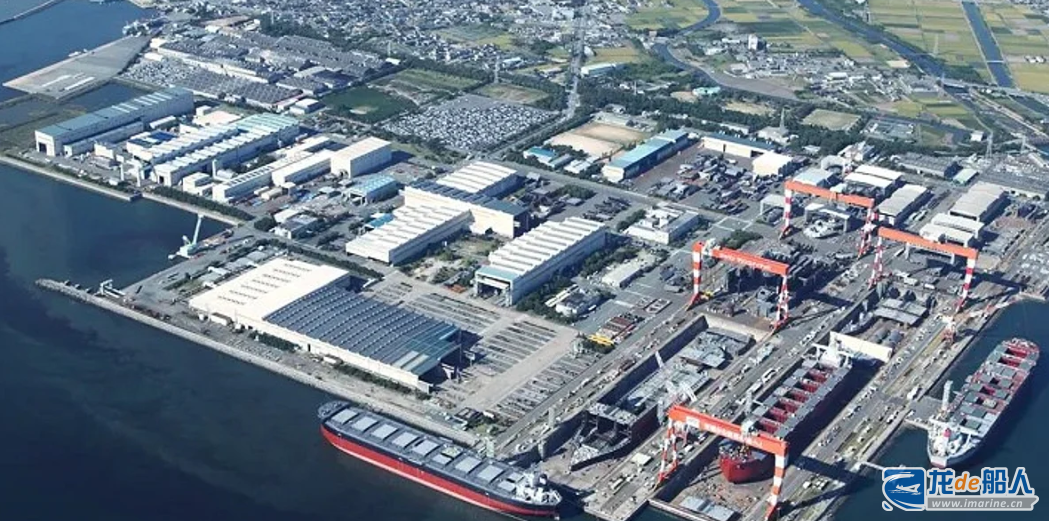
Japan’s shipbuilding industry announces the resumption of LNG carrier construction.
According to industry sources, the Japanese government will collaborate with private shipbuilders to advance the construction of LNG carriers. This marks the first time in seven years that the Japanese shipbuilding industry has resumed construction of this type of vessel, following the delivery of one LNG carrier each by Mitsubishi Heavy Industries and Kawasaki Heavy Industries in 2019. Discussions on the matter began on March 19.
Currently, a widely discussed proposal in Japan involves Imabari Shipbuilding—the country’s largest shipbuilding group—planning to utilize a portion of the shipyard facilities belonging to Oshima Shipbuilding for the construction of LNG carriers. Oshima Shipbuilding is a shipyard specializing in the construction of bulk carriers, with its primary vessel types including Handymax, Supramax, and Kamsarmax vessels. It also undertakes ship repair, refit, and steel structure fabrication and installation projects. The shipyard ranks among the top globally in market share for Supramax bulk carriers.
This resumption of LNG carrier construction is not the first step Japan has taken to revitalize its shipbuilding industry.
In June 2025, Imabari Shipbuilding announced that it would incorporate Japan Marine United (JMU), Japan’s second-largest shipbuilder, into its subsidiary structure through a share acquisition; in January 2026, Imabari Shipbuilding completed the equity transfer of Japan Marine United with JFE Holdings and IHI Corporation, acquiring 15% of the shares from each of the latter two companies, thereby increasing its stake in Japan Marine United to 60%. Japan Marine United officially became a subsidiary of Imabari Shipbuilding.
As a result of this merger, the combined production capacity of Imabari Shipbuilding and Japan Shipbuilding Corporation has propelled them to become the world’s fourth-largest shipbuilding group, reportedly positioning them to compete with China State Shipbuilding Corporation, which ranks first, and HD Hyundai Group, which ranks second.
Through this merger, the combined production capacity of Imabari Shipbuilding and Japan Marine United has surged to make them the world’s fourth-largest shipbuilding group—a position reportedly capable of competing with the top-ranked China State Shipbuilding Corporation and the second-ranked HD Hyundai Group.
To revitalize its domestic shipbuilding industry, the Japanese government has formulated a plan aiming to double Japan’s shipbuilding capacity—currently standing at approximately 9.08 million gross tons—by 2035. To this end, Japan plans to invest 1 trillion yen in public and private funds over the next decade, introducing automated equipment starting in 2028 and fully expanding production capacity in 2034, supported by expanded dry docks.
Having secured a substantial share of the shipbuilding market, Japan’s shipbuilding industry faces a protracted battle.
Regarding reports that Japan is resuming the construction of LNG carriers, South Korea’s shipbuilding industry believes that while this move will have little short-term impact on Korean shipyards, some concerns do remain.
Currently, Japanese shipyards hold zero outstanding orders for LNG carriers; consequently, it is expected to take a considerable amount of time for them to re-establish a firm foothold in this market segment. Furthermore, Japanese shipyards have historically specialized in constructing Moss-type LNG cargo tanks, rather than the membrane-type tanks that currently dominate the market. In light of these factors, this move by Japan is unlikely to have any significant impact on the major LNG carrier shipyards currently operating in China and South Korea.
It is reported that membrane-type LNG cargo tanks can be customized to fit the shape of the hull, offering high space utilization; however, they possess relatively weak impact resistance and demand a high level of technical expertise. Shipyards such as Hudong-Zhonghua, Jiangnan Shipyard, Dalian Shipbuilding Industry Corporation (DSIC), HD Hyundai Heavy Industries, HD Hyundai Samho, Hanwha Ocean, and Samsung Heavy Industries all utilize membrane-type cargo tank systems.
In contrast, while Moss-type cargo tanks enable stable transport, their use of spherical storage tanks results in relatively low space utilization efficiency. Unlike the situation at Chinese shipyards, Japanese shipyards face higher costs for raw materials and labor, thereby depriving them of a competitive advantage in pricing.
Although Japan faces various challenges in restarting its LNG carrier construction operations, it remains a force to be reckoned with. Japan dominated the global shipbuilding industry for decades; even if the specific vessel designs have evolved, the country possesses extensive experience in the field of LNG carrier construction.