


Japanese shipping company Mitsui O.S.K. Lines (MOL) has signed a financing agreement with an Asian syndicate for Singapore’s first Floating Storage and Regasification Unit (FSRU). The syndicate members include: Japan Bank for International Cooperation (JBIC), Mitsubishi UFJ Financial Group, DBS Bank, Oversea-Chinese Banking Corporation (OCBC), and Standard Chartered Bank (Singapore).
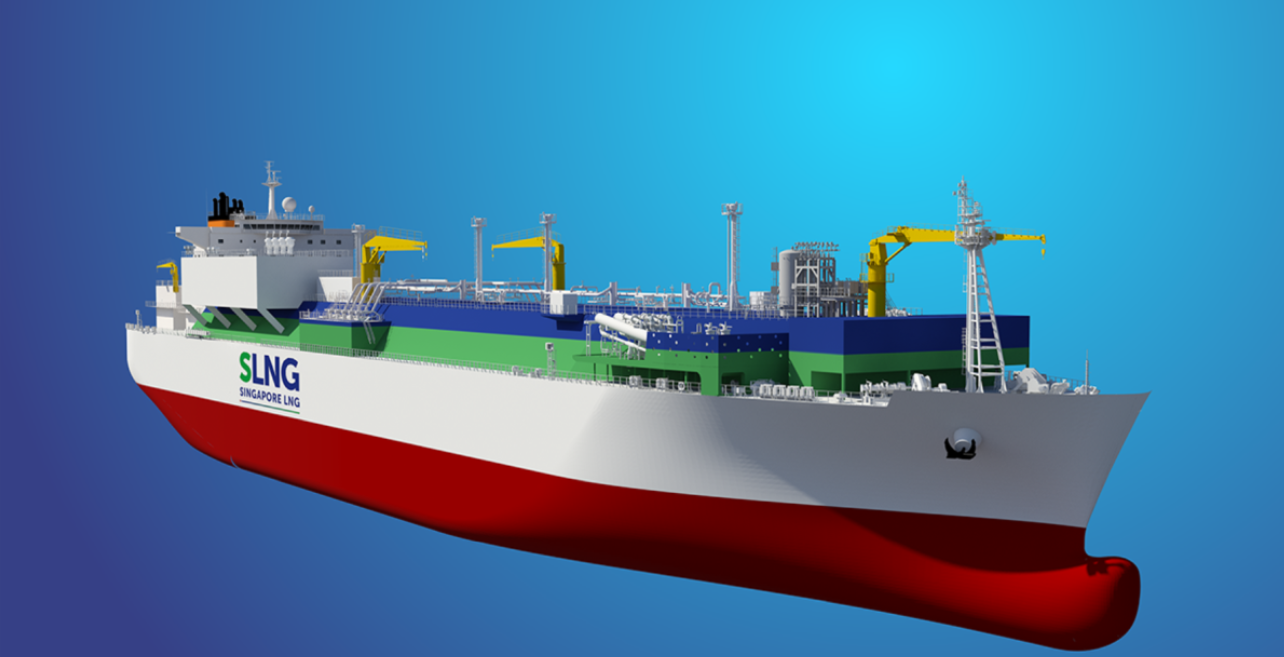
MOL did not disclose specific terms of the agreement, but according to information released by the Japan Bank for International Cooperation, the parties signed an agreement in December 2025 to provide up to $189 million in financing for Singapore’s first FSRU. This covers their joint loan share with UnicornMark Discovery, the FSRU asset management company under MOL.
Singapore LNG Corporation (SLNG) has signed a long-term charter agreement with MOL for this FSRU. It will be moored at Jurong Port, where it will receive, store, and regasify LNG before delivering the natural gas ashore.
In October 2024, MOL signed a construction contract with Hanwha Ocean for Singapore’s first FSRU, valued at approximately US$413 million. The vessel is currently under construction and is scheduled for delivery in October 2027.
The FSRU measures 299 meters in length and 51 meters in beam, with a storage capacity of 204,000 m³ and an annual regasification capacity of 5 million m³. According to SLNG, the unit is uniquely designed to operate continuously for 25 years without dry-docking maintenance, a first in the FSRU field. To achieve this and ensure compliance, the FSRU will receive multiple “SMART” classification notations from the American Bureau of Shipping (ABS), signifying its adoption of advanced digital technologies to improve operational efficiency, enable predictive maintenance, and enhance safety.
The FSRU’s main generator set will be equipped with a SMART MHM (Mechanical Health Monitoring) certified system to collect operational data in real time. This data will provide in-depth insights into the mechanical condition and operating status, enabling proactive maintenance based on data. Dedicated maintenance spaces and customized operating channels are designed to ensure that critical systems can be repaired in situ, maintaining optimal operating conditions while ensuring compliance.
The FSRU is expected to be operational by 2030. Once operational, SLNG’s total LNG processing capacity will increase to 15 million tons per year, providing greater resilience to meet Singapore’s future natural gas demand.