


The docks (shipbuilding facilities) at HD Hyundai Heavy Industries’ shipyards in Ulsan’s Mipo Bay and Jeonha Bay areas remained fully occupied even at the end of the year, according to South Korea’s mainstream media outlet Chosun Ilbo. As of the 25th of last month, 10 docks were densely packed with large commercial vessels under construction. The quays, where final assembly processes occur after launching, were also filled with ships awaiting departure.
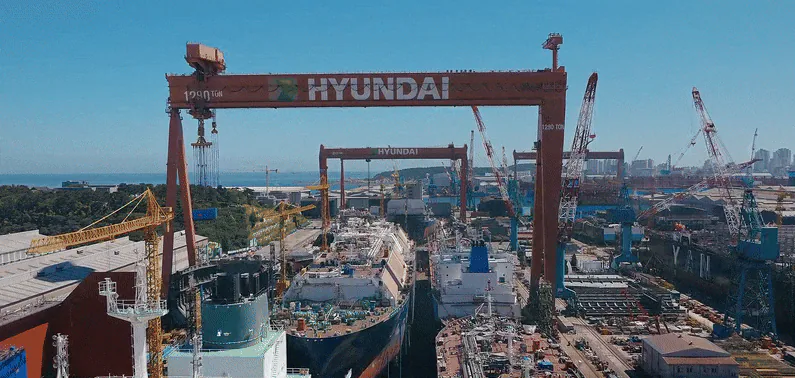
An HD Hyundai Heavy Industries official stated, “With 14 total docks, around 30 ships are currently under construction, operating nonstop. Approximately 40 ships are also docked at the quays undergoing outfitting and sea trials. Due to space constraints, we are conducting double berthing—mooring two ships side by side—to proceed with work.”
In 2026, South Korea’s shipbuilding industry is expected to continue its strategy of selective orders at “fair prices,” backed by a sufficient three-and-a-half-years’ worth of secured projects. According to industry sources, delivery slots are already fully booked until 2028, and competition among shipowners for 2029 slots is intensifying, gradually driving up ship prices.
Profitability improvements are also anticipated to accelerate. This is because orders secured since 2023, when ship prices began rising, will start reflecting in 2026 earnings. Han Seunghan, an SK Securities researcher, noted, “The cost burden is easing as prices for steel plates—a key raw material—have stabilized downward. Robust profit growth is expected as high-value orders and improved productivity align with deliveries.”
Export Volume Rises 8% Despite Stabilizing Export Value… “Commercial Ships Remain Cash Cows”
According to the Korea Institute for Industrial Economics and Trade (KIET)’s recent “2026 Economic and Industrial Outlook” report, South Korea’s shipbuilding sector is projected to see export volume rise to 10.46 million CGT (compensated gross tonnage) in 2026, a 7.9% increase from 2025. This growth is attributed to increased deliveries of commercial ships, the sector’s mainstay.
However, export value is expected to decrease by 4.0% to $30.326 billion (approximately 43.9 trillion Korean won). This decline is not due to falling ship prices but shifts in ship types. Lee Eun-chang, a KIET researcher, explained, “While the 2025 export value was inflated by high-priced offshore plant exports, 2026 will see reduced figures. However, deliveries of core commercial ships like liquefied natural gas (LNG) carriers will increase, expanding the volume of ships exported.”
The order portfolio is also shifting toward high-value and specialized ships. According to NH Investment & Securities’ research division, in 2026, domestic shipbuilders’ new orders by ship type will be led by LNG carriers (33%), followed by offshore plants (21%) and specialized ships (18%). This reflects a strategic focus on high-value markets like LNG carriers, where South Korea holds a dominant 66% market share, avoiding the container ship market dominated by China (72% share, South Korea at 22%).

“High-Value LNG Carriers to Surge in 2026”… Rising Prices Amid Order Boom
Expectations are particularly high for the LNG carrier market, where South Korean shipbuilders excel. Jung Yeon-seung, an NH Investment & Securities researcher, stated, “While 2025 saw weaker-than-expected LNG carrier orders, activity picked up in the fourth quarter, with letters of intent (LOIs) for slot reservations continuously submitted.”
NH Investment & Securities forecasts that South Korean shipbuilders’ combined new orders in 2026 will reach approximately $38.8 billion (56 trillion Korean won), a 10% increase from the previous year. Jung analyzed, “Key 2026 orders will focus on LNG carriers and tankers. Tanker prices are rising due to high freight rates, and LNG carrier prices are also gaining negotiating power as orders expand, signaling an upward trend in newbuilding prices.”
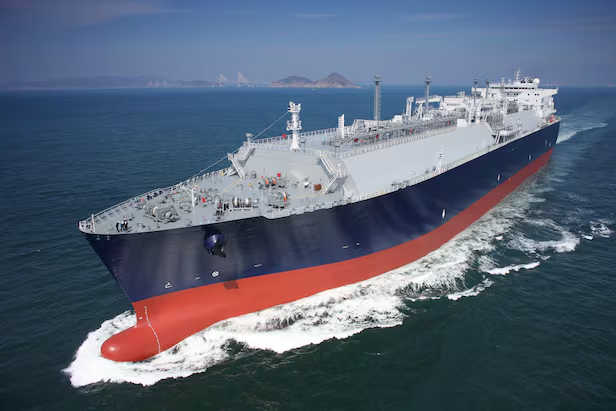
Securities firms predict that within the next 6–12 months, newbuilding prices for LNG carriers will exceed $260 million (370 billion Korean won), a 5% increase from late last year. Jung added, “Of the 77 LNG carriers expected to be ordered globally in 2026, South Korean shipbuilders are projected to secure 72. With 70 deliverable slots in 2029 already partially filled (20 slots taken), competition for remaining slots will likely drive prices higher.”
Green Light for U.S. Defense Market Entry… “2026 to Lay Cooperation Groundwork”
Many view 2026 as a year for South Korean shipbuilders to lay the foundation for entering the U.S. defense market. Following U.S. President Donald Trump’s designation of Huntington Ingalls Industries (HII) as the primary builder for the U.S. Navy’s next-generation frigate on the 19th of last month—and plans to expand surface combatants (BBG) to 20–25 ships—South Korean shipbuilders are anticipated to benefit.
Han Seunghan noted, “HII’s shipyard will inevitably face production bottlenecks when constructing new frigates, making external collaboration essential.” Consequently, partnerships with South Korean shipbuilders like HD Hyundai Heavy Industries (which has a partnership with HII) or Hanwha Ocean (which has a Maintenance, Repair, and Overhaul agreement with the U.S. Navy and local yards) are likely for subsequent orders.
However, most analysts agree that visible results from U.S. defense collaboration will take years. Jung explained, “U.S. legal revisions and potential facility investments by shipyards are prerequisites for direct collaboration. 2026 should be seen as a year to enhance long-term cooperation possibilities with South Korean shipbuilders ahead of actual U.S. warship construction.”
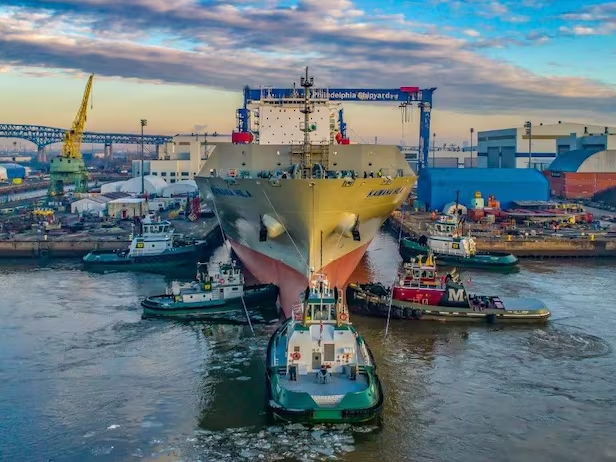
Lee Eun-chang echoed, “2026 will focus on establishing a foundation for South Korea-U.S. shipbuilding cooperation.” He added, “Hanwha Ocean’s Philly Shipyard, for instance, will face challenges in hiring local personnel to expand production. Next year will be a period of ‘trial and error’ as they secure orders, finalize designs, and train staff.”
Domestic shipbuilders are expanding overseas bases and production capacity to address structural booms. The KIET forecasts significant growth in South Korean shipbuilders’ overseas production in 2026, particularly in Vietnam (up to 20%) and the U.S. (over 20% increase).
Lee concluded, “Investments and expansions in the U.S. by South Korean shipbuilders are expected to boost exports of MRO and related services. Next year, domestic shipbuilders will likely construct around 11 million CGT and secure orders between 11–12 million CGT, maintaining a three-and-a-half-years’ backlog.”