


In 2025, the global new shipbuilding market showed a downward trend, with total orders for the year reaching 56.43 million compensated gross tonnage(CGT) across 2,036 vessels. This represented a decline of approximately 27% compared to the same period the previous year (76.78 million CGT across 3,235 vessels).
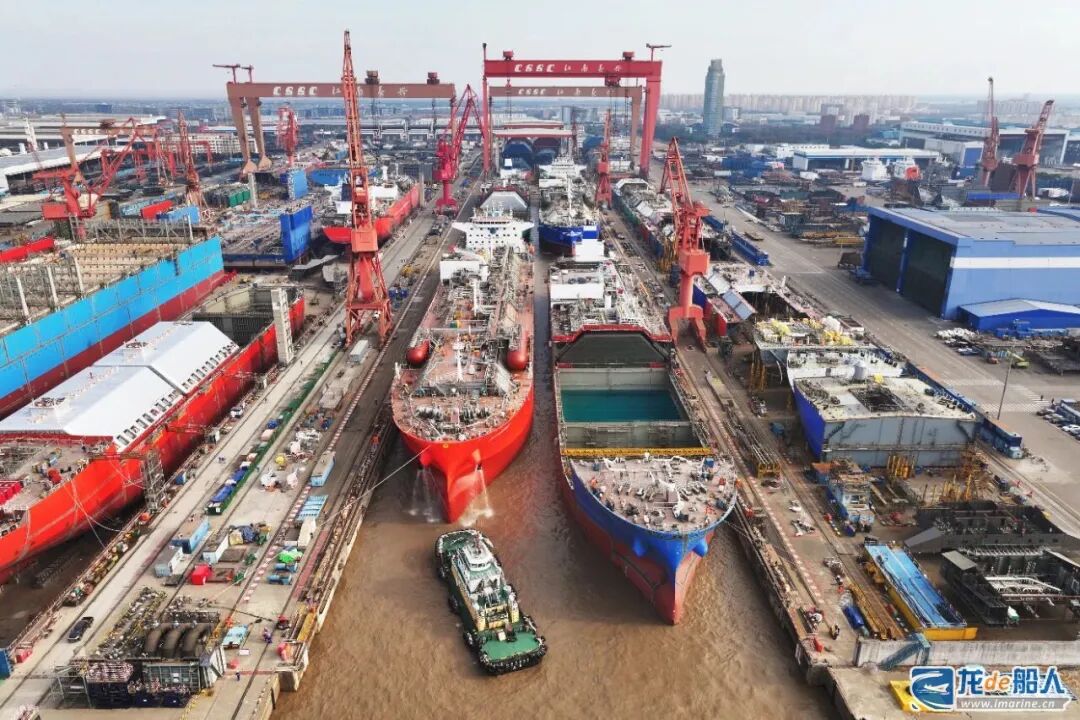
Entering 2026, the new shipbuilding market began to heat up. Chinese shipyards, leveraging their consistently robust order intake performance, surpassed their South Korean and Japanese counterparts in order volume. They firmly secured the top global position at the start of the year, welcoming the Year of the Horse with impressive results.
According to statistics, during the first one and a half months of 2026 (January 1 to February 16), global shipbuilders announced orders totaling 366+68 vessels. New orders were reported across multiple ship types, including container ships, bulk carriers, gas carriers, ro-pax vessels, ro-ro vessels, bunkering vessels, and offshore support vessels.
By country, during the statistical period, Chinese shipbuilders secured a total of 280+49 new ship orders, accounting for approximately 76.5% based on confirmed orders. South Korean shipbuilders received 47+10 new ship orders, representing about 12.8%. Shipbuilders from Japan and other countries secured 39+9 orders, making up roughly 10.7%. As Asia’s three major shipbuilding nations, the gap in order volumes between Chinese and South Korean shipbuilders reached 233+39 vessels, highlighting the formidable competitiveness of Chinese shipbuilders across major vessel segments. Meanwhile, the market share of Japanese shipbuilders has further contracted.
Entering 2026, container ships remain the mainstay of orders; liquefied natural gas (LNG) carriers have reversed the sluggish trend of 2025, with several new ships already secured; and very large crude carriers (VLCCs) are also experiencing a surge in orders.
The total number of container ship orders is 122+6, accounting for approximately 33.3% of the total orders based on confirmed orders. Of these, Chinese shipbuilders received 114+4 orders, while the remaining 8+2 orders were received by South Korean shipbuilders.
The total number of LNG carrier orders is 22+7, which accounts for about 59% of the total of 37 orders for 2025. Chinese shipbuilders and South Korean shipbuilders have received orders for 13+5 and 9+2 ships respectively.
The total number of VLCC orders is 42+1, which accounts for about 70% of the total of 60 orders for 2025. Among them, shipyards in China, South Korea, and Japan have received orders for 38+1, 3, and 1 respectively.
In contrast, shipbuilding enthusiasm in the bulk carrier sector was even more subdued. During the statistical period, the total number of orders for all ship types was 35+12 vessels. Apart from the 7 vessels undertaken by Japanese shipyards, all of them were built by Chinese shipyards.
During the reporting period, several new shipbuilding projects by Chinese shipbuilders are noteworthy.
On January 13, Jiangnan Shipyard announced a contract worth RMB 16.788 billion for 12 dual-fuel LNG-powered 18,000 TEU container ships for COSCO Shipping Lines. This marks China’s first billion-yuan order of the year and the nation’s inaugural large-scale dual-fuel container shipbuilding project. On January 15, Jiangnan Shipyard signed a contract with Singaporean shipowner EPS for two LNG carriers, securing the first LNG carrier order for Chinese shipyards in 2026. On January 30, Jiangnan Shipyard received another order for four LNG carriers.
Hudong-Zhonghua Shipbuilding has secured orders for 7+5 LNG carriers from Malaysian International Shipping Company (MISC) and Greek TMS Cardiff Gas. The order from TMS Cardiff Gas marks Hudong-Zhonghua’s successful entry into the European market as China’s leading LNG shipbuilder in the large LNG carrier segment, gaining recognition from a major European shipowner and achieving a significant breakthrough in market expansion. Concurrently, this order brings Hudong-Zhonghua’s global order book for this ship type to 45 vessels, setting a new world record for orders received for this class of LNG carriers.
The largest order for MR product tankers so far in 2026 has also been secured by a Chinese shipyard: Guangzhou Shipyard International (GSI) signed a contract with Greek shipowner Central Group for 10 50,000 DWT MR product tankers, with a total value of nearly $500 million. Moreover, this marks Central Group’s first foray into Chinese shipbuilding, choosing GSI as its first choice. Previously, Central Group had relied on South Korean shipyards for newbuilds, and this shift reflects its trust and recognition of Chinese shipyards.
Dalian Shipbuilding Industry Corporation’s (DSIC) recently announced Suezmax dynamically positioned shuttle tanker project also warrants attention. The order, placed by AET—a tanker company under Malaysia’s MISC Group—marks the world’s first hybrid-powered shuttle tanker.
In the 2026 new shipbuilding market, Hengli Heavy Industries emerged as the most remarkable dark horse. So far this year, the company has secured 62+4 new ship orders. Based on confirmed orders, this represents 16.9% of the total order volume, including 5+2 bulk carriers, 35 VLCCs, 14 tankers, and 8+2 container ships. Particularly in the tanker market, out of the 42 VLCCs ordered globally this year, Hengli Heavy Industries secured 35, demonstrating overwhelming dominance.
From multi-billion-dollar contracts to breakthroughs in high-end vessel designs, from Asian to European markets, China’s shipbuilding industry is flourishing across multiple fronts and leading the way across the board, setting an impressive start for 2026 with its formidable capabilities.