

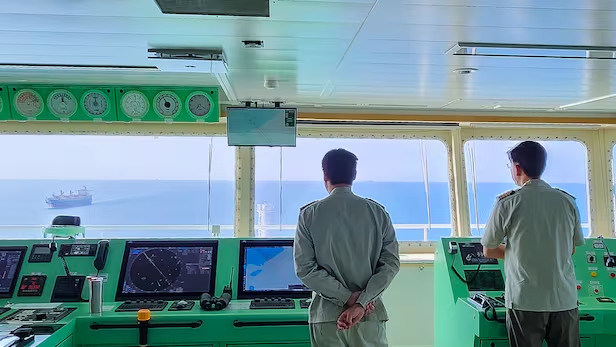
The South Korean government has proposed collaborating with shipbuilding companies to jointly develop artificial intelligence (AI)-based autonomous navigation technology. However, some within the South Korean shipbuilding industry have expressed clear doubts about this plan, arguing that differences in AI technological capabilities and R&D directions among shipbuilders will make such cooperation difficult to advance.
According to South Korean media reports, Deputy Prime Minister and Minister of Economy and Finance Koo Yun-cheol recently stated: “The South Korean government will collaborate with Hanwha Ocean, HD Hyundai Heavy Industries, and Samsung Heavy Industries (hereinafter referred to as the ‘three major shipbuilding companies’) to fully advance the research and development of AI autonomous navigation vessels.”
The report states that the three major shipbuilding companies and others have responded to the government’s proposal and launched a joint AI-related data collection project to collect and accumulate environmental data such as waves, wind and ocean currents, as well as operational data such as the Automatic Identification System (AIS), engine speed and radar information.
Regarding this joint project proposed by the South Korean government, shipbuilding industry insiders pointed out: “Given that the three major shipbuilders’ autonomous navigation technology R&D has reached a mature stage, this cooperative process may not proceed as smoothly as the government anticipates. If autonomous navigation technology is categorized by level, ‘fully unmanned navigation’ is classified as the highest Level 4. After evaluation, the technological capabilities of the three major shipbuilders are already approaching Level 3, which is the ‘remote control of unmanned vessels’ stage.”
Previously, Samsung Heavy Industries had installed its independently developed long-range autonomous navigation system (SAS, Samsung Autonomous Ship) on Evergreen Marine’s 15,000 TEU container ship and successfully completed trans-Pacific voyage verification.
The “HiNAS Control” system, developed by AVIKUS, an autonomous navigation vessel solutions subsidiary of HD Hyundai Heavy Industries, has been in real-world application since 2023. Through performance verification, it has achieved a 15% reduction in carbon emissions and a 15% improvement in fuel efficiency.
Hanwha Ocean’s autonomous navigation test vessel, the Hanbi, is currently in the technology development phase with plans to achieve the highest level of autonomous navigation—fully unmanned navigation—by 2030.
Based on an analysis of the technological capabilities and R&D directions of the three major shipbuilders, South Korean industry insiders point out that differences in the R&D focus and characteristics of autonomous navigation technologies among shipbuilders also pose challenges for collaboration. For instance, Company A concentrates its R&D efforts on real-time route optimization based on environmental data such as wave height, wind direction, ocean currents, and submerged obstacles, as well as GPS and the tracks of other vessels. Company B, however, emphasizes data exchange with shore-based control centers. This divergence in R&D priorities inevitably leads to conflicts in development strategies.
Additionally, some within South Korea’s shipbuilding industry express pessimism toward the model of “shifting from shipbuilding to joint system development.” Shipbuilders view vessel operating systems as a “key differentiator for securing orders,” requiring distinctiveness from competitors, making it difficult to accept the government’s call for joint development.
Furthermore, some within the South Korean industry hold a pessimistic view of the “not building ships, but instead jointly developing systems” model. Shipbuilding companies see the ship’s operating system as a “differentiating factor for securing orders”, requiring differentiation from competitors, thus making it difficult for them to accept the government’s joint development requirements.
Another industry insider stated, “Autonomous navigation technology, like the self-driving technology of automakers, is the result of independent research and development by individual companies through large-scale investments. Because it is essentially a trade secret, shipbuilding companies find it difficult to accept the requirement to integrate it into a single system.”
A representative from the Korea Planning&Evaluation Institute of Industrial Technology (KEIT)’s shipbuilding and marine project stated: “For the government to successfully advance joint R&D in AI autonomous navigation, it must propose clear incentive measures to encourage shipbuilding companies to participate with the substantial R&D investments they have made.”