


The latest market report from the Baltic and International Maritime Council (BIMCO) indicates that the global orderbook is currently at a historic high, with the Chinese shipbuilding industry further expanding its market share. However, as delivery volumes are set to surge over the coming years, domestic shipyards face a significant test of their production capacity; expanding capacity indiscriminately risks creating idle capacity down the line.
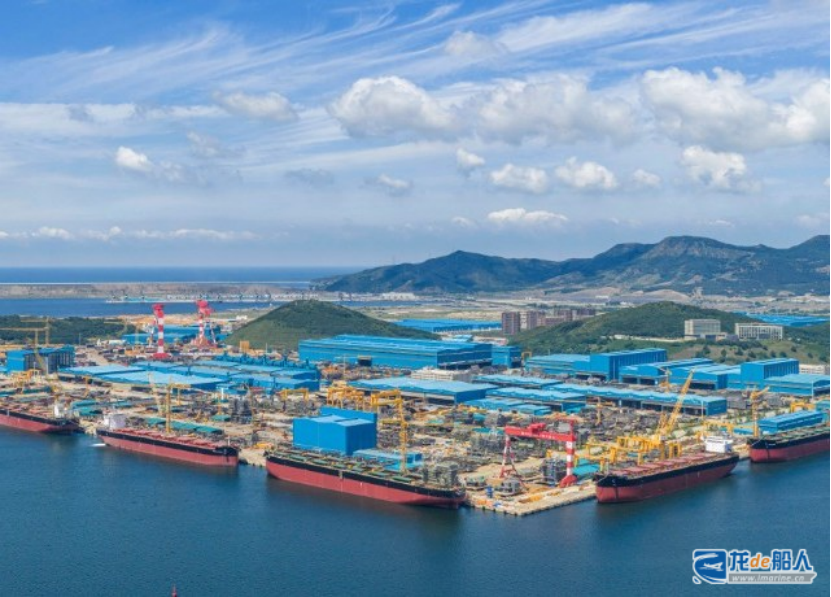
As of September 1, 2026, the global orderbook reached 203.2 million compensated gross tons (CGT), an increase of 13% compared to 180 million CGT during the same period last year. While this figure is slightly below the all-time peak of 210.4 million CGT recorded in May of this year, it remains higher than the previous record of 195.4 million CGT set in 2008.
Over the past year, Chinese shipbuilders have secured 74% of all new shipbuilding orders globally (measured in CGT). As of early September, China accounted for 64% of the global orderbook, followed by South Korea at 19% and Japan at 6%.
Chinese shipbuilders hold a commanding lead across a range of mainstream vessel types; they account for at least 72% of the orderbook for oil tankers, liquefied gas carriers, bulk carriers, general dry cargo ships, and roll-on/roll-off (Ro-Ro) vessels. Notably, they hold 81% of the global orderbook for container ships.
Niels Rasmussen, Chief Shipping Analyst at BIMCO, stated: “Over the past 12 months, container ships have been the primary driver of the current expansion in the orderbook. They now account for 30% of the global orderbook and have contributed 68% of the growth in orders seen over the last year.”
The influx of new orders points to a significant surge in deliveries over the coming years.
For the three major shipbuilding nations, scheduled deliveries are set to reach 40.1 million CGT in 2025, rising to 55.9 million CGT in 2026, and climbing further to 60 million CGT by 2028. Notably, Chinese shipbuilders are tasked with delivering 44 million CGT in 2028—a volume that would set an all-time record and represent nearly double the output projected for 2025 (22.7 million CGT).
The surge in orders has brought capacity constraints into sharp focus. According to BIMCO, based on the highest annual output recorded over the past five years, Chinese shipbuilders’ current orderbooks represent 4.2 years of production capacity, compared to 1.9 years for South Korea and 1.7 years for Japan. The backlog for Chinese shipbuilders is significantly larger than that of their Japanese and South Korean counterparts.
When calculated against the peak planned annual delivery volumes for the 2021–2030 period, the orderbooks for Chinese shipyards equate to 2.1 years of capacity, while the figures for both Japan and South Korea fall to 1.6 years.
BIMCO notes that Chinese shipbuilders, in particular, need to expand their capacity to manage the delivery pressures expected in the coming years. At the same time, the organization warns that such expansion carries risks; should the market for new vessels cool down, shipbuilders could face substantial operational strain.
Looking back at industry history, the massive ordering spree that preceded the 2008 global financial crisis prompted shipbuilders to aggressively expand capacity, pushing global new-vessel deliveries to 54.4 million compensated gross tons (CGT) in 2010 and 2011. As market conditions subsequently weakened, deliveries dropped to a low of 31.2 million CGT in 2020 before eventually bottoming out and beginning to recover.
During the industry’s downturn, a large number of shipyards went bankrupt or closed down. Data shows that the number of active shipyards in China fell from 379 in 2010 to 117 in 2019. Globally, the number of active shipyards declined by as much as 60% between 2009 and 2017.