


Over the past decade, the 24,000-TEU “Megamax” vessel has been regarded as the natural upper limit for container ship size, but shipping consultancy Alphaliner’s analysts now believe the container ship market may be ready to break through this limit.
Alphaliner has reportedly revived the “Gigamax” class vessel concept it first proposed in 2021. The firm believes that, with ongoing improvements in ship design, rising fuel costs, and carbon pricing mechanisms, the container ship market is expected to make 27,500-TEU vessels commercially viable by the 2030s.
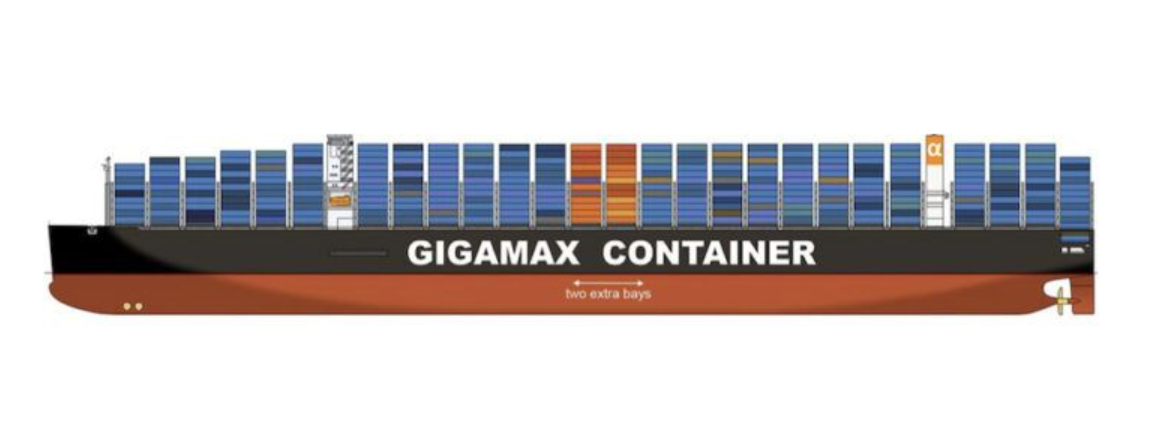
The “Gigamax-25” class vessels proposed by Alphaliner are approximately 414 meters long and 63.3 meters wide, while the current largest “Megamax-24” class vessels are approximately 400 meters long and 61 meters wide. The “Gigamax-25” class vessel will feature a 25-row container layout and an additional cargo hold area at the bow, enabling it to carry over 27,000 TEU; it will utilize a liquefied natural gas (LNG) dual-fuel propulsion system and be designed for a speed of 18 knots or less.
Alphaliner estimates that the deeply optimized “Gigamax-25” class vessels will have fuel consumption only slightly higher than that of the 20,500-TEU “Megamax” class, but will be able to carry approximately 7,000 additional TEUs.
Another key point is that, despite the larger size of the “Gigamax-25” vessels, it is highly likely that major ports worldwide—which currently accommodate 24,000 TEU-class ships—will be able to handle the new vessel without the need for large-scale renovations. Alphaliner estimates that the additional 14 meters in length and 2.5 meters in width of the “Gigamax-25” vessels can be accommodated at many terminals using existing capacity in cranes, berths, turning basins, and fairways at many terminals.
In its latest weekly report, Alphaliner stated that Danish shipping giant Maersk—currently the world’s second-largest liner operator—is the shipping company most likely to be the first to trial “Gigamax-25”-class container ships.
Alphaliner explained that, among the world’s top eight shipping companies, Maersk is the only one that has never ordered a 24,000 TEU-class container ship. The average capacity of its 31 largest vessels is approximately 19,600 TEU, meaning that if Maersk were to build “Gigamax-25”-class vessels, the capacity of its core fleet could increase by about 40 percent. At the same time, Maersk’s “Gemini Cooperation” hub-and-spoke network is better suited for operating large vessels because its main routes call at fewer ports.
In addition, Mediterranean Shipping Company (MSC) and COSCO Shipping are also considered potential shipping companies for building “Gigamax-25”-class vessels.
It is understood that Alphaliner’s renewed focus on the upper size limit for container ships and its reintroduction of the “Gigamax-25” class vessel concept stem from the optimism displayed by the market during the recently concluded 32nd SMM in Germany; reportedly, Chinese shipyards have received new inquiries from major shipping companies regarding large vessels.
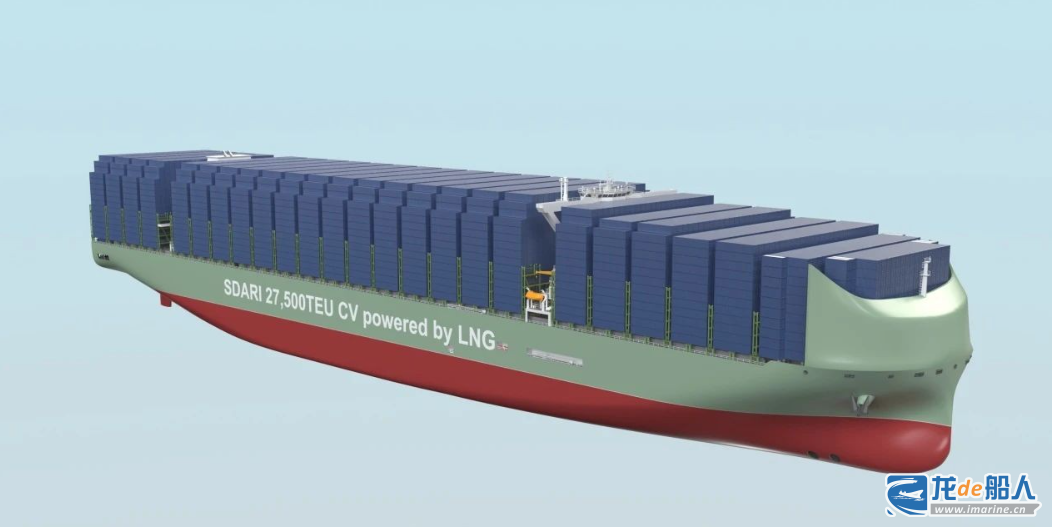
During the 2024 SMM, the world’s largest 27,500-TEU LNG dual-fuel container ship—independently developed by the Shanghai Ship Research and Design Institute (SDARI) of China State Shipbuilding Corporation—made its official debut and received Approval in Principle (AiP) from Det Norske Veritas (DNV).
As for the container ship market, data from the Baltic and International Maritime Council (BIMCO) shows that as of early September, the global container ship fleet’s capacity was just 8,000 TEU short of 34 million TEU, while the 46 container ships scheduled for delivery in September had a total capacity of 286,000 TEU. which means that with just a few more new vessels delivered by global shipyards, the global container fleet’s capacity will easily surpass the 34 million TEU mark.
At that point, the container ship market will set a historical record of adding 10 million TEU of capacity in five and a half years; by comparison, it took slightly more than ten and a half years to increase capacity from 14 million TEU to 24 million TEU—an increase of 10 million TEU as well.
Currently, the global orderbook for container ships has reached a new high, totaling 1,795 vessels/14.7 million TEU, of which newbuilding orders of 10,000 TEU and above account for 68% of the total.