


Recently, Japanese Minister of Land, Infrastructure, Transport and Tourism Yasushi Kaneko officially announced the Japanese government’s first round of investments in the shipbuilding industry, which has been designated as one of the country’s 17 key investment sectors. This initial investment totals 600 billion yen (US$3.8 billion), with the government contributing approximately US$1.4 billion. The investment represents a pivotal step in Japan’s efforts to revitalize its shipbuilding industry.
Under the plan, the government’s initial shipbuilding investment will be directed primarily to Imabari Shipbuilding, Japan Marine United (JMU), and Namura Shipbuilding. Specifically, Imabari Shipbuilding (along with its subsidiary Tadotsu Shipyard), Japan Marine United, and Namura Shipbuilding (along with its subsidiary Hakodate Dock) will receive government subsidies of 114 billion yen (approximately US$729 million), 49.4 billion yen (approximately US$316 million), and 49.9 billion yen (approximately US$320 million), respectively.
Three shipbuilders, including Imabari Shipbuilding, plan to use the funds to expand and modernize their factories. The core direction is to develop the next generation of ocean-going shipbuilding technology.
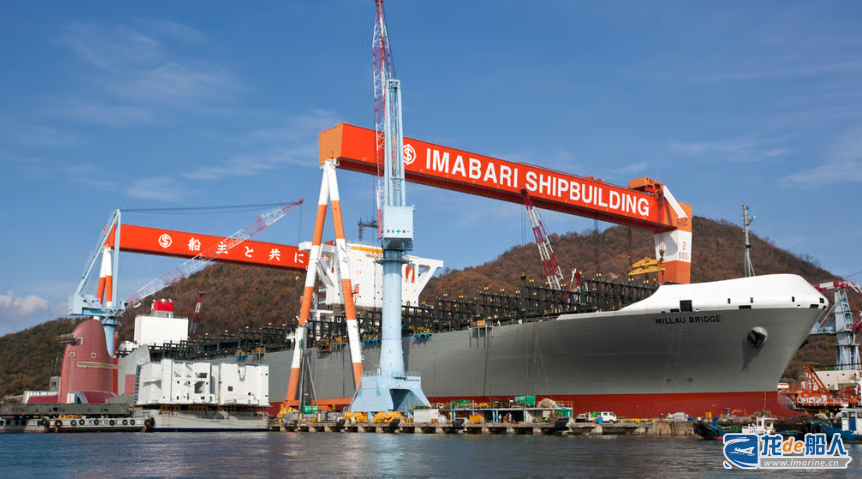
It is reported that while Japan rose to become the world’s leading shipbuilding nation between the 1980s and 1990s, its market share subsequently shrank significantly due to the rise of shipbuilding enterprises in China and South Korea.
Data from the Japan Ship Exporters’ Association (JSEA) indicates that in 2025, Japanese shipbuilders secured orders for 186 new vessels totaling nearly 9 million gross tons—a 16.5% decline from 2024—and delivered 191 vessels amounting to 8.32 million gross tons. That year, their share of the global new shipbuilding market stood at only about 9%.
As the shipbuilding industry enters a new boom cycle—and against the backdrop of heightened geopolitical tensions and instability in maritime energy supply chains—Japan has increasingly recognized the importance of securing the initiative in shipbuilding and is currently pushing forward a comprehensive revitalization of the sector.
Japan has set a goal to double its shipbuilding capacity by 2035. Japanese officials stated that the revitalization plan for the shipbuilding industry would be implemented in phases, with a total investment of approximately 1 trillion yen (US$6.4 billion) funded through public-private partnerships. The industry had previously emphasized to the government the urgent need for investment, asserting that state support is essential to regain some of the market share it has lost.
It is worth noting that Namura Shipbuilding, which received Japan’s first round of shipbuilding investment subsidies, is planning to construct and commission a brand-new dry dock for building large vessels by 2035. The facility will be located at the company’s core Imari plant.
This marks the first time in nine years that a new large-scale dry dock has been built in Japan; the last one dates back to 2017, when Imabari Shipbuilding completed a 600-meter-by-80-meter dry dock at its Marugame Plant in Kagawa Prefecture. The new dry dock project at Namura Shipbuilding is also a direct result of Japan’s plan to revitalize its shipbuilding industry.