


Thenamaris, the Greek shipping giant controlled by Nikolas Martinos, has made a rare move into the container ship newbuild market while simultaneously placing additional orders for large gas carriers; all these orders have been secured by Chinese shipyards.
Hengli Heavy Industries Secures Order for Four Container Ships
Fleet data from the Thenamaris website indicates that the shipowner has ordered four 3,200 TEU container ships from Hengli Heavy Industries. Bearing hull numbers HL–C3100–13, HL–C3100–14, HL–C3100–22, and HL–C3100–23, the vessels are scheduled for delivery in 2028.
These container ships measure approximately 199.9 meters in length and 35.2 meters in breadth. They are equipped with an EVERLLENCE 6G60ME-C 10.5-TIII HPSCR-EGCS main engine, an open-loop exhaust gas cleaning system (scrubber), a shaft generator, and a shore power system.
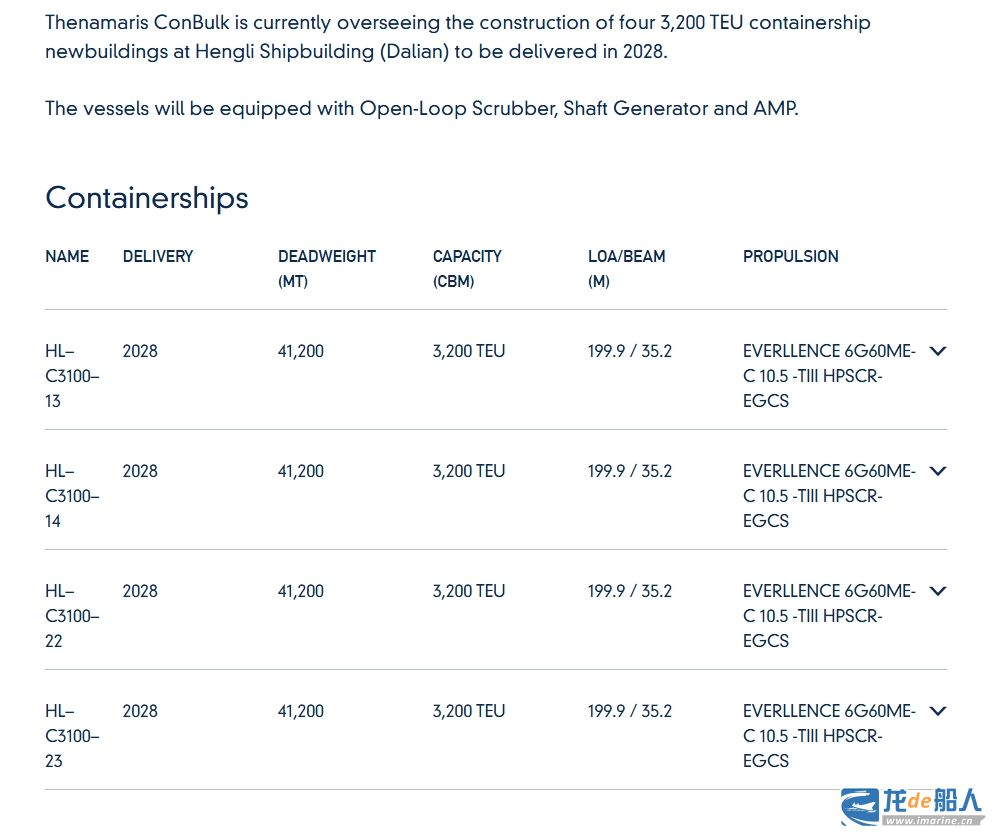
The construction of these new vessels will be overseen by Thenamaris ConBulk, the dry bulk and container shipping division of Thenamaris; established in 2020, the division currently operates a fleet comprising 24 bulk carriers and two container ships. Its two existing container ships, the *Seasmile* and *Seadream*, are 5,071 TEU vessels built and delivered by HD Hyundai Samho in 2013 and 2014, respectively.
For Thenamaris, this bulk order for four container ships represents a rare move into the container shipping market.
The announcement of this latest project marks a further deepening of the partnership between Hengli Heavy Industries and Thenamaris in the newbuilding market; earlier this year, the two parties signed a contract for the construction of three 113,300 DWT Aframax/LR2 product tankers, scheduled for delivery in the fourth quarter of 2028 (two vessels) and the first quarter of 2029 (one vessel).
Jiangnan Shipyard Secures Order for One VLAC
In addition to its expansion into the container ship market, Thenamaris has placed an additional order with Jiangnan Shipyard—a subsidiary of China State Shipbuilding Corporation (CSSC)—for one 90,000-cubic-meter dual-fuel Very Large Ammonia Carrier (VLAC). This brings the total number of VLACs ordered through this partnership to three, with all vessels scheduled for delivery in 2029.
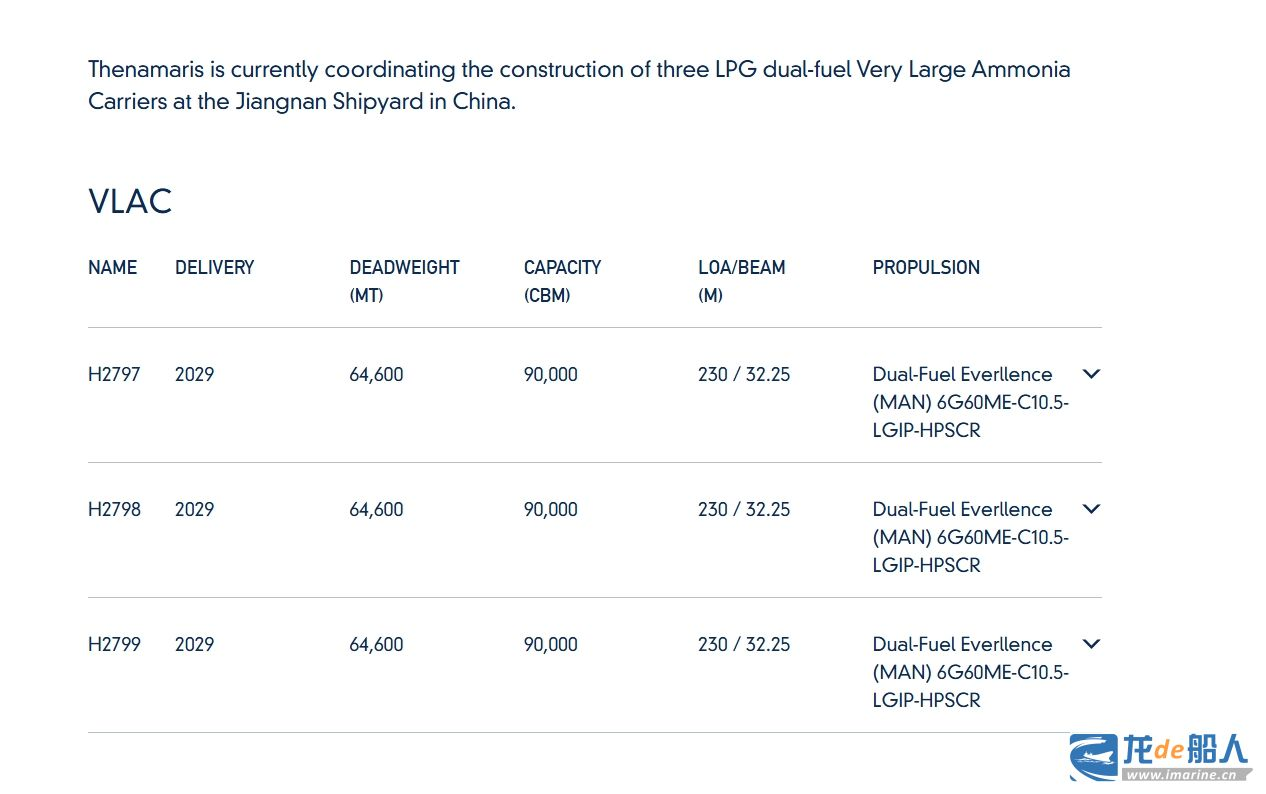
Previously, on April 3, 2026, Jiangnan Shipyard signed a contract with Thenamaris for the construction of the first two VLACs, marking the beginning of their collaboration in the newbuild market. With this order, Thenamaris has officially entered the VLAC newbuild sector, further expanding its gas shipping operations.
According to Jiangnan Shipyard, this VLAC model features a next-generation low-resistance hull design. While adhering to the dimensional constraints of the original Panama Canal, the design optimizes the bow and stern profiles as well as the waterline distribution to balance maximized cargo capacity with minimized hydrodynamic resistance, thereby significantly enhancing overall operational efficiency. Furthermore, the vessel is equipped with an LPG dual-fuel propulsion system; compared to conventional fuel-powered systems, this setup achieves significant reductions—approximately 20% in CO2 emissions and 99% in SOx emissions—fully complying with EEDI Phase III requirements.
Thenamaris currently has 19 vessels under construction.
Data from the company’s official website indicates that Thenamaris has 19 vessels currently under construction—comprising 12 tankers, 3 VLACs, and 4 container ships—with orders primarily placed at Chinese and South Korean shipyards (accounting for 17 and 2 vessels, respectively).
Orders placed with Chinese shipyards are scheduled for delivery between 2028 and 2030, comprising: three VLACs from Jiangnan Shipyard; four container ships and three Aframax/LR2 product tankers from Hengli Heavy Industries; two Suezmax tankers from Shanghai Waigaoqiao Shipbuilding; three Aframax/LR2 product tankers from Dalian Shipbuilding; and two MR2 product tankers from COSCO SHIPPING Heavy Industry (Guangdong).
Two MR2 product tankers ordered from the South Korean shipyard HD Hyundai Heavy Industries are expected to be delivered in 2029.
According to its official website, Thenamaris was established in 1972 and currently operates a diversified fleet—including 50 tankers, 24 bulk carriers, 7 LNG carriers, 6 LPG carriers, and 2 container ships—which, together with 19 vessels under construction, brings the total fleet size to 108 ships.