


Under the leadership of current CEO Vincent Clerc, Danish shipping giant Maersk intends to revive its fleet expansion plans. This move signals a departure from the long-standing policy of capping container fleet capacity—a core tenet of the company’s strategy for the current decade.
During the 2020s—a period of exceptionally high profits for the container shipping industry—Maersk repeatedly emphasized that it would maintain its fleet size within the 4.0 to 4.4 million TEU range, with newbuilds primarily serving to replace aging vessels rather than adding net capacity.
Now, however, Maersk’s cautious fleet expansion strategy appears to be shifting. The company’s operated fleet has already surpassed 4.7 million TEU, well above the previously established upper limit. Meanwhile, French liner giant CMA CGM—currently ranked third globally—is closing the gap with Maersk in terms of fleet capacity and holds a significantly larger orderbook.
Maersk signaled this strategic shift when releasing its financial results for the second quarter of 2026, stating: “Given that the existing fleet has reached capacity limits, we will ensure we possess the necessary capacity to support business growth.”
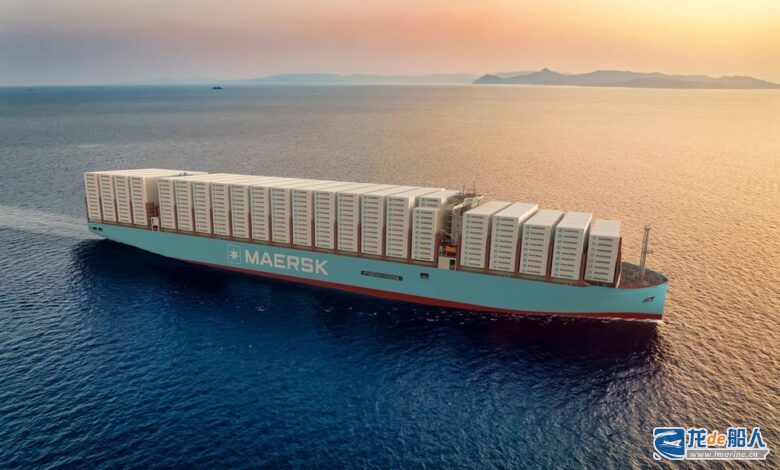
In response, shipping consultancy Linerlytica believes that Maersk may be set to launch a new round of ship orders. Data shows that since 2018, the annualized growth rate of Maersk’s fleet has been only 2%, while that of its major competitors has reached as high as 11.7%. The firm points out that eight years of capacity restraint have left Maersk in urgent need of expanding its capacity at this time, just as global container ship order backlogs have reached an all-time high.
However, not all shipping companies anticipated that Maersk would place a flurry of orders.
Philip Damas, Managing Director at Drewry, analyzed that Maersk has two main objectives: replacing aging vessels to meet increasingly stringent environmental requirements; and adding more vessel types suited to the rapid growth of regional trade.
Based on the agency’s statistics, Maersk currently operates 46 large container ships with a capacity of 15,000 TEU or more, but has only seven orders for small and medium-sized container ships with a capacity of 6,000 TEU or less.
Philip Damas also believes that Maersk’s previous cautious fleet expansion strategy was justified: “In recent years, Maersk has not over-ordered vessels like most other major shipping companies, which will expose it to a lower risk of overcapacity between late 2027 and 2029.”
Philip Damas observes: “Placing orders now would mean facing higher newbuild costs; instead, Maersk might wait for the next industry downturn to acquire large container ships at low prices from shipowners struggling with overcapacity.”
Vespucci Maritime, another shipping consultancy, similarly notes that Maersk’s decision to abandon its capacity cap does not automatically signal a massive wave of new orders; it could also indicate a shift toward a more aggressive chartering strategy.
In line with this, Alphaliner analyst Jan Tiedemann noted that Maersk has recently been “very active” in chartering vessels, which only serves to confirm that Maersk misjudged the newbuild market several years ago. The analyst stated, “Maersk misjudged the timing; it placed orders for large container ships too late and in insufficient numbers, and now needs to add another 10 to 20 or more vessels.”
Tiedemann anticipates that Maersk may order large LNG dual-fuel container ships later this year, with delivery tentatively scheduled for between 2029 and 2031.