


On August 11, Yangzijiang Maritime—a listed subsidiary of Yangzijiang Shipbuilding (Holdings) Ltd.—announced its financial results for the first half of 2026. This marks the company’s first semi-annual report disclosure since its listing in Singapore in November 2025.
The report indicates that for the period ending June 30, 2026, Yangzijiang Maritime generated revenue of US$81.6 million, a 49% increase year-on-year (compared to US$54.6 million), driven primarily by the strong performance and strategic expansion of its maritime business. Net profit attributable to shareholders stood at US$44.9 million—down from US$63.5 million in the same period last year—reflecting continued profitability. The company’s fleet exceeds 120 vessels, including orders for over 60 new vessels.
Orders for over 60 new vessels; fleet size continues to expand.
During the reporting period, the fleet managed by Yangzijiang Maritime expanded to over 120 vessels—including more than 60 newly built vessels—spanning a diverse range of types such as oil tankers, gas carriers, bulk carriers, container ships, and offshore support vessels.
Currently, the combined scale of Yangzijiang Maritime’s two maritime funds stands at US$2 billion, with over 40% of the capital invested in eco-friendly vessels. In the first half of this year alone, the company secured orders for nearly 40 new vessels, with a primary focus on the bulk carrier and oil tanker markets.
Early in the year, Yangzijiang Maritime announced orders for 16 new vessels across three types—comprising 40,000 DWT bulk carriers and MR/LR2 product tankers—to be built by Qidong Qianyao Heavy Industry and Jiangsu Haifeng Shipbuilding. In April, the company announced orders at domestic shipyards for eight eco-friendly 319,000 DWT Very Large Crude Carriers (VLCCs); market reports indicate that Hantong Ship Heavy Industry secured this order, which has since expanded to 12 vessels. Also in April, a further order for 10 new vessels was announced—including four product/crude oil tankers, four product/chemical tankers, and two 40,000 DWT bulk carriers—with construction awarded to Qianyao Heavy Industry and Haifeng Shipbuilding. Delivery of these new vessels is scheduled for the 2027–2029 period.
It is worth noting that Qidong Qianyao Heavy Industry and Jiangsu Haifeng Shipbuilding—both of which have entered into deep cooperation with Yangzijiang Maritime—are classified as second- or third-tier domestic shipyards. Qidong Qianyao Heavy Industry is a newly established shipyard (founded in 2024) specializing in shipbuilding, conversion, and sales; prior to the disclosure of Yangzijiang Maritime’s new orders, there was no market record of the yard signing contracts or delivering vessels. Although Jiangsu Haifeng Shipbuilding has been in existence for nearly two decades, it had suspended operations for many years and is now re-entering the shipbuilding market by leveraging these new orders from Yangzijiang Maritime.
Regarding the selection of shipyards, Yangzijiang Maritime noted in an announcement that second- and third-tier Asian shipyards are currently facing idle capacity and have limited access to global clients; furthermore, the inability of many such yards to issue advance payment guarantees further constrains their capacity to secure international orders. In light of these market barriers and financing limitations, Yangzijiang Maritime has established partnerships with such shipyards through direct procurement and deep engagement, thereby securing shipyard capacity at shipbuilding costs 10% to 15% below the market average.
Regarding its fleet assets, Yangzijiang Maritime is unlocking greater value through methods such as asset monetization, vessel resales, and long-term charters. As of the first half of 2026, the company has secured charter agreements for 13 vessels in its fleet—comprising 12 tankers (including oil, chemical, and product tankers) and one AHTS (Anchor Handling Tug Supply) vessel—with charter terms ranging from one to eight years.
Meanwhile, in the nine months since its listing in November 2025, Yangzijiang Maritime has signed resale contracts for 12 newbuild vessels—comprising four bulk carriers and eight MR product tankers—generating total proceeds of US$500 million; these vessels are scheduled for staggered delivery between 2027 and 2028.
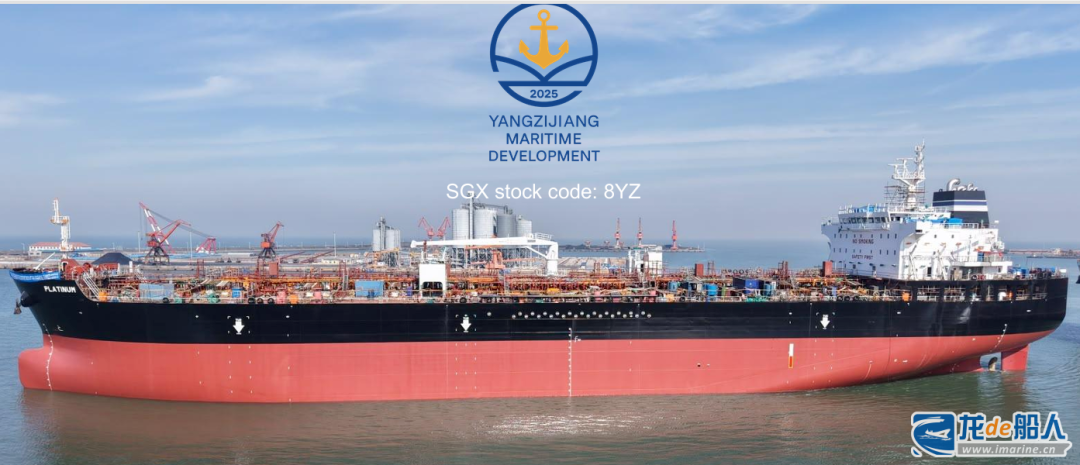
Yangzijiang Maritime’s maritime business delivers strong performance with revenue growth.
Especially benefiting from the expansion and good operating performance of the maritime business, Yangzijiang Maritime’s revenue increased significantly in the first half of 2026. During the reporting period, it achieved revenue of US$81.6 million, a year-on-year increase of 49%.
Specifically, the maritime business generated revenue of US$51.7 million, a 70% increase year-over-year (compared to US$30.4 million); the cash management business generated revenue of US$14.4 million, a 120% increase year-over-year (compared to US$6.5 million); and other non-maritime investment businesses generated revenue of US$15.5 million, a 12% decline year-over-year (compared to US$17.7 million).
Driven by the expansion of its core maritime operations, Yangzijiang Maritime saw a concurrent rise in operating costs during the first half of the year. Operating costs for its maritime fund assets climbed to US$26.9 million—up from US$9.4 million in the same period last year—due to factors such as higher oil prices driving up shipping costs, increased transit fees, adjustments to chartering strategies, and vessel depreciation. When including service fees, legal expenses, financing costs, and other operating outlays, the company’s total expenses for the first half of the year surged to US$32.7 million, a 152% increase year-on-year (compared to US$13.0 million).
As of June 30, 2026, Yangzijiang Maritime maintained a robust balance sheet, with net assets attributable to shareholders of approximately US$1.8 billion. During the reporting period, the company deployed cash into its core maritime business, shifting its asset structure from current to non-current assets; it closed the period with US$238 million in cash and cash equivalents, reflecting a healthy cash flow position.
Commenting on the performance for the first half of 2026, Ren Yuanlin, Executive Chairman and CEO of Yangzijiang Maritime, stated: “Since our listing in November 2025, the company has been dedicated to enhancing profitability through the strategic expansion of its maritime business, steadily growing its shipbuilding order backlog, and continuously refining a mature, replicable, and asset-light business model. Given the two-to-three-year shipbuilding cycle, a transitional period is inevitable before our maritime investments generate returns—a phase that requires upfront capital expenditure and the incurrence of associated costs.”
Ren Yuanlin noted: “Leveraging deep maritime expertise and an established global network, the company’s strategy of ‘securing sales contracts early’ allows it to lock in reasonable capital gains while ensuring predictable future earnings as vessels are progressively delivered. Backed by a disciplined capital recycling strategy and a robust balance sheet, the company is committed to expanding its base of recurring operating revenue and capital gains returns, thereby creating long-term value for shareholders.”
Data indicates that Yangzijiang Maritime positions itself as a strategic hub connecting shipyards, shipowners, charterers, and capital markets, serving as a provider of one-stop maritime financial solutions. The company’s business model is built on two pillars: identifying high-potential maritime investment projects—including the acquisition of maritime assets at favorable prices—and unlocking value through flexible asset monetization strategies, such as vessel resale, chartering income, and capital management.