

Weeks After the 2+2 Order from Xiamen Shipyard, Sallaum Lines Signs New Order with China Merchants Shipyard for One + One 8,600 CEU Newbuilding.
On June 2026, Sallaum Lines announced the signing of a new shipbuilding contract with China Merchants Shipyard for the construction of one + one additional 8,600 CEU Pure Car and Truck Carrier (PCTC).
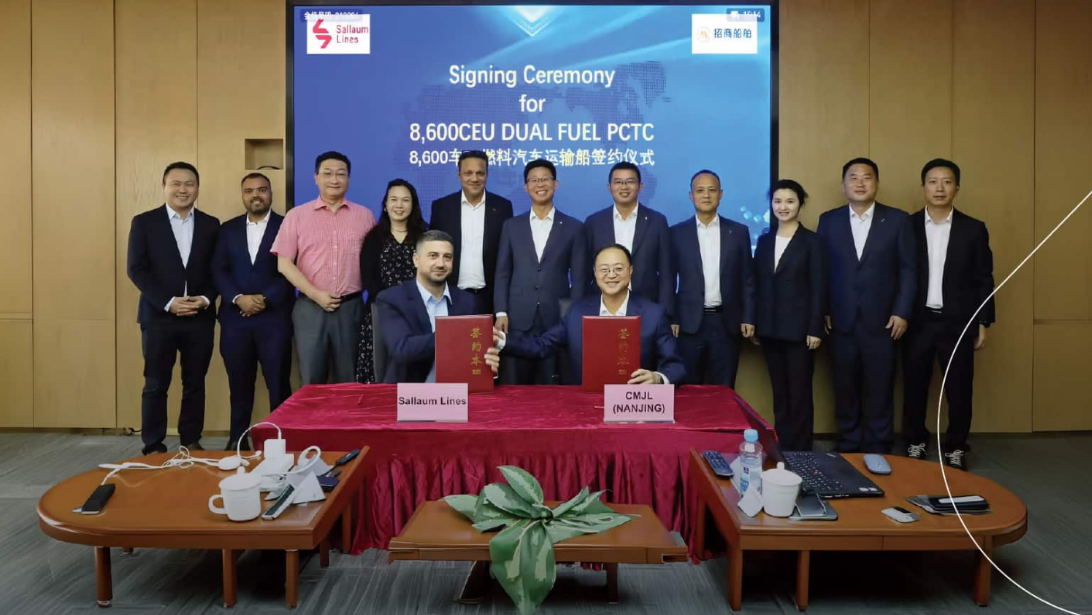
The new vessel will be LNG dual-fuel and ammonia-ready, with delivery scheduled for 2029. This latest firm order comes only weeks after Sallaum Lines announced a separate newbuilding agreement with Xiamen Shipbuilding Industry Co., Ltd. for two firm 8,600 CEU vessels, with options for two additional vessels.
The China Merchants order adds further momentum to Sallaum Lines’ newbuilding programme and confirms the company’s continued investment in modern, high-capacity RoRo tonnage at a time when the global PCTC market remains structurally important to automotive supply chains.
The newly signed vessel at China Merchants Shipyard brings Sallaum Lines’ total newbuilding programme to nine vessels, representing a total order value of above USD 850 million. The programme includes four vessels already delivered, one vessel scheduled for delivery in August 2026, one vessel scheduled for delivery in December 2026, and three vessels scheduled for delivery in 2029.
Strengthening the Newbuilding Pipeline
Sallaum Lines has already made significant progress in renewing its fleet.
The company previously ordered six LNG dual-fuel vessels, of which four have already been delivered. The fifth vessel is scheduled for delivery in August 2026, followed by the sixth vessel in December 2026.
The recently announced 2+2 order at Xiamen Shipbuilding marked the next phase of this expansion, introducing larger 8,600 CEU vessels into the company’s future fleet. The new order at China Merchants Shipyard adds 1+1 vessel to the pipeline and further strengthens the company’s delivery schedule for 2029.
Together, these investments position Sallaum Lines to serve a market where vessel quality, cargo flexibility, environmental performance, and long-term availability are becoming decisive factors.
Designed for Flexibility
The newly ordered vessel will have a carrying capacity of 8,600 Car Equivalent Units, placing it among the largest vessels in the Sallaum Lines fleet.
The vessel will be designed to support a broad cargo mix, including passenger vehicles, light commercial vehicles, trucks, heavy rolling equipment, and project cargo. This flexibility is important for Sallaum Lines’ global trade network, which serves routes across Europe, Africa, Asia, the Middle East, and the Americas.
As trade patterns continue to shift, especially with the growth of Chinese vehicle exports and changing flows into emerging markets, the ability to carry different types of rolling cargo becomes increasingly valuable.
The 8,600 CEU design gives Sallaum Lines additional scale, while maintaining the operational flexibility required to serve a wide range of customers and ports.
LNG Dual-Fuel and Ammonia-Ready
The new vessel will be equipped with LNG dual-fuel technology, allowing it to operate on LNG as well as conventional marine fuels when required.
LNG remains an important transition fuel for deep-sea shipping. It offers an available and practical pathway to lower-emission operations today, while the industry continues to develop the infrastructure, regulation, and commercial availability of future fuels.
At the same time, the vessel will be built with an ammonia-ready design. This means that the ship is being prepared from the design stage for potential future conversion, once green ammonia becomes more mature as a marine fuel solution.
For Sallaum Lines, this is a practical approach to the energy transition. The company is not relying on one single pathway. Instead, it is investing in vessels that can operate efficiently today while remaining adaptable for tomorrow.