


On June 30, the land bidding and listing transfer procedures for the Tianjin Xinneng Offshore & Ship Manufacturing Project in Tianjin Port Free Trade Zone were successfully completed, marking the official revitalization of this idle land that had lain unused for more than a decade. The operating entity of the project is Tianjin Xinneng Ship Engineering Co., Ltd.
Public records show that Tianjin Xinneng Ship Engineering Co., Ltd. was incorporated in September 2025, registered in Lingang Economic Zone, Binhai New Area, Tianjin, with a registered capital of RMB 10 million and Wang Zhanxiong serving as its legal representative. Its business scope covers manufacturing of metal ships, ship design, construction and repair, as well as the research, development, manufacturing and sales of offshore engineering equipment.
The Tianjin Xinneng Offshore & Ship Manufacturing Project originated as the Phase II ship-breaking base project of Fangtong Zhonggang—a subsidiary of Tianjin Teda Investment Holding Group. Although the project commenced operations in June 2012, it came to a complete standstill in 2014 due to drastic changes in the ship-breaking market. Consequently, over 160,000 square meters of shoreline and land lay idle for an extended period, becoming a “dormant asset” within the Lingang Industrial Zone that urgently required revitalization.
In February 2025, the Tianjin Port Free Trade Zone signed an investment cooperation framework agreement in Tokyo, Japan, for the Tianjin Xinneng Offshore Engineering Vessel Manufacturing Project, with plans to establish a modern demonstration base for a vessel circular economy that integrates shipbuilding, maintenance, and recycling.
The Tianjin Xinneng Offshore & Ship Manufacturing Project is situated along the shoreline south of the North Harbor Basin in the central Lingang area, covering a land area of approximately 160,000 square meters. With a total investment of about 1.05 billion yuan, the project focuses on the repair and construction of vessels under 100,000 deadweight tons (DWT). The primary vessel types include specialized ships such as floating cranes, heavy-lift engineering vessels, semi-submersible vessels, deck carriers, heavy-lift vessels, and multi-purpose ships. Upon completion, the project will achieve an annual shipbuilding capacity of 150,000 DWT, with projected annual revenue of approximately 1.2 billion yuan (about US$177 million) once fully operational.
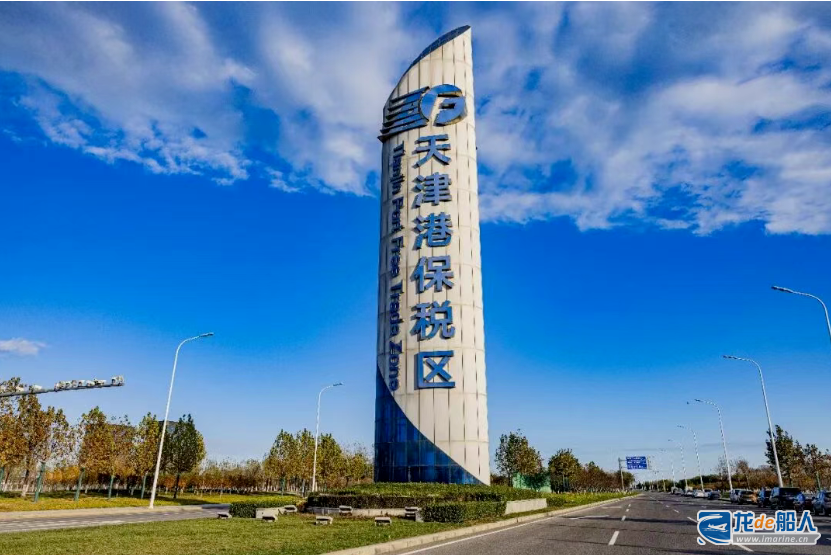
The implementation of this project not only effectively revitalizes long-idle shoreline resources but also strengthens the specialized vessel repair and manufacturing sector. It completes the full industrial chain for marine engineering equipment—spanning design, construction, and maintenance—and drives the local supply chain to upgrade from providing isolated components to offering integrated systems. Furthermore, it solidifies the scale advantages of the shipbuilding and marine engineering industry, injecting new momentum into the development of Tianjin’s marine economy.
As one of Tianjin’s advantageous industries, the shipbuilding and offshore engineering sector serves as a core engine for the development of the marine economy and a key pillar supporting the integrated development of the port, industry, and city. Currently, the Tianjin Port Free Trade Zone is home to nearly 150 supporting enterprises in fields related to shipbuilding and offshore engineering.
Recently, the headquarters project for Lecang Energy’s green and intelligent ship retrofitting was announced to be located in Tianjin; the Management Committee of the Tianjin Port Free Trade Zone, Tianjin Port Group, and Shanghai Lecang Energy Technology Co., Ltd. have reached a strategic cooperation agreement regarding the project.
LeCang Energy has recently announced that its headquarters for green and intelligent vessel retrofitting will be established in Tianjin; the Administrative Committee of the Tianjin Port Free Trade Zone, Tianjin Port Group, and LeCang Energy Technology Co., Ltd. have reached a strategic cooperation agreement regarding the project.
The LeCang Energy headquarters project is capable of undertaking orders for the dual-fuel retrofitting of large international vessels. With a planned investment of 2 billion yuan, the company aims to build an industrial base in the central Lingang area of Tianjin Port that integrates R&D for green marine propulsion systems, technical services for intelligent retrofitting, and core equipment integration; the facility is designed to retrofit 20 to 30 large container ships—each with a capacity of over 10,000 TEUs—per year.