

Malaysia International Shipping Corporation (MISC) announced that it had had secured a contract from Petronas Gas Bhd (PGB) to provide and maintain a newbuild floating storage and regasification unit (FSRU).
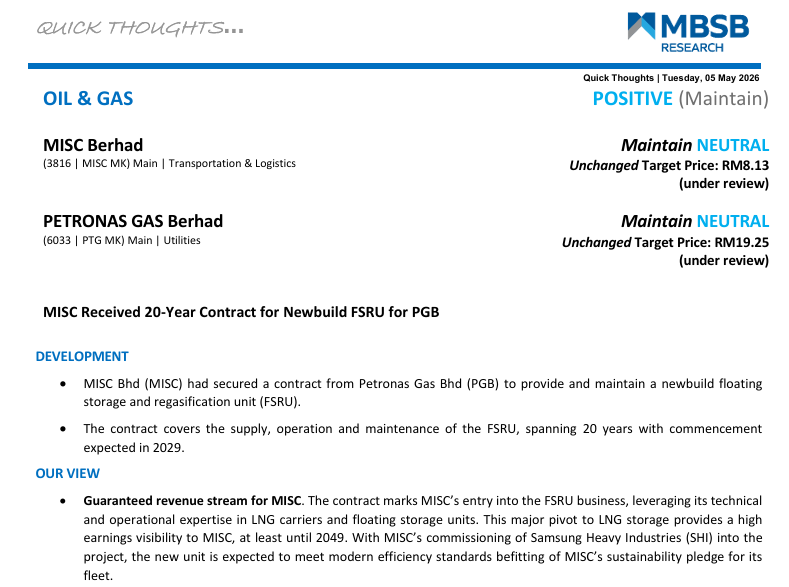
The contract covers the supply, operation and maintenance of the FSRU, spanning 20 years with commencement expected in 2029.
Guaranteed revenue stream for MISC. The contract marks MISC’s entry into the FSRU business, leveraging its technical and operational expertise in LNG carriers and floating storage units. This major pivot to LNG storage provides a high earnings visibility to MISC, at least until 2049. With MISC’s commissioning of Samsung Heavy Industries (SHI) into the project, the new unit is expected to meet modern efficiency standards befitting of MISC’s sustainability pledge for its fleet.
Risk concentrated on construction and execution. Since the project relies on SHI, any disruption from the supply chain and technical hitches could delay the entire project, including RGT-3. Other risks would include maintenance, as FSRUs have the tendency to corrode faster than land-based storage and would need regular maintenance even while being built.
Upside strong for both groups. While no value was disclosed, a newbuild FSRU typically costs between USD300m-350m (approximately RM1.4b-1.6b). However, we noted that land-based terminals are higher in upfront cost than FSRUs, ultimately shielding both companies from additional upfront costs. Construction for FSRUs also typically takes 2-3 years, making the target 2029 commencement doable. The flexibility of FSRUs to move cargo also promised a potential additional revenue in transportation cost.
Potential earnings impact. Earnings impact would be significant in 2029 onwards. For MISC, we opine that the group will be investing roughly RM1.6b into the newbuild FSRU, giving them an estimated annual revenue of RM200m-250m (based on a USD120kpd charter rate for FSRU). Considering the financing costs, MISC could see +3% to +5% earnings increase. For PGB, we opine that the cost of the RGT-3 project is around RM3b, including the FSRU newbuild. Under the Incentivebased Regulation (IBR) framework, PGB earns a return on capital estimated at 7% of the asset base (as compared to RGT 1 and -2). Subsequently, this would translate to a boost in PGB’s bottom line of +5% to 9% increase.
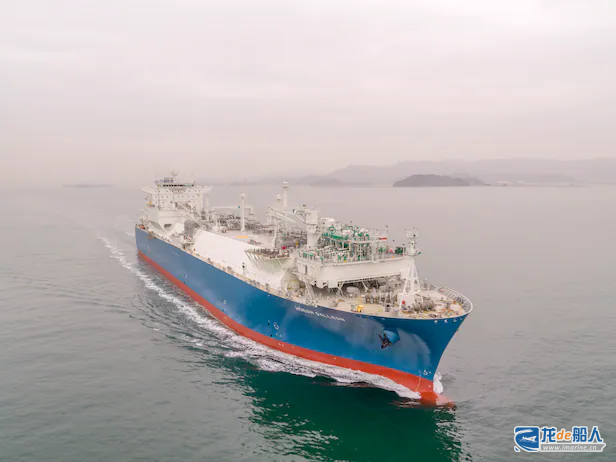
On May 4, Samsung Heavy Industries signed a construction contract with MISC for the FSRU, an order valued at 484.8 billion KRW (approximately USD330 million). A Samsung Heavy Industries official stated, “Amidst the recent surge in demand for energy infrastructure security, FSRUs represent the fastest and most practical alternative.”
To date, Samsung Heavy Industries has secured cumulative new vessel orders totaling approximately USD3.4 billion, comprising one LNG-FSRU, six LNG carriers, and two Very Large Ethane Carriers (VLECs).