


Data shows that Hanwha Ocean has the highest average working hours per employee among South Korea’s three major shipbuilders. Hanwha Ocean explained that this high figure is due to the growing proportion of orders for complex vessel types, such as liquefied natural gas (LNG) carriers.
Man-hours (MH) refer to the amount of work completed by a worker in one continuous hour (excluding rest periods) and serve as a core indicator of labor productivity. Total man-hours are calculated by multiplying the number of front-line workers by the duration of the work, while man-hours per capita is derived by dividing total man-hours by the total number of employees. This figure does not represent the actual working hours of employees; rather, it is primarily used to measure the per-capita workload and the intensity of labor input during the production process.
According to data recently disclosed on the Financial Supervisory Service of Korea’s electronic disclosure system, in 2025, the actual man-hours worked by South Korea’s three major shipbuilders—HD Hyundai Heavy Industries, Hanwha Ocean, and Samsung Heavy Industries—were 33.352 million, 31.065589 million, and 28.372 million, respectively.
In 2025, HD Hyundai Heavy Industries, Hanwha Ocean, and Samsung Heavy Industries had 43,884, 28,982, and 28,903 employees, respectively. Based on these figures, the average annual working hours per employee for HD Hyundai Heavy Industries, Hanwha Ocean, and Samsung Heavy Industries in 2025 were approximately 760, 1,071, and 982 hours, respectively.
Thus, Hanwha Ocean has the highest average working hours per employee among the three major shipbuilders, and its labor intensity is the highest in the South Korean shipbuilding industry.
In terms of annual target man-hours, Hanwha Ocean also faces significant workforce pressure. Last year, Hanwha Ocean set a target of 30,904,801 man-hours, which was lower than Hyundai Heavy Industries but higher than Samsung Heavy Industries. Although the total number of man-hours fell short of Hyundai Heavy Industries, Hanwha Ocean has approximately 15,000 fewer employees, resulting in a significantly higher per-capita workload.
Hanwha Ocean explained that the higher average man-hours per employee are due to an increased proportion of orders for complex vessel types, such as LNG carriers and FLNGs. These vessel types require cryogenic cargo tanks, dual-fuel propulsion systems, and high-standard safety designs, which entail more processes and precision work compared to the construction of ordinary merchant ships. This means that even if the number of vessels built remains the same, the number of man-hours required will inevitably increase.
Moreover, Hanwha Ocean believes that “the relatively high number of working hours per employee can also be interpreted as higher productivity per employee.”
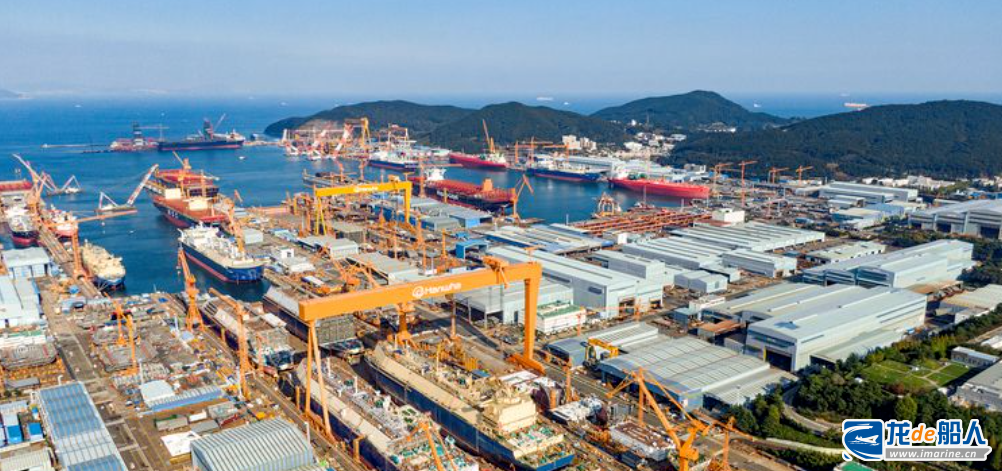
However, the actual workload felt by frontline workers at shipyards also depends on the number of dry docks. Industry data shows that HD Hyundai Heavy Industries has 14 dry docks, Samsung Heavy Industries has 8, and Hanwha Ocean has only 5.
Docks are the core facilities that determine a shipyard’s production capacity; the greater the number of docks, the more evenly the workload is distributed. Conversely, when there are fewer docks, maintaining production capacity is likely to result in both higher workloads per dock and higher workloads per employee.
Industry analysts in South Korea note that although Hanwha Ocean possesses a relatively small number of dry docks and a modest workforce, the actual number of vessels under construction remains among the highest among South Korean shipyards, resulting in the heaviest workload per employee. In response, Hanwha Ocean emphasized: “Our company is prioritizing stable production and operations to maintain a reasonable workload… In recent years, we have continuously advanced efforts to stabilize production.”