


Due to the conflict in the Middle East and the blockade of the Strait of Hormuz, South Korea’s shipbuilding industry is currently facing supply issues regarding ethylene—a specialized gas used in ship construction. The South Korean government plans to draw upon existing stockpiles to address the immediate supply shortage while formulating long-term countermeasures.
According to a Yonhap News Agency report on the 16th, the Korea Shipbuilding & Offshore Engineering Association recently submitted an application to the Ministry of Trade, Industry and Energy of South Korea (MOTIE), stating that there is an urgent need to secure the supply of ethylene required for shipbuilding.
Korean officials stated: “We have conducted a review of the ethylene supply and demand situation in response to the Association’s request and are currently exploring methods to support affected companies.” Furthermore, in response to a coordination request from the Korean government, the Korea Petrochemical Industry Association is collaborating with its member companies to determine how to minimize the impact of the disruption in ethylene supply and demand within the shipbuilding industry.
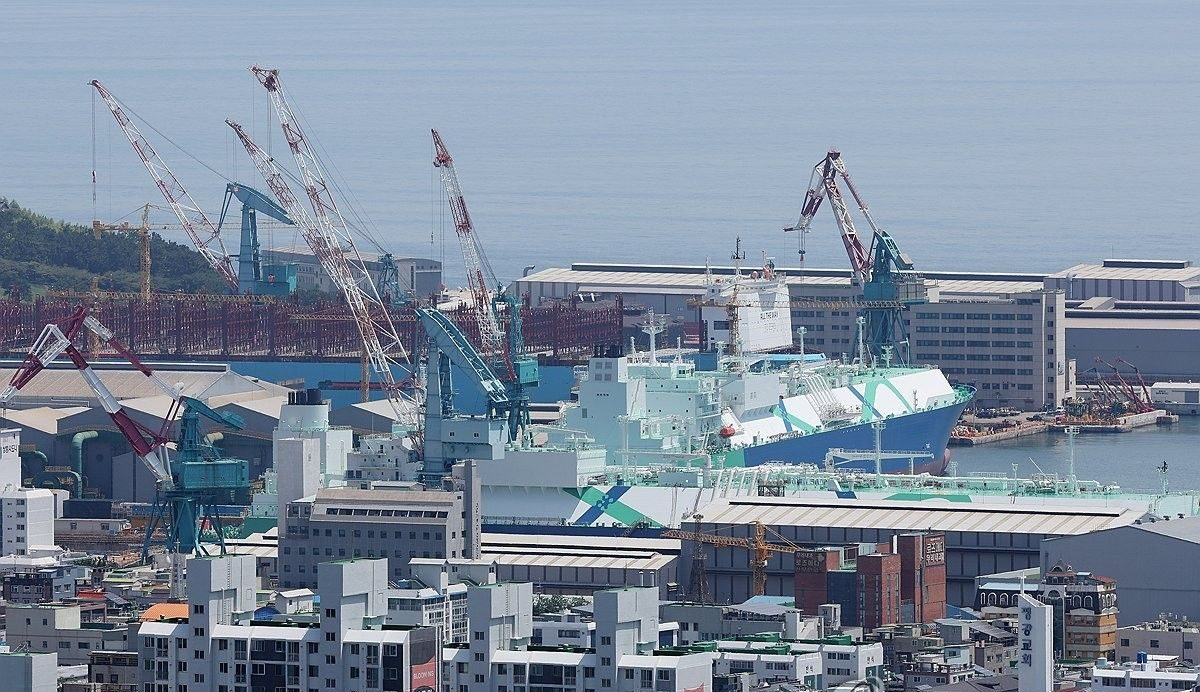
According to analyses, the disruption in the supply and demand of ethylene within South Korea’s shipbuilding industry is primarily attributable to the conflict between the United States, Israel, and Iran—a situation that triggered a chain reaction resulting from the interruption of naphtha feedstock imports from the Middle East.
Ethylene is a fundamental raw material for the manufacture of petrochemical products. As a substance derived from naphtha, ethylene is an indispensable material in the shipbuilding industry for the processing or cutting of marine-grade steel plates.
Approximately half of the naphtha supplied in South Korea relies on imports, while the remainder is produced through domestic crude oil refining. However, if crude oil imports from the Middle East are disrupted for an extended period, the supply will be vulnerable to shortages. Data shows that around 70% of South Korea’s crude oil imports come from the Middle East, and 54% of its imported naphtha is transported via the Strait of Hormuz.
Officials within the South Korean shipbuilding industry stated: “Ethylene inventories at some shipyards could be depleted in as little as two weeks. Although shipyards can substitute liquefied petroleum gas (LPG) for ethylene as the cutting gas during operations, the former is also import-dependent; therefore, ensuring a stable supply of ethylene remains the primary solution.”
Currently, Yeocheon NCC (YNCC)—South Korea’s largest ethylene producer—notified customers on March 4 that it would delay or adjust product supplies and declared force majeure. Hanwha Solutions, LG Chem, and Lotte Chemical have also informed their customers of the potential for force majeure situations.
According to reports, one of South Korea’s three major shipbuilding giants has begun seeking out new petrochemical suppliers in an effort to expand its procurement volume. An official from a petrochemical company stated: “Recently, a shipbuilding firm with which we have had no prior business dealings reached out to inquire whether we could supply ethylene… They have urgently set about finding alternative solutions, as their existing suppliers indicated that they might struggle to consistently provide the promised quantities.”
An official from MOTIE stated: “Given that chemical companies currently hold a certain level of inventory, we have coordinated with the Korea Chemical Industry Association and decided to prioritize meeting urgent requirements. Measures have already been implemented in the short term to ensure that shipbuilding companies’ production remains unaffected, and we will provide our full support to prevent any long-term disruptions.”
Although the South Korean government and the shipbuilding industry are responding by diversifying ethylene supply chains and seeking alternative materials, some observers argue that substances such as acetylene and propane—often viewed as substitutes for ethylene in cutting processes—are unlikely to serve as fundamental solutions, given that they, too, must be produced using crude oil or natural gas as raw materials.
An industry insider in the Korean shipbuilding sector stated: “In the cutting process, no material matches ethylene in terms of combining both operational efficiency and cost-effectiveness. If the instability in ethylene supply persists over the long term, it is bound to disrupt shipbuilding operations; therefore, a swift response is imperative. We are currently in discussions with the government to formulate countermeasures.”
It is reported that the ethylene used for cutting in the shipbuilding industry exists in a gaseous state; not only is it difficult to store on a large scale, but its transportation methods are also restricted. Consequently, this sector has become the first within South Korea’s shipbuilding industry to flash a red warning signal regarding supply.
Currently, major South Korean shipyards hold an order backlog spanning at least the next three years and are working at full capacity to enhance shipbuilding efficiency in order to expedite vessel deliveries to shipowners. If the supply issues regarding “cutting gas” for these shipyards remain unresolved, it will inevitably impact shipbuilding progress and, consequently, affect delivery schedules.