


On December 11, the U.S. Coast Guard awarded five polar safety icebreakers to Davie Defense. Under the agreement, Davie Defense will build the vessels at its Helsinki Shipyard in Finland, with the remaining three built at shipyards in Galveston and Port Arthur, Texas.
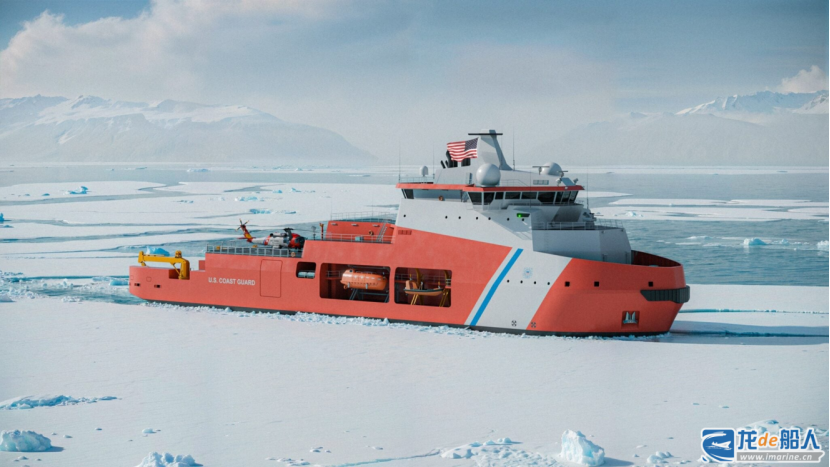
With this, the construction contracts for all 11 polar safety icebreakers planned by the United States to accelerate its polar operational capabilities have been awarded. The remaining six vessels will be built by Finnish shipbuilder Rauma Marine Constructions (RMC) and Bollinger Shipyards, the largest private shipbuilding/repair company in the United States, with two and four vessels respectively. The construction cooperation agreements for both vessels were awarded on December 29, 2025. The first polar safety icebreaker is expected to be delivered in early 2028.
The model in which the U.S. Coast Guard awarded this contract marks an unprecedented shipbuilding collaboration between the United States, Canada and Finland. This series of shipbuilding contracts stems from the Icebreaker Cooperation Agreement (ICE Pact) signed by the three countries in July 2024.
According to reports, the aforementioned 11 polar safety icebreakers will adopt two different design schemes. The six new ships from Finnish shipbuilder RMC and US shipyard Bollinger Shipyards will be built based on the production multipurpose icebreaker (MPI) design of Canada’s Seaspan Shipyard, which is based on Canada’s National Shipbuilding Strategy framework and jointly developed with Finland’s Aker Arctic Technology.
The icebreaker developed by Seaspan Shipyard is approximately 100 meters long, can carry about 85 crew members, has a displacement of about 9,000 tons, a gross tonnage of 7,600, and is capable of breaking through ice layers up to 4 feet (about 1.22 meters) thick. It has a range of 12,000 nautical miles and can operate continuously for up to 60 days. It uses a diesel-electric propulsion system and is equipped with a variable-speed DC bus propulsion device with an output power of about 7,200 kilowatts. It meets the Lloyd’s Register PC4 polar ice class standard and can carry out missions ranging from defense and maritime sovereignty maintenance to scientific research and search and rescue in the Arctic region year-round.
The five polar safety icebreakers contracted by Davie Defense are based on another mature platform. Its sister shipyard, Helsinki Shipyard, has previously built and delivered seven similar vessels, which are now in operation. A company representative stated, “By conducting construction work in Texas and drawing on the mature icebreaking technology of Helsinki Shipyard, Davie Defense is able to build icebreakers that meet the operational needs of the U.S. Coast Guard in extreme and harsh environments.”
Currently, the U.S. Coast Guard operates only three polar icebreakers: the heavy icebreaker USNS Polar Star, commissioned in 1976; the medium icebreaker USNS Healy; and the recently commissioned icebreaker USNS Storis, a converted merchant ship. The U.S. Coast Guard requires at least nine polar safety icebreakers.
The awarding of up to 11 polar safety icebreakers comes at a crucial juncture for the U.S. Coast Guard, which has secured over $8.6 billion in funding through the One Big Beautiful Bill Act. This funding, specifically for the construction of heavy, medium, and light polar safety icebreakers, represents the agency’s largest single funding commitment in its history.
It is understood that both Davie Defense and the Helsinki Shipyard belong to the British maritime group INOCEA, which has operations in Finland, Canada, and the United States. In 2025, INOCEA, through Davie Defense, acquired the shipbuilding assets of Gulf Copper & Manufacturing Corporation in Texas and plans to invest $1 billion to transform it into an “American icebreaker factory,” in other words, a factory specifically designed to build safe icebreakers for polar regions.
Gulf Copper has been operating along the U.S. Gulf Coast for 75 years. Its shipbuilding bases each have two dry docks with quay lengths of approximately 1,219 meters and 305 meters respectively. Previously, it mainly served offshore oil and gas, ocean transportation, petrochemicals, and government agencies. Its business focuses include ship repair, marine services, and marine infrastructure.
Founded in 1946, Bollinger Shipyards is the largest ship repair company in the Gulf Coast region and one of the largest privately owned shipyards in the United States. It specializes in building patrol boats, salvage and research vessels, barges, offshore oilfield support vessels, drilling platforms, lifts, tugboats, and other steel and aluminum vessels. It has 11 shipyards and 22 dry docks in Louisiana and Mississippi.
Rauma Marine Constructions is a Finnish private shipbuilding company founded in 2014. By taking over the assets and business of STX Finland Rauma shipyard, it continues the local shipbuilding tradition dating back to the 16th century. Its main business includes the construction, maintenance, conversion, and upgrading of specialized vessels such as car and cargo ferries, icebreakers, ships and government vessels. As of 2024, its order book exceeded €1 billion, with deliveries scheduled until 2028.