


Having made significant inroads into the U.S. defense shipbuilding market, Hanwha Group is now facing the harsh reality of outdated facilities and a shortage of skilled workers at American shipyards.
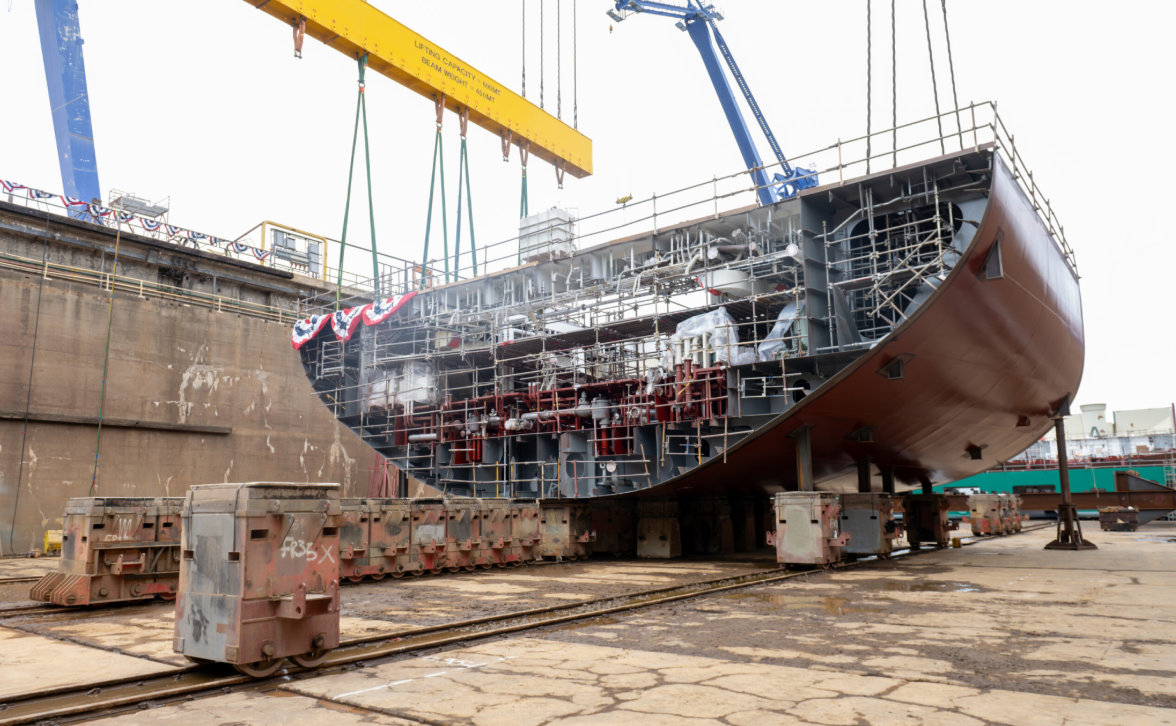
The latest example is the delayed delivery of a national security multi-mission training vessel from Hanwha Philly shipyard due to critical propulsion system defects. Korean shipbuilding experts believe this delay is not simply a matter of mechanical failure, but rather exposes the current state of collapse within the U.S. shipbuilding ecosystem.
According to recent reports from U.S. media outlets, the delivery date for the “State of Maine”, a national security multi-mission training vessel being built by Hanwha Philly Shipyard for the U.S. Department of Transportation’s Maritime Administration (MARAD), has been delayed from the end of 2025 to February 2026 or later.
The trigger for this delivery delay was a serious propulsion system malfunction that occurred on the “State of Maine” during sea trials in the second half of 2025. Specifically, defects were discovered in the propeller shaft and stern shaft bearings, which are crucial for the vessel’s operation. Affected by this defect, the ship returned to dry dock in September 2025 for major repairs, involving the removal and reinstallation of core components.
This major overhaul has delayed the delivery of the “State of Maine” from its original planned date of the end of 2025 to February 2026 or later. Project delays have become commonplace for the “State of Maine,” which was initially scheduled for delivery in 2024, but has been repeatedly delayed until the end of 2025. This latest mechanical failure has only exacerbated the already challenging timeline.
An insider in South Korea’s shipbuilding industry pointed out: “Propeller shaft alignment and bearing installation are fundamental processes in shipbuilding, demanding extremely high precision. That such a basic mechanical transmission system—rather than an advanced combat system—has developed defects fully demonstrates the severe deterioration in the technical proficiency of U.S. shipyard workers.”
Reportedly, construction of the “State of Maine” began before Hanwha Group’s subsidiary acquired the Philly shipyard in December 2024. This indicates that although the vessel was built under the direction of the shipyard’s previous owner, Norway’s Aker Group, the ultimate responsibility for completing the construction and rectifying defects still rests with Hanwha Group. Local sources commented, “It’s understandable that Hanwha Group feels wronged, as the project they inherited was already in disarray, and now they have to ‘clean up the mess’.”
Notably, the State of Maine is the third multi-mission training vessel commissioned by the U.S. Maritime Administration. Its naming ceremony in August 2025 drew prominent attendees including South Korean President Lee Jae-myung, several high-ranking South Korean officials, and Pennsylvania Governor Josh Shapiro. At the time, the vessel was hailed as a model of the ROK-U.S. alliance and shipbuilding technology cooperation. However, the revelation of quality issues just months later will undoubtedly cause significant negative repercussions.
Regarding the current situation at Hanwha Philly Shipyard, Hanwha Group’s plan for “normalizing operations” at the shipyard is far more complex than simply completing the acquisition. The process is expected to be incredibly challenging and will likely cost far more than anticipated. While outdated shipbuilding equipment can be upgraded with sufficient funding, cultivating skilled technicians capable of high-precision work is something that cannot be achieved solely with money and time.
Hanwha Group has invested significant resources and capital into Hanwha Philly Shipyard. Beyond expanding its order backlog through new vessel orders, the company plans to invest $5 billion to construct two new dry docks and three additional piers to boost production capacity. It is also evaluating the feasibility of building a new hull assembly facility.
Hanwha Group aims to increase the annual production capacity of Hanwha Philly Shipyard from less than two vessels to 20 vessels through this expansion. The company plans to build LNG carriers, naval modules, and hull sections at this U.S. shipyard, with long-term ambitions to construct U.S. naval vessels. This includes its recent bold declaration to enter the submarine construction market.
Relevant sources have pointed out: “This propeller shaft defect incident is symbolic, highlighting the precarious state of the American shipbuilding infrastructure. Whether Hanwha Group can quickly resolve this ‘legacy risk’ and transfer advanced South Korean production management systems and technologies to the United States will determine its success or failure in the American market.”