


On January 6, Kawasaki Heavy Industries announced via its official website that it has signed a contract with Japan Suiso Energy for the construction of one 40,000 m³-class liquid hydrogen carrier. This marks the largest liquid hydrogen carrier for which a firm shipbuilding order has been placed globally.
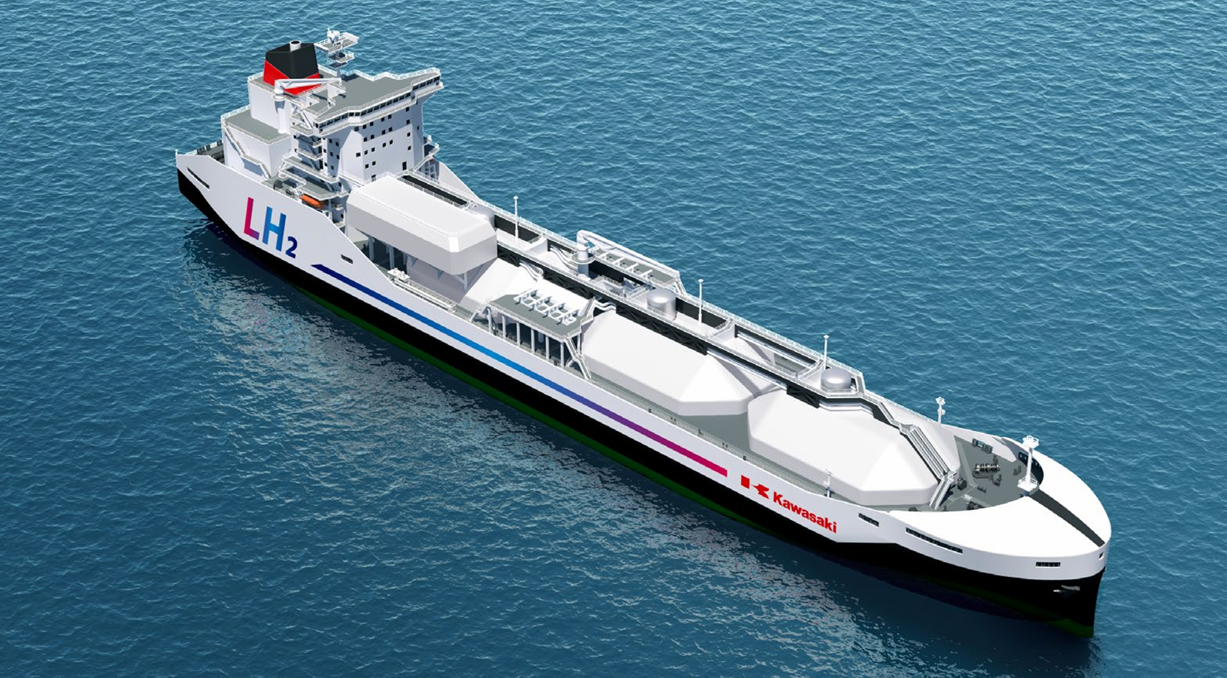
The vessel will be built at Kawasaki’s Sakaide Works (Sakaide City, Kagawa Prefecture). JSE is the project operator for the New Energy and Industrial Technology Development Organization (NEDO) Green Innovation Fund Project: Liquefied Hydrogen Supply Chain Commercialization Demonstration which plans to demonstrate by FY2030 the ship-to-base loading/unloading of liquefied hydrogen and perform trials under ocean-going conditions.
This liquid hydrogen carrier measures approximately 250 meters in length, 35 meters in beam, with a summer full load draft of 8.5 meters. Its cargo hold capacity is about 40,000 cubic meters, and it maintains a speed of approximately 18 knots. Classed by Nippon Kaiji Kyokai (NK), it flies the Japanese flag.
The main features of the new vessel are as follows.
- Equipped with cargo tanks for liquefied hydrogen with a total capacity of around 40,000 m³. Uses a high-performance insulation system to reduce the generation of boil-off gas (BOG) caused by natural heat ingress from the outside, enabling large-scale transportation of cryogenic liquefied hydrogen.
- The electric propulsion system features a hydrogen/oil-based dual-fuel generator engine in addition to a conventional oil-based generator engine. Furthermore, the installation of a hydrogen gas supply system with a compressor and a heat exchanger enables BOG generated from the liquefied hydrogen cargo tanks to be used as a propellant, reducing CO₂ emissions during liquid hydrogen transport.
- Equipped with a cargo handling system capable of loading and unloading large volumes of liquefied hydrogen. Double-wall vacuum jacketed piping keeps the material at an extremely low temperature for efficient and safe transfer between the onshore facility and the liquefied hydrogen tanks on the vessel.
- With a shape and draft that consider the low density of liquefied hydrogen, the vessel requires less power and has a high propulsion efficiency.
- The hydrogen fuel system, fuel supply system, and cargo handling system for liquefied hydrogen and hydrogen gas are risk assessed, and suitable safety measures taken to ensure that the liquefied hydrogen poses no risk to the crew, environment, or structural integrity and soundness of the vessel.
By providing a stable supply of large volumes of hydrogen and supporting the decarbonization of electricity generation, mobility, and industry, the new vessel will help to realize a hydrogen-based society. Kawasaki and JSE will continue to cooperate with diverse businesses to construct a commercial-scale, international supply chain for liquefied hydrogen and realize a carbon neutral society by 2050.