


A recent report by South Korea’s mainstream media outlet The Chosun Ilbo reveals that South Korean shipbuilders face multiple uncertainties in their expansion into the U.S. market, with the Korea-U.S. shipbuilding partnership appearing more like a high-stakes gamble for the South Korean shipbuilding industry!
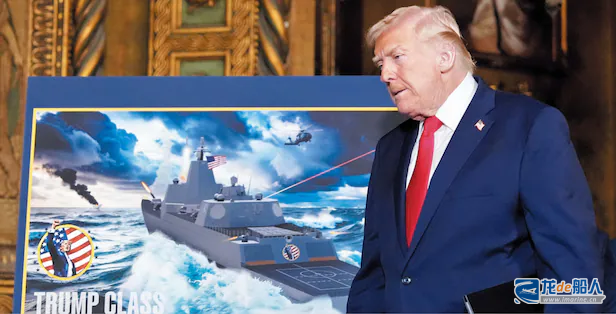
The report states that US President Trump first mentioned the South Korea-US shipbuilding cooperation in November 2024, just before his second presidential election and inauguration. At that time, the South Korean shipbuilding industry was excited about the possibility of “building U.S. warships in South Korea.”
A year has passed, and while Trump has frequently commented on the South Korea-U.S. shipbuilding cooperation, tangible progress has been minimal. He has made no attempt to amend the Jones Act, which mandates that “U.S. vessels must be built in the United States,” nor has he touched the Burns-Tollefsen Act, which prohibits the overseas construction of U.S. Navy vessels. In fact, the Burns-Tollefsen Act requires no revision—it contains provisions allowing the president to request exemptions from Congress on national security grounds. Yet Trump has never exercised this authority.
Reports indicate that the U.S. government has not only failed to facilitate the development of South Korean shipbuilding enterprises in the United States, but has even continued to tighten relevant restrictions. For instance, the U.S. recently removed the clause of “prioritizing support for South Korean enterprises to participate in U.S. overseas shipbuilding investment” from the National Defense Authorization Act for the upcoming fiscal year at the last minute; the yet-to-be-approved Department of Defense Appropriations Act for the next fiscal year by the U.S. Congress not only prohibits funding for the overseas construction of U.S. warships, but also explicitly bans budget allocations for overseas manufacturing projects of ship hull sections.
These restrictions mean that the overseas construction of U.S. Navy ships remains under multiple constraints. Meanwhile, the U.S. midterm elections will be held in November 2026; if the Republicans lose, Trump will face a “lame duck” presidency, and subsequent issues such as South Korea-U.S. shipbuilding cooperation remain uncertain.
The report also clarified that the core of the Korea-U.S. shipbuilding cooperation project—the “Make American Shipbuilding Great Again, MASGA” initiative that has excited South Korea’s shipbuilding industry—is not about “importing foreign-built vessels and flying the U.S. Navy flag.” Instead, it mandates that U.S. Navy vessels must be constructed by American workers at domestic shipyards. During Trump’s first term in 2017, the U.S. initiated the construction of 20 Constellation-class frigates. In 2020, Italy’s largest shipbuilder Fincantieri secured the contract, with related construction commencing at its U.S. shipyard in 2022.
However, during the project’s implementation, supply chain disruptions and skilled labor shortages for the Constellation-class frigate program grew increasingly severe. The initial delivery date for the first vessel, originally scheduled for 2026, has now been postponed to 2029. Ultimately, during Trump’s second term, the decision was announced in November 2025 to cancel the four Constellation-class frigates yet to be started at Fincantieri’s U.S. shipyard, retaining only the two already under construction.
A month after announcing the cancellation of his Constellation-class frigate order, on December 22, 2025, Trump announced plans to build the “Trump-class” warships, named after himself. With the Constellation-class frigate program delayed for three years and ultimately canceled, Trump pushed for a “golden fleet” equipped with still-developing weapons such as electromagnetic railguns, laser weapons, and hypersonic missiles, and declared that the new frigates needed for the “golden fleet” would be “developed in cooperation with South Korea’s Hanwha Group.”
The report analysis indicates that the delays at Fincantieri’s U.S. shipyards on the Constellation-class frigate project stem not from technical shortcomings but from the decline in the foundational capabilities of the the U.S. shipbuilding industry. In contrast, shipyards at South Korea’s Ulsan and Geoje shipbuilding bases possess the capacity for rapid delivery. Moreover, Hanwha Group’s acquisition of Philly Shipyard and its renaming to Hanwha Philly Shipyard similarly requires the use of American workers and supply chains within the United States.
In addition, on the same day that Trump unveiled the new frigate, Hanwha Philly Shipyard announced its entry into the U.S. nuclear submarine market.
As a U.S. shipyard focused on the merchant ship market, Hanwha Philly Shipyard previously had no experience in shipbuilding, not even in building basic warships such as frigates. Now, however, it has announced its direct foray into the pinnacle of naval equipment manufacturing—nuclear submarine construction. The report concludes that, under the MASGA banner, the South Korean shipbuilding industry may be gradually stepping into a giant casino called “Trump”.