


South Korean shipbuilder HD Hyundai Heavy Industries recently announced plans to invest an additional 17 billion won (approximately US$12.72 million) by 2026 to bolster on-site safety capabilities; the project scope encompasses metal surface wave communication technology, the introduction of vision sensors, and upgrades to safety training systems.
HD Hyundai Heavy Industries stated that its metal surface wave communication technology aims to eliminate communication dead zones in areas such as enclosed spaces on ships. Following the conclusion of labor-management negotiations, visual sensors will be installed in high-risk areas to detect hazardous situations in real time. Additionally, the company will strengthen its safety organization and staffing by establishing a “Safety and Technology Department” tasked with improving production techniques and conducting on-site inspections, thereby enhancing on-site emergency response capabilities and professional expertise.
Meanwhile, HD Hyundai Heavy Industries announced a comprehensive review of major safety incidents from the past decade, re-examining the preventive measures taken at the time to prevent such events from recurring.
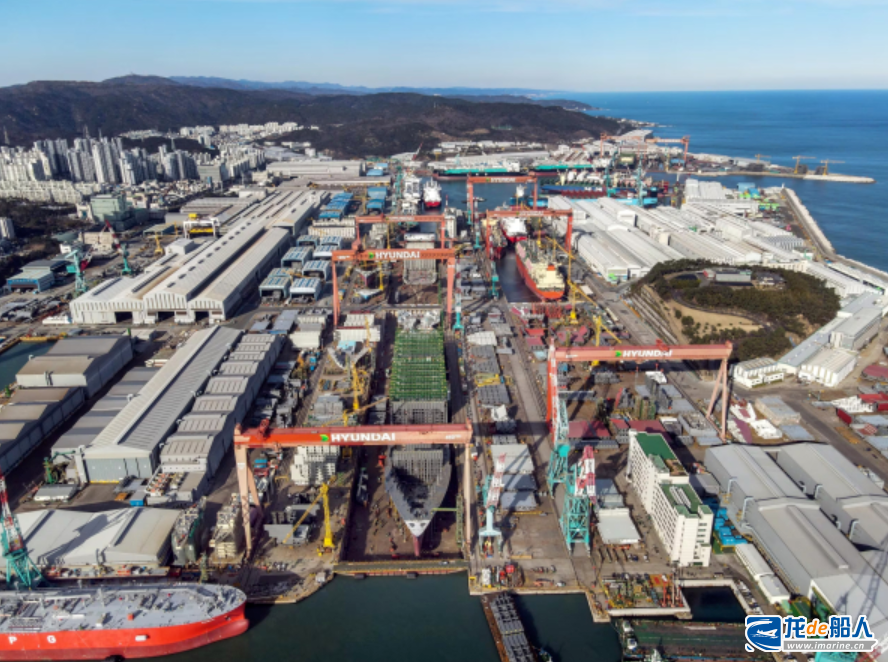
Since the beginning of this year, HD Hyundai Heavy Industries’ shipyards have experienced several fatal accidents, which may be one of the key reasons why the company announced additional investments in safety at this time.
In April, a fire broke out on a submarine undergoing repairs at HD Hyundai Heavy Industries’ Ulsan shipyard, resulting in the death of a subcontracted worker responsible for sea trials. The worker was performing cleaning duties inside the submarine when the incident occurred.
On July 9, a worker at the HD Hyundai M&S Ulsan plant (an affiliate of HD Hyundai Heavy Industries) tragically fell to his death from a height while inspecting a gantry crane on the slipway.
On July 18, an Uzbek subcontractor (in his 20s) at HD Hyundai Heavy Industries’ Ulsan Shipyard was trapped between a work gondola and the superstructure while performing grinding work on the liquid cargo hold of a liquefied natural gas (LNG) carrier under construction; he ultimately died in the incident.
On July 24, a subcontracted worker (in his 30s) at Gunsan shipyard died after his head became pinned between a protruding lifting lug on a hull block and the protective guard of a winch while he was operating a stationary winch in reverse.
On August 28, a subcontracted worker at Ulsan shipyard was found dead in the boiler room near the welfare facilities.
Due to the frequent occurrence of accidents, South Korea’s Ministry of Employment and Labor (MOEL) initiated a high-level on-site inspection—equivalent to a special audit—of HD Hyundai Heavy Industries starting August 18.