


Hengli Heavy Industries recently announced that it secured contracts to build 11 Very Large Ammonia Carriers (VLACs) within a single week. The orders cover three vessel specifications: 88,000 cubic meters, 90,000 cubic meters, and 93,000 cubic meters. The successful securing of these projects marks a significant breakthrough for Hengli Heavy Industries in the field of cryogenic gas carriers.
Notably, public orders for VLACs globally totaled approximately 40 vessels during the first seven months of 2026; this means the volume of contracts signed by Hengli Heavy Industries in a single week exceeded one-quarter of the total orders placed during that seven-month period. Hengli Heavy Industries remarked, “In a market segment with a total capacity of only 40 to 60 vessels, such a high concentration of orders within a single week is extremely rare in the history of global shipbuilding.”
Currently, Hengli Heavy Industries ranks first globally in terms of its VLAC order backlog, marking a major leap forward for the company in the cryogenic tanker sector—from securing its “first order” to becoming a “market leader in scale.”
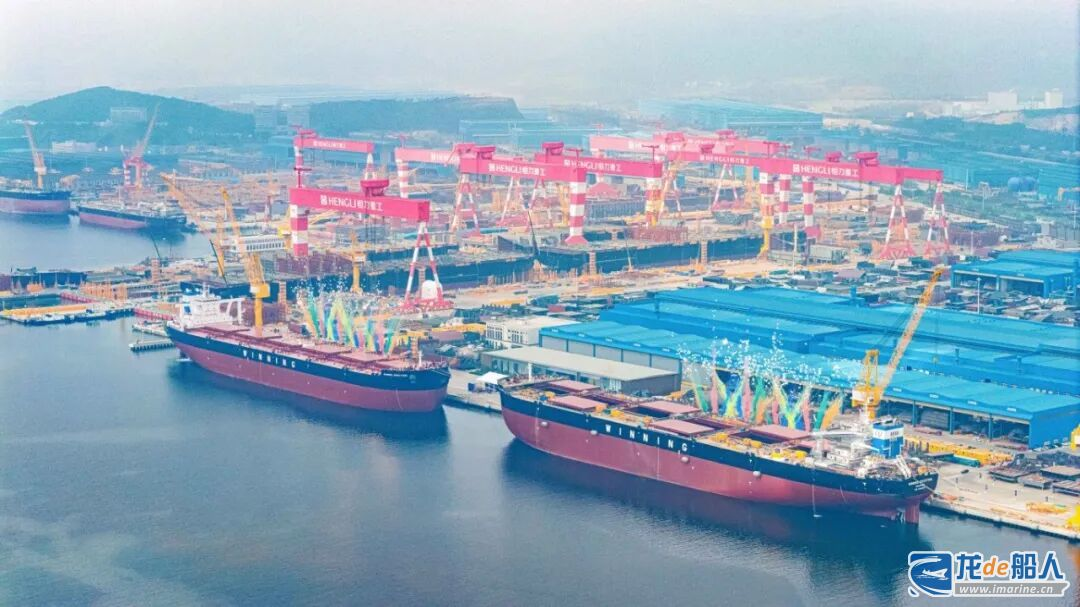
Hengli Heavy Industries states that the key factor enabling the securing of these volume orders is its end-to-end, in-house capability to supply core equipment for cryogenic liquid cargo systems. By leveraging its proprietary capabilities in Type-A liquid cargo tanks, dual-fuel main engines, and generators, the company has successfully established the full implementation chain for this core equipment, effectively transforming its technical expertise into tangible market competitiveness.
Hengli Heavy Industries independently manufactures Type A cargo tanks. As the core component for storing liquid ammonia in VLACs, these tanks must maintain structural integrity and a hermetic seal over long periods at cryogenic temperatures (-33°C), a requirement that entails significant technical challenges. By achieving fully independent manufacturing of Type A cargo tanks, Hengli Heavy Industries has eliminated reliance on a limited number of overseas suppliers for this critical component, thereby gaining a competitive edge in construction timelines, project costs, and safety performance under operational conditions.
Hengli Heavy Industries has independently developed LPG dual-fuel engines. This series of vessels is equipped with LPG dual-fuel engines independently developed and manufactured by Hengli Heavy Industries, achieving full-chain self-sufficiency from liquid cargo tanks to propulsion systems. In-house engine production eliminates the “waiting for engines” bottleneck—while most shipyards worldwide rely on external suppliers for main engines, with lead times of 12 to 18 months, Hengli Heavy Industries can control its own production schedule. At the same time, during operation, the vessels can use a portion of the liquid cargo they are transporting as fuel, creating a closed-loop operational cycle where “transporting cargo serves as fuel reserves.”
The independent sourcing of generators is equally critical. The vessel’s power plant acts as its “pacemaker,” supplying electricity to the entire vessel. In the context of liquid ammonia transport, generators must be capable of withstanding ship motion and low-temperature environments while meeting the specific power requirements of the liquid cargo system. Independent sourcing ensures the reliability and suitability of the power system.
Hengli Heavy Industries highlights three major technological breakthroughs that underpin its differentiated competitiveness in the VLAC sector: compared to traditional models, in-house component integration enables controllable construction schedules and optimized project costs, while simultaneously ensuring reliable performance regarding cryogenic containment and safe operation during liquid ammonia transport.
The global shipping industry is accelerating its transition toward low-carbon operations; as a zero-carbon fuel, ammonia is driving a continued rise in demand for VLACs. The International Energy Agency (IEA) forecasts that the share of ammonia fuel in the shipping sector will surge from 8% in 2030 to 46% by 2050. DNV projects that seaborne ammonia trade volumes could reach approximately 120 million tonnes annually by 2050—approaching the current scale of the LPG trade—necessitating a fleet of around 200 VLACs to meet this growing demand.
Ammonia contains no carbon; upon complete combustion, it yields only water and nitrogen, making it a naturally zero-carbon fuel. Moreover, as an efficient hydrogen carrier, it bypasses the technical bottlenecks associated with the cryogenic storage and transport of liquid hydrogen, allowing hydrogen to be released via catalytic cracking upon arrival at the destination. VLACs are not merely vessels for transporting ammonia; they serve as critical infrastructure for the future hydrogen energy supply chain.
The securing of this batch order further solidifies Hengli Heavy Industries’ market position in the cryogenic vessel sector, enabling the company to seize opportunities arising from the growth of clean-energy shipping and to continuously expand its presence in the high-end offshore engineering and green vessel markets. Leveraging its large-scale dry dock capacity, Hengli Heavy Industries has rapidly entered the green shipping arena and is steadily strengthening its gas carrier product portfolio. From VLACs and VLGCs to LNG carriers, the company’s product lineup is evolving from a breakthrough in a single vessel type to comprehensive coverage across the entire spectrum of gas carriers.