


On September 11, Hanwha Ocean’s Geoje Shipyard held a steel-cutting ceremony for a next-generation icebreaking research vessel being built for the Ministry of Oceans and Fisheries of South Korea, marking the official start of construction on South Korea’s second icebreaking research vessel.
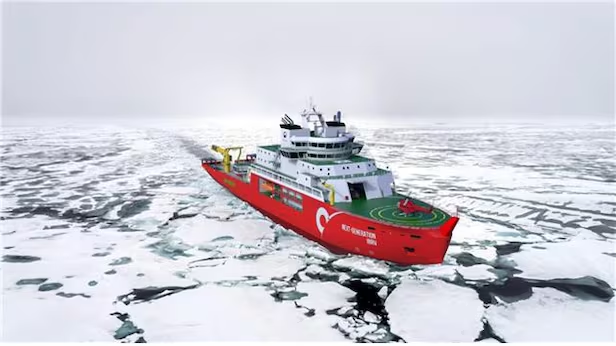
Ordered in July 2025 at a cost of 250 billion won (approximately $180 million), the vessel is scheduled for delivery in December 2029 and is expected to enter service in the Arctic in the summer of 2030.
South Korea’s new-generation icebreaking research vessel has a gross tonnage of 16,560, more than double that of the country’s first icebreaking research vessel, the “Araon” (7,507 gross tons). It will provide more space for scientific research facilities and living quarters, and the crew size will increase from 85 to 100.
The new vessel offers approximately 50% improvements in both performance and ice-breaking capability. Classified as a PC 3 icebreaker, it is capable of breaking through 1.5-meter-thick ice at a speed of 3 knots and features bidirectional ice-breaking capabilities. Designed to operate normally in extreme cold—down to minus 45 degrees Celsius—the vessel will be equipped with an eco-friendly dual-fuel system (LNG and MGO) to reduce carbon emissions. To support researchers conducting long-term scientific work in extreme environments, onboard living facilities, such as cabins and dining areas, will meet the standards of top-tier passenger liners.
Previously, South Korea had only one icebreaker research vessel, the “Araon,” to conduct research in the Arctic and Antarctic, which resulted in lengthy deployment times and limited periods for field research. Furthermore, due to limitations in its icebreaking capabilities, it was difficult to access the Arctic Ocean.
The Ministry of Oceans and Fisheries of South Korea stated that it will use the new vessel to conduct Arctic scientific research, studying sea ice conditions, Arctic Ocean fish stocks, and seabed geology. Under this plan, the number of days South Korea spends on scientific research expeditions in the Arctic and Antarctic each year will increase from 85 to 270—more than a threefold increase.