


The Japanese shipbuilding industry, which had previously been squeezed by Chinese and South Korean shipbuilders—leading to a significant decline in its global market share—has launched a new project to build a large dry dock for the first time in nine years. The project is part of Japan’s high-profile “Revitalization of the Domestic Shipbuilding Industry” initiative, and aims to restart the construction of high-value-added vessels, such as liquefied natural gas (LNG) carriers, a sector that has been effectively stagnant since 2019.
With a $628 million Investment, a New Large-Scale Dry Dock to Be Built for the First Time in 9 Years
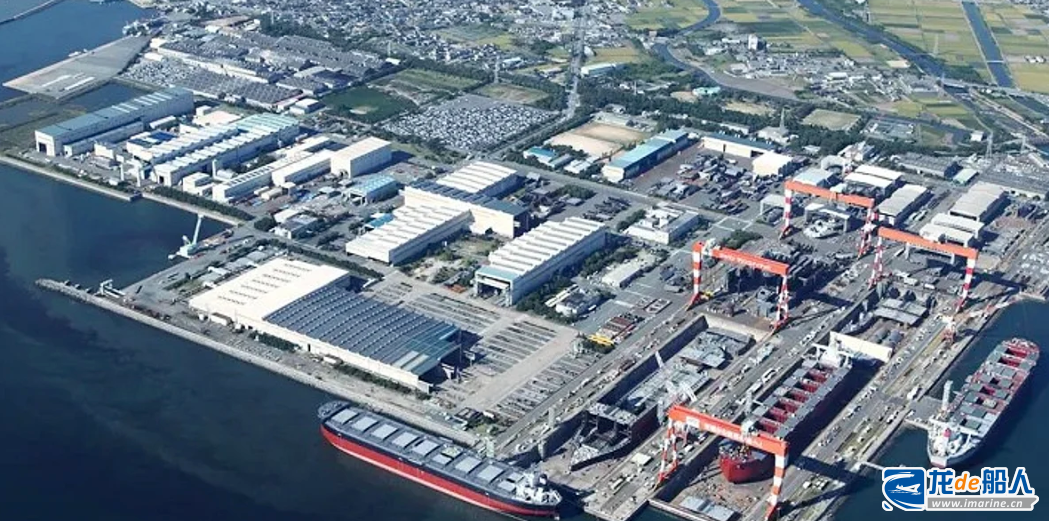
According to a recent report by Nikkei Asia, Namura Shipbuilding, a major Japanese shipbuilder, plans to construct and commission a brand-new dry dock for building large vessels by 2035. The facility will be located at the Imari Plant, the core of Namura Shipbuilding’s operations. Affected by sharp increases in the prices of construction materials and marine equipment, Namura Shipbuilding revealed: “The total investment for this project is nearly 100 billion yen (approximately $628 million at current exchange rates), and we will actively seek substantial government subsidies.”
Currently, Namura Shipbuilding’s Imari facility operates a large dry dock measuring approximately 450 meters by 70 meters, which is primarily used to build high-value-added vessel types; the dry dock maintains a high utilization rate. Namura Shipbuilding is currently moving full steam ahead with plans for the construction and installation of core equipment—such as giant gantry cranes—related to the new dry dock project.
It is worth noting that this marks the first time in nine years that Japan has built a new large-scale dry dock; the last such project dates back to 2017, when Imabari Shipbuilding—Japan’s largest shipbuilding group—completed a 600-meter-by-80-meter dry dock at its Marugame Plant in Kagawa Prefecture.
Imabari Shipbuilding’s new drydock project is a direct result of Japan’s plan to revitalize its shipbuilding industry. In June 2026, Japan announced that it would include the shipbuilding industry as one of the country’s 17 priority investment areas.
The Japanese government has set a development goal to double domestic shipbuilding capacity from approximately 9 million gross tons (GT) to 18 million GT by 2035, backed by a combined public-private investment of 1 trillion yen (approximately US$6.275 billion at current exchange rates). Recognizing that a shortage of large-scale domestic shipyard infrastructure is the primary bottleneck to achieving this target, the industry has decided to launch a major infrastructure expansion project to overcome these constraints.
Three Shipbuilders Form an Alliance to Re-enter the Market for LNG and Hydrogen/Ammonia Carriers
Reportedly, the new large drydock at Namura Shipbuilding will serve as the core shipbuilding base for the Japanese shipbuilding industry as it resumes construction of high-value-added vessel types, such as LNG carriers and next-generation hydrogen/ammonia carriers.
In June 2026, Japan designated support for the construction of LNG carriers as a core priority for investment in the shipbuilding industry. Accordingly, Japan’s three major shipbuilders—Imabari Shipbuilding, Kawasaki Heavy Industries, and Namura Shipbuilding—formed a consortium and agreed to achieve an annual production capacity of 3 to 5 environmentally friendly gas carriers by around 2035.
According to an agreement reached by the three shipbuilders, the Kawasaki Heavy Industries Sakaide Plant is the leading candidate for the core construction base. However, the three shipbuilders believe that the Kawasaki Heavy Industries Sakaide Plant alone will struggle to fully meet the annual production capacity target set by the Japanese government; if, however, the new dry dock at Namura Shipbuilding comes online as planned, it will bridge the capacity gap.
After “losing its crown as the world’s leading shipbuilder” several years ago, Japan aims to regain market share
It is understood that during the 1980s and 1990s, Japan rose to become the world’s leading shipbuilding power. However, as South Korean shipbuilders leveraged government support and price competitiveness, Japanese shipbuilders’ competitiveness has gradually weakened since the 2000s, and South Korean shipbuilders have taken over market dominance.
Meanwhile, in recent years, Chinese shipbuilders have further encroached upon Japan’s share of the shipbuilding market—which has now shrunk to around 10%—by leveraging their massive production capacity and rapidly advancing capabilities in ship R&D and construction; in contrast, Chinese shipbuilders have surged far ahead of their South Korean and Japanese counterparts in terms of market share.
However, although Japan’s shipbuilding industry has recovered, it will not be easy for it to capture a larger share of the market from Chinese and South Korean shipbuilders.
Taking LNG carriers as an example, Japanese shipbuilders currently have zero outstanding orders for this vessel type. Compared to Chinese and South Korean shipbuilders, which have already established a firm foothold in this market, Japan will have to spend considerable time and money to catch up.
In addition, the Moss-type LNG cargo tanks primarily built by Japanese shipbuilders several years ago have been replaced by the currently dominant membrane-type LNG cargo tanks; therefore, the shift in cargo tank types poses another major challenge for Japanese shipbuilders as they resume this shipbuilding business. While Japanese shipbuilders are struggling to break through this impasse, Chinese and South Korean shipbuilders will inevitably gain more experience in building membrane-type LNG carriers, making it even harder for Japanese shipbuilders to catch up in this market segment.
In addition, Japanese shipbuilders face higher costs for raw materials and labor, which prevents them from gaining a price advantage. In response, the Japanese government has indicated its intention to provide subsidies to shipowners who order LNG carriers from Japanese shipyards, in order to bridge the price gap between Japanese shipyards and those in China and South Korea in the new-build LNG carrier market, thereby enhancing Japan’s competitiveness in this market segment.