


Ray Car Carriers, an Israeli shipowner known for placing orders with South Korean shipyards, appears to be shifting its shipbuilding strategy and is reportedly set to place a bulk order for pure car and track carriers (PCTCs) with Guangzhou Shipyard International, a subsidiary of China State Shipbuilding Corporation.
Ray Car Carriers and Guangzhou Shipyard International are in the final stages of negotiations for 10 to 14 liquefied natural gas (LNG)-fueled 8,600 CEU PCTCs, with a total order value of approximately $1 billion, according to TradeWinds. Sources revealed that this batch of new vessels is not a speculative order but will be built under long-term charter contracts.
It is worth noting that if this order is finalized, it will mark a departure from Ray Car Carriers’ previous practice of placing orders exclusively with shipyards owned by South Korea’s HD Hyundai, as the company will be directing a new shipbuilding project to China for the first time. This signifies that Chinese shipyards have taken their competitiveness in the car carrier sector to a new level.
Ray Car Carriers was founded in 1992 and has since grown into a leading global operator in the roll-on/roll-off (RoRo) car carrier sector. Its fleet currently comprises more than 60 active PCTCs, with several additional LNG dual-fuel PCTCs under construction at HD Hyundai shipyards. The shipowner’s most recent announcement of a PCTC order was in April 2026, involving two 7,300 CEU PCTCs to be built by HD Hyundai Heavy Industries at a total cost of approximately $270 million.
In comparison, the vessels Ray Car Carriers is set to order from Guangzhou Shipyard International are larger, with a cargo capacity approximately 17.8% higher than that of HD Hyundai Heavy Industries’ 7,300 CEU class. In terms of order value, the contract currently under negotiation with Guangzhou Shipyard International is more than 3.7 times the value of HD Hyundai Heavy Industries’ existing confirmed contracts. If this order under negotiation ultimately results in an actual construction contract, it will further increase Chinese shipyards’ market share in the car carrier sector.
Of the 37 PCTC orders (including options) announced in 2026, Chinese shipyards secured 35, accounting for nearly 95% of the total; South Korean shipyards received 2 vessels, while no orders were announced for Japanese shipyards. In terms of shipyards, the orders were placed with shipyards under China Merchants Shipbuilding, Guangzhou Shipyard International, CIMC Raffles, Xiamen Shipbuilding Industry, Yangzhou Guoyu Shipbuilding, and South Korea’s HD Hyundai Heavy Industries, among others.
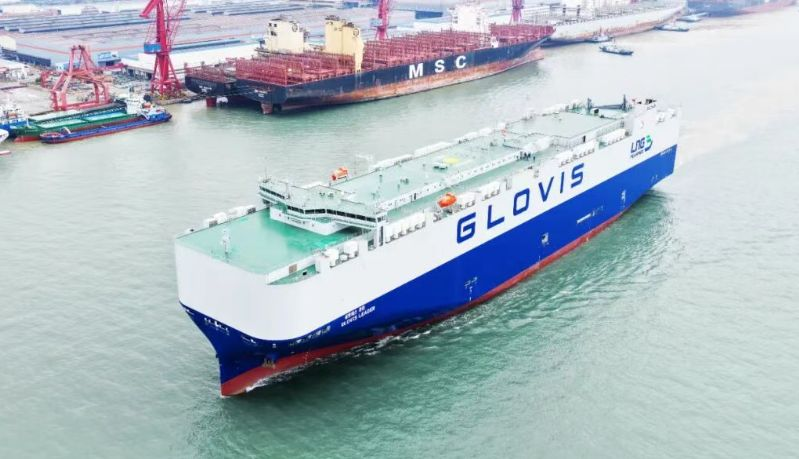
During the shipbuilding phase, on April 28, 2026, the world’s first 10,800 CEU PCTC, the “GLOVIS LIGHTHOUSE,” was completed and delivered by Guangzhou Shipyard International. With a maximum capacity of 10,800 vehicles, the vessel set a new global record for carrying capacity among ships of its kind, marking a major breakthrough for Chinese—and indeed global—shipyards in this vessel class; Shortly thereafter, Waigaoqiao Shipbuilding delivered the first 10,800 CEU PCTC, the “GLOVIS LIGHTHOUSE”, further solidifying Chinese shipyards’ market position in this vessel class.
In the PCTC sector, South Korean and Japanese shipyards have long been regarded as the leading shipbuilders. However, in recent years, Chinese shipyards have been reshaping the industry landscape through their continuously improving R&D and construction capabilities. The competitiveness of Chinese shipyards is not limited to ship prices; their core advantage lies in having established the capacity for mass production of PCTCs.
Having the capacity for mass production means that large-scale orders from shipowners are more likely to be concentrated at Chinese shipyards. Securing a series of orders not only increases the number of vessels built but also enables design optimization, cost reduction, improved production efficiency, and a stable supply chain for equipment through repetitive construction, thereby ensuring future orders.
In contrast to China, securing bulk orders remains a weakness for South Korean shipyards. A representative from the South Korean shipbuilding industry stated: “If South Korean shipbuilders continue to focus solely on high-value-added individual orders, and if the bulk-building model of Chinese shipyards becomes firmly established, then the influence of Chinese shipbuilders in the future market for environmentally friendly, high-value-added PCTCs may expand even further.”