


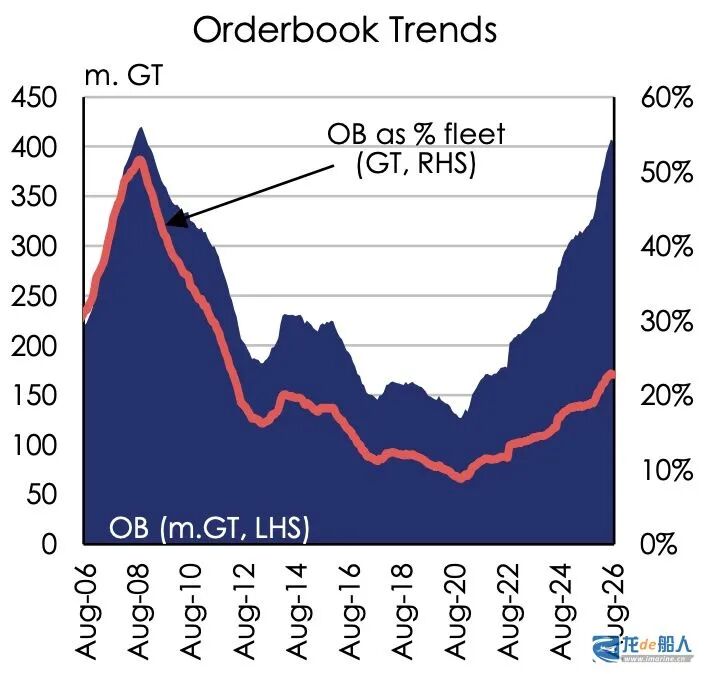
The total volume of new ship orders worldwide rose 27% year-over-year, reaching its highest growth rate since the eve of the 2008 financial crisis; the volume of new ship contracts is now approaching the levels seen during the pre-Lehman boom in the shipping industry.
The Lehman Crisis refers to the event in 2008 when Lehman Brothers, the fourth-largest investment bank in the United States, filed for bankruptcy protection following failed investment decisions and the collapse of acquisition negotiations, marking the onset of the global financial crisis. As a result, the global shipping industry entered a downturn that lasted several years, characterized by large-scale order cancellations, delivery delays, ship abandonment, and defaults by shipowners. Many shipyards in China and South Korea suffered losses or even went bankrupt.
Latest Clarksons data shows that as of early August 2026, the global merchant fleet totaled 117,022 vessels, with a gross tonnage of approximately 1.8 billion metric tons, representing a 4% year-over-year increase; Global shipyards’ order backlog stood at 9,012 vessels, totaling approximately 405.9 million gross metric tons, representing a 27% year-over-year increase in gross metric tons over the past 12 months. By comparison, the growth rate of the global shipyard order backlog during the same period was nearly seven times that of the fleet’s growth rate.
However, global shipowners’ enthusiasm for shipbuilding shows no signs of waning. According to Clarksons data, in the first seven months of 2026, global shipowners placed orders for 1,947 new vessels totaling approximately 105.7 million metric tons, with demand for newbuilds remaining strong across all shipping segments.
However, the shipbuilding boom will eventually come to an end. Based on current trends, new ship orders are approaching the record of 173.7 million metric tons set in 2007—the peak year of the last shipping supercycle.
So far this year, Greece has been the most active shipowner nation in the newbuild market, with Chinese shipowners close behind. Although Singapore ranks third, it lags significantly behind Greece and China.
From 2006 to 2007, the shipping industry experienced an unprecedented surge in new ship orders, driven by soaring freight rates, loose financing conditions, and market optimism regarding the seemingly limitless growth of China’s commodity demand. Before the financial crisis struck, the global order backlog had swelled to more than 50 percent of the existing fleet’s size at the time.
Since then, the newbuilding market has never again seen an order growth rate comparable to that of this boom; even the post-pandemic surge in orders failed to reach that level: In 2021, as liner and liquefied natural gas (LNG) shipowners reinvested record profits into the newbuilding market, global orders rose by approximately 24% year-over-year; In 2024, new ship orders rose by 26% year-over-year, marking an exceptionally strong year.
Consequently, the 27% growth rate recorded during the aforementioned order statistics period (early August 2025 to early August 2026) stands as the highest growth rate since the outbreak of the 2008 financial crisis.
At the same time, the sheer scale of the current global order backlog is equally striking. Throughout the 2020s, the global merchant fleet order backlog averaged approximately 230 million to 240 million metric tons. The current order backlog of 405.9 million gross metric tons is approximately 70% to 75% higher than the average for the decade to date.
In 2026, driven by factors such as fleet renewal, aging vessels, and uncertainty surrounding future fuel and emissions requirements, global shipowners’ enthusiasm for shipbuilding remains undiminished. Against this backdrop, the industry is eager to compare the boom in orders in 2026 with that of 2008.