


In the first half of 2026, South Korean shipowner HMM invested over KRW 2 trillion to acquire vessels, accelerating its fleet expansion; during the same period, it took delivery of 14 vessels of various types. This move aligns with HMM’s mid-to-long-term growth strategy.
According to recent data released by South Korea’s Financial Supervisory Service, HMM invested a total of 2.2577 trillion won (approximately US$1.633 billion) in vessel acquisitions during the first half of 2026—a 245% surge compared to the 655 billion won spent in the same period of the previous year. This investment amount is approximately 3.6 times the company’s operating profit of roughly 623.2 billion won (approximately US$451 million) for the same period.
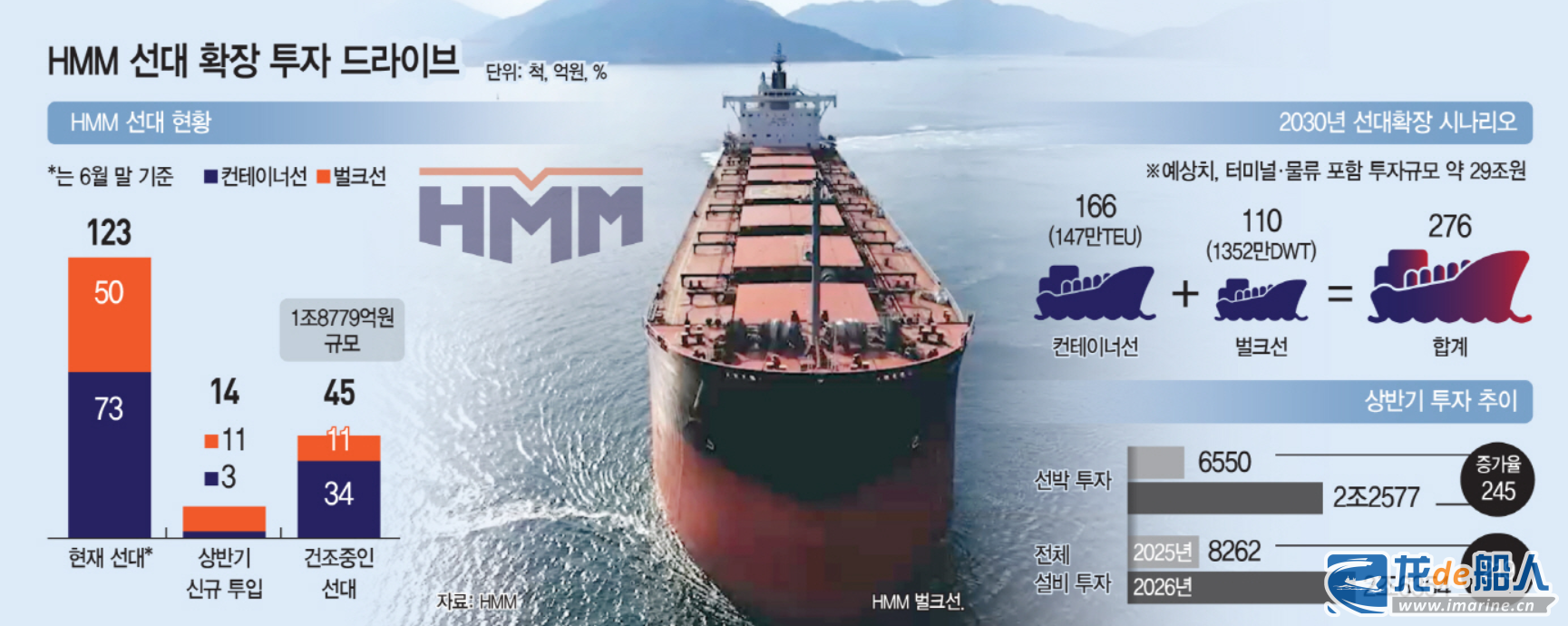
Large-scale investment in vessels is a core component of HMM’s medium- to long-term growth strategy, which calls for investing approximately 29 trillion won in the fleet, ports, and logistics infrastructure by 2030. The goal is to expand the container fleet from the current 73 vessels to 166 and the bulk carrier fleet from 50 to 110.
In the first half of 2026, HMM took delivery of 14 new vessels, including 5 bulk carriers, 3 container ships, 2 liquefied gas carriers, 2 car carriers, and 2 oil tankers. This indicates that the shipping company is not only investing in container capacity but is also focusing on enhancing the competitiveness of its non-container operations.
Regarding new shipbuilding orders, as of the first half of 2026, HMM has placed orders for at least 20 new vessels—primarily container ships and liquefied gas carriers—with shipyards in China and South Korea. These include five 2,000 TEU and seven 3,000 TEU container ships from Huanghai Shipbuilding, as well as ten 2,800 TEU container ships and two 90,000-cubic-meter class VLGCs from HD Hyundai Heavy Industries; the delivery dates for these vessels are scheduled between 2028 and 2029.
As of the end of June 2026, HMM had 45 new vessels under contract and under construction, with a total construction cost of approximately 1.8779 trillion won (approximately US$1.358 billion).
As the scale of investment has surged, market attention has focused on HMM’s financial resilience. To support large-scale investments, HMM needs to stabilize its cash generation capabilities while actively diversifying its business portfolio. The shipping line’s strategy is to reduce its heavy reliance on the container business and expand its bulk cargo operations, thereby mitigating performance volatility caused by fluctuations in the shipping market.
Currently, HMM’s container business accounts for over 80% of its operating revenue, and the shipping company is diversifying its revenue base by expanding into business areas such as bulk carriers, liquefied gas carriers, car carriers, and oil tankers.
Meanwhile, HMM is actively pursuing long-term contracts of affreightment (COAs) with the aim of mitigating the impact of market volatility on its performance by securing a stable, long-term volume of cargo.
HMM stated, “As the expansion of AI data centers in the U.S. and grid modernization projects move forward, demand for the transport of cargo—primarily electrical and infrastructure equipment—continues to grow… The company is working to sign COAs with major global shippers in the second half of the year to ensure a stable volume of cargo.”