

In the market for high-value-added vessel types, competition for orders between China and South Korea has expanded from liquefied natural gas (LNG) carriers to very large ammonia carriers (VLACs).
In recent years, as the potential uses of ammonia as a marine fuel and a hydrogen carrier (converting hydrogen into ammonia for transport) have become increasingly apparent, demand for VLACs—specifically designed for long-distance ammonia transport—is rising to meet growing trade volumes.
According to statistics, from January to July 2026, global shipowners publicly announced a total of 40 VLAC orders, with Chinese and South Korean shipbuilders securing 26 and 14 vessels, respectively. Orders for Chinese shipbuilders were distributed among Jiangnan Shipyard (10 vessels), Hengli Heavy Industries (14 vessels), and Yangzijiang Shipbuilding (2 vessels); orders for South Korean shipbuilders were secured by HD Hyundai Samho (11 vessels) and Hanwha Ocean (3 vessels).
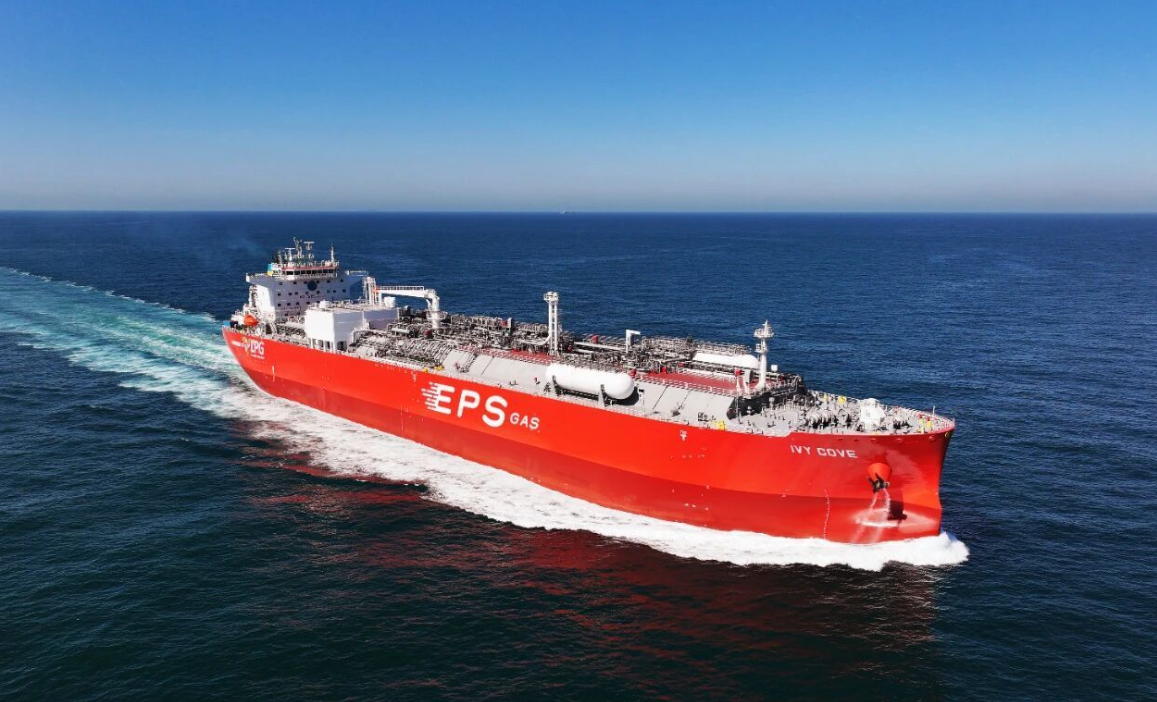
Specifically, Jiangnan Shipyard’s 10 VLACs are associated with Singapore’s East Pacific Shipping, Southwest Shipping, Greece’s Thenamaris, and CYH Shipping, with 2, 2, 2, and 4 vessels, respectively, scheduled for delivery between 2028 and 2030.
It is worth noting that as China’s first shipbuilder to build VLACs, Jiangnan Shipyard delivered China’s first 93,000-cubic-meter-class VLAC, the “IVY COVE”, on June 10, 2026. The vessel is a derivative (Panda 93A) of the fourth-generation VLGC premium ship type independently developed and designed by Jiangnan Shipyard, and represents the world’s first order for this ship type. Its delivery date preceded that of the “Jane Maersk”—a VLAC of the same specifications delivered by HD Hyundai Samho to Maersk—by approximately one month.
Hengli Heavy Industries’ 14 VLACs come in two sizes: the 88,000-cubic-meter class and the 93,000-cubic-meter class. Information on the owners of 10 of these vessels has been made public: Evalend (Greece, 2 vessels), Dynacom (Greece, 2 vessels), Capital (Greece, 2 vessels), and Emarat Maritime (Dubai, 4 vessels).
Currently, Hengli Heavy Industries has achieved a key breakthrough in VLAC construction: On June 23, the company’s first 93,000-cubic-meter VLAC was successfully launched, becoming the world’s first VLAC built on a shipbuilding slipway and successfully launched, thereby breaking the industry’s long-standing practice of constructing large gas carriers exclusively in dry docks.
Yangzijiang Shipbuilding’s two 88,000-cubic-meter-class VLACs are being built for the British shipowner Union Maritime; the first vessel is scheduled for delivery in 2029, and the second in 2030.
Regarding South Korean shipbuilders, the 11 VLACs secured by HD Hyundai Samho were ordered by Synergy Shipping—a joint-venture shipping company under Turkey’s Ciner Group—and the Belgian shipowner Transpetrol; the orders comprise 9 and 2 vessels respectively, with delivery scheduled between 2029 and 2030.
As of the end of July 2026, HD Hyundai Samho held orders for 22 VLACs; combined with the VLAC orders held by HD Hyundai Heavy Industries, HD Hyundai currently possesses the largest VLAC orderbook among South Korean shipbuilders.
Hanwha Ocean’s three vessels were all ordered by the UK-based shipowner Zodiac Maritime, bringing the shipyard’s total VLAC orderbook to 10 vessels as of the end of April 2026.
Amid growing interest in ammonia as an eco-friendly marine fuel, competition between Chinese and South Korean shipbuilders for orders of VLACs—a high-value-added vessel type—is expected to intensify further.
Additionally, according to the “Roadmap to Carbon Neutrality by 2050” released by the International Energy Agency (IEA), the share of ammonia fuel in the shipping industry is projected to rise from 8% in 2030 to 46% in 2050. In light of this, competition between Chinese and South Korean shipbuilders for ammonia-fueled vessels is likely to be equally intense.