


On June 10, Jiangnan Shipyard, a subsidiary of China State Shipbuilding Corporation (CSSC), officially named and delivered the first vessel in a series of 93,000 m³ Very Large Ammonia Carriers (VLACs) built for Singapore-based EPS. The vessel is named “IVY COVE.”
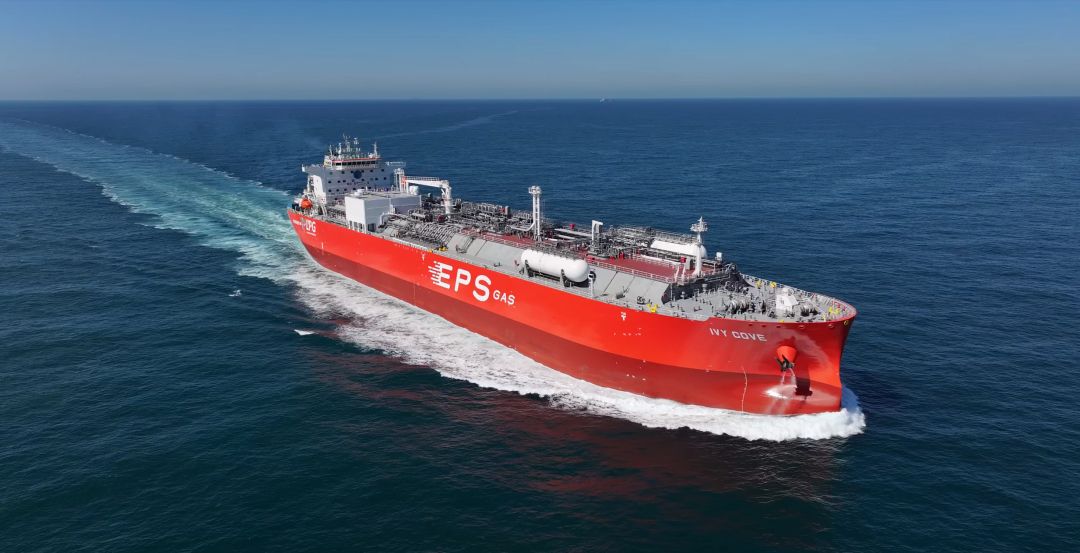
This vessel is a new-generation VLCC developed entirely by Jiangnan Shipyard. It is the first 93,000 m³ VLCC delivered in China and marks the world’s first order for this ship type. Following delivery, it will be chartered by Trafigura, a global commodity trading giant.
The 93,000 m³ VLAC is a derivative of the Panda 93A, a fourth-generation VLGC premium ship type independently developed and designed by Jiangnan Shipyard. It has a total length of 230 meters, a beam of 36.6 meters, a draft of 22.5 meters, and a structural draft of 13 meters, and is classed by Lloyd’s Register.
In terms of ship performance, the PANDA 93A breaks through the resistance and wake optimization technology for medium-to-high speed, high block coefficient vessels. It enables the ship to maintain balanced and efficient hydrodynamic performance under full load, ballast, and different liquid cargo density conditions.
Jiangnan Shipyard’s R&D team pioneered the combined application of a wave-damping and seakeeping hull form patent and both pre- and post-propeller energy-saving devices, achieving an optimal balance between speed and cargo capacity. This also ensures the vessel’s waterway accessibility and terminal handling compatibility, bringing its overall energy efficiency to internationally advanced levels.
This vessel type offers exceptional flexibility in cargo loading—it can carry a full cargo of either liquid ammonia or a variety of liquefied petroleum gases, such as propane and butane. Additionally, due to the limited volume of bulk liquid ammonia cargoes, the vessel is capable of carrying two different types of liquefied gases simultaneously.
This vessel design incorporates an “upgrade interface”; by installing a proven LPG dual-fuel main engine and shaft generator, it can reduce CO₂ emissions by approximately 20% and sulfur oxide emissions by approximately 99%, thereby meeting the stringent requirements of EEDI Phase 3 and laying a solid foundation for a future upgrade to ammonia propulsion.