


Recently, Italian shipbuilder Fincantieri announced on its official website that the large cruise ship “Norwegian Aura,” built by its Monfalcone shipyard for Norwegian Cruise Line Holdings (NCL), has been launched. The new ship is expected to be delivered and put into operation in the spring of 2027.
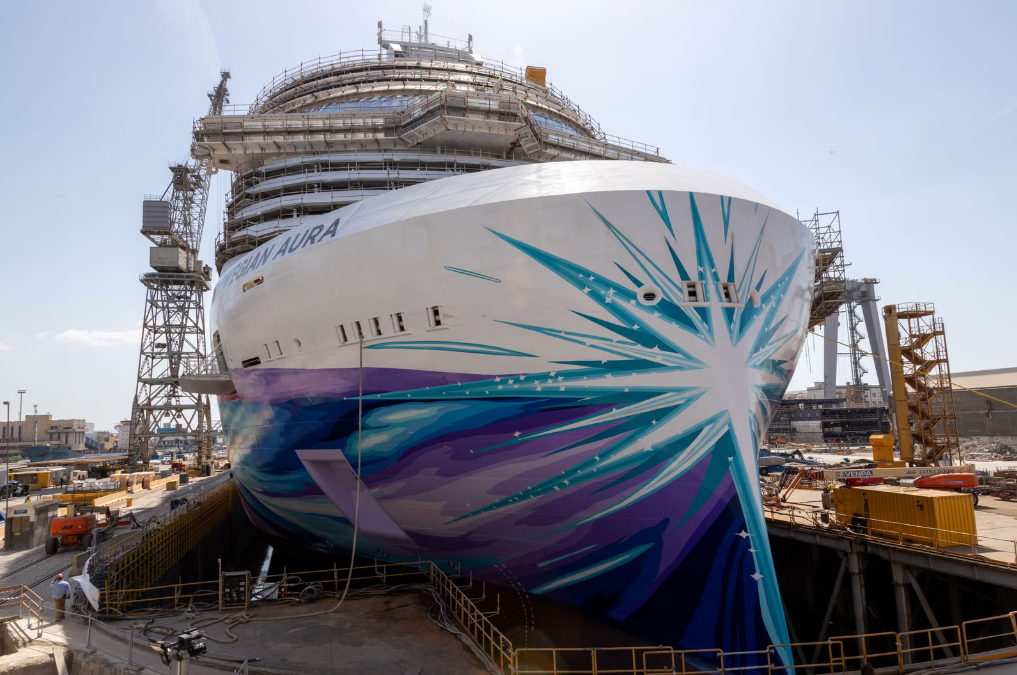
The launch ceremony, marking the transition to the final outfitting and interior finishing phase, was attended by Andrea Marongiu, Senior Director of Newbuilding Project Owner of NCL and Cristiano Bazzara, Director of the Monfalcone shipyard.
With a gross tonnage of approximately 170,000 tons and a length of 344 meters, “Norwegian Aura” is 10% larger than the previous Prima Plus Class vessels, “Norwegian Aqua” and “Norwegian Luna,” and the first NCL ship to be built at the Monfalcone shipyard. The ship features 1,976 cabins and can accommodate approximately 3,880 guests. Distinctive project elements include a large water park with the most slides of any NCL ship, a rope course, a vertical climbing wall, and the Ocean Boulevard, NCL’s 360-degree outdoor promenade.
The construction of “Norwegian Aura” is part of the established partnership between Fincantieri and Norwegian Cruise Line Holdings Ltd. (NCLH), further strengthened by a recent order of three additional cruise ships, one for each of the Company’s three brands, NCL, Oceania Cruises, and Regent Seven Seas Cruises, bringing the total number of vessels up to 16 with scheduled deliveries through 2037. This strategic collaboration has supported NCLH’s fleet development and evolution, contributing to the introduction of innovative design solutions and increasingly higher standards in terms of quality, efficiency, and onboard experience.
The Monfalcone shipyard confirms its status as a center of excellence for the construction of next-generation cruise ships. As the production heart of Fincantieri in this segment, it has delivered over 40 units and continues to build increasingly advanced vessels, thanks also to continuous infrastructure upgrades, with strong attention to safety and personnel well-being. Approximately 6,500 people work on site, within a supply chain generating over 23,000 total jobs.