


After securing orders to complete five idle offshore vessels that have remained unfinished for nearly a decade, Indian shipbuilder Swan Defence and Heavy Industries (SDHI) has landed a major contract to build four ammonia-dual-fuel bulk carriers—marking the first order for such vessels ever awarded to an Indian shipbuilder.
On April 7, SDHI announced on its official website that the shipbuilder had signed a contract with Energy ONE to build four 92,500 DWT ammonia-dual-fuel bulk carriers. The first vessel is expected to be delivered in October 2029, with subsequent vessels to be delivered every four months. The order is valued between 15.01 billion and 30 billion rupees (approximately 160 million to320 million), which translates to a construction cost per vessel ranging from 40 million to80 million.
These ammonia-dual-fuel bulk carriers will be designed by South Korea’s KMS-EMEC and built at SDHI’s Pipavav shipyard. The vessels will measure 229.5 meters in length and 37 meters in width, featuring ammonia-fueled propulsion systems and classified by Det Norske Veritas (DNV).
Notably, this batch of newbuilds represents the first ammonia-dual-fuel vessels constructed by Indian shipyards and is among the largest commercial vessels ever built by Indian shipbuilders, marking a significant step forward for India’s shipbuilding industry in terms of both technology and scale.
Energy ONE is the general partner of New Energy One (NEO), an investment fund registered in Jersey (Channel Islands, UK). NEO is dedicated to investing in green newbuild assets and plans to invest $2 billion in the zero-emission vessel sector to help industrial end-users and commodity producers reduce greenhouse gas (GHG) emissions.
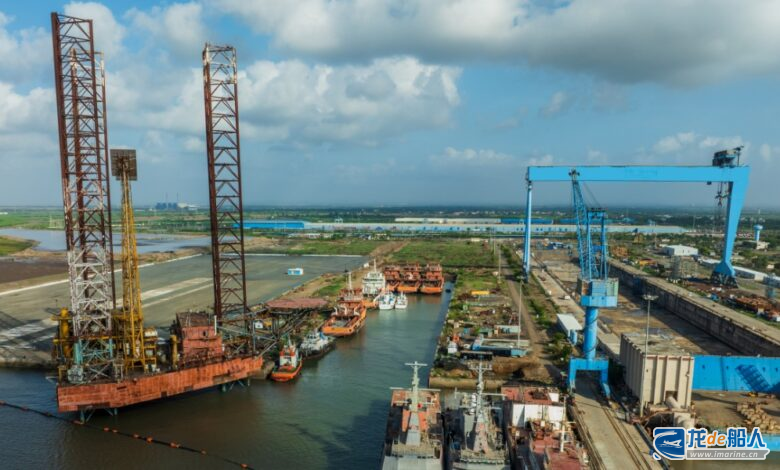
According to reports, SDHI—formerly known as Reliance Naval Engineering Limited (RNEL), which operated the Pipavav Shipyard—is a leading Indian shipbuilding and heavy equipment manufacturing company. It boasts India’s largest dry dock (662 meters × 65 meters) and one floating dock (340 meters × 60 meters), a site area of 2 million square meters, and a 1.2-kilometer-long waterfront, capable of constructing Very Large Crude Carriers (VLCCs) and offshore structures.
SDHI operates a dedicated offshore engineering dock capable of fabricating, installing, and loading heavy engineering modules such as large platforms and offshore structures. Having recently completed a $250 million refurbishment and upgrade project, the yard now possesses the capability to build large commercial vessels, with its current production capacity accounting for nearly 30% of India’s total capacity.
Currently, SDHI is actively pursuing new shipbuilding orders. In addition to the recently announced four 92,500 DWT ammonia-dual-fuel bulk carriers, the contract for 6+6 IMO II-class chemical tankers (18,000 DWT each) placed by Norwegian shipowner Rederiet Stenersen earlier this year has officially taken effect, with a total value of $227 million. This batch of chemical tankers marks the first major shipbuilding order secured by SDHI since taking over the Pipavav shipyard. The first vessel is scheduled for delivery by the fourth quarter of 2028, with subsequent vessels to be delivered at fixed intervals.
In addition to the newbuild project, SDHI has sold five “stalled” platform supply vessels (PSVs) to offshore vessel owner San Maritime India. The buyer acquired the vessels on an “as-is” basis and has signed a contract with SDHI to resume construction.
It is understood that the five PSVs SDHI is set to resume construction on are part of a series of offshore vessel orders secured during the RNEL era. The original owner was the Indian National Oil and Gas Company, with a total of 12 vessels in the series, each with a deadweight tonnage of approximately 2,500 tons and a total contract value of approximately $112 million.
This batch of PSVs was originally scheduled for full delivery by the end of 2011, with the first seven vessels completed and delivered before RNEL ran into financial difficulties. The subsequent five vessels were delayed due to the suspension of the shipyard’s operations; construction was halted entirely in 2017, eventually leading to the shipyard’s bankruptcy.