


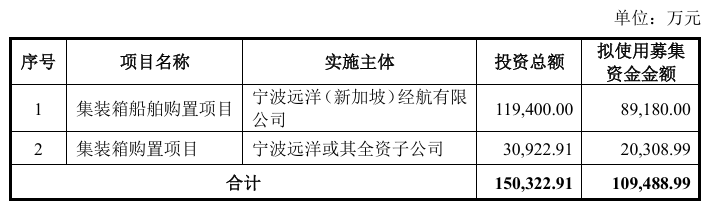
On the evening of April 2, Ningbo Ocean Shipping released the “2026 Plan for the Private Placement of A-Shares,” proposing to raise up to RMB 1.1 billion through a private placement to fund projects for the acquisition of container ships and containers. Of this amount, approximately RMB 892 million will be used to purchase four 2,700 TEU container ships, and approximately RMB 203 million will be used to purchase matching containers.
According to the disclosure, Ningbo Ocean Shipping plans to conduct a private placement of A-shares to its controlling shareholder, Ningbo Zhoushan Port, and strategic investor Beibu Gulf Port. Ningbo Zhoushan Port and Beibu Gulf Port will ubscribe to the shares on an equal basis in cash, each contributing approximately RMB 547 million to participate in the subscription. The proceeds will be used entirely for the expansion of the company’s core business, specifically for the purchase of four 2,700 TEU container ships and the corresponding containers. This move will not only significantly enhance the company’s transport capacity and optimize its fleet structure but will also create synergies with the introduction of the strategic investor.
Ningbo Ocean Shipping stated that the company currently owns 45 container ships, of which 39 are vessels with a capacity of less than 2,400 TEU, accounting for over 86% of the fleet. In recent years, with the development of the container shipping industry, the trend toward larger vessels has emerged as one of the key trends in the sector, as large ships offer lower unit transportation costs and are therefore more competitive in long-distance transport.
To align with these industry dynamics and its strategic development plans, the company aims to increase the proportion of larger vessels in its fleet. Through the implementation of this fundraising project, the company plans to acquire four 2,700 TEU container ships to meet its future container shipping capacity requirements, increase the proportion of large container ships in its fleet, optimize the mix of vessel types, and satisfy the diverse freight needs of various customers.