


Da Qing 268, China’s first dual-fuel methanol-powered bunkering vessel managed by Wah Kwong Ship Management (Shenzhen) Limited, has completed Hong Kong’s first green methanol bunkering operation on 5 March, according to Hong Kong Maritime Hub.
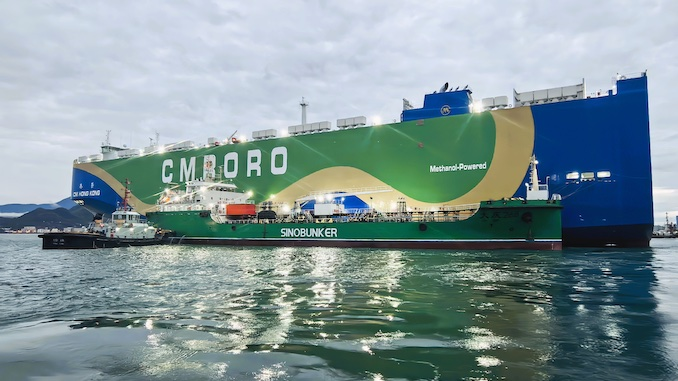
Carried out via a ship-to-ship transfer, the operation bunkered 500 tonnes of green methanol to CM Hong Kong, the world’s first methanol dual-fuel Ro-Ro vessel. The landmark delivery confirms Hong Kong’s capability to support green methanol bunkering and marks the city’s entry into a new phase of sustainable marine fuel supply.
A ceremony was held in Hong Kong the same day, with representatives from key government and industry bodies and over 100 guests from the shipping, energy, equipment manufacturing, finance and maritime sectors.
As ship manager of Da Qing 268, the Wah Kwong Ship Management team provided operational assurance throughout the process. From performance optimisation during the shipbuilding phase, the team oversaw the vessel’s first green methanol bunkering in Shenzhen in January, followed by multi-port cargo operations in Zhanjiang and Dongguan, Guangdong province, and the preparatory work for this mission. Strict controls were maintained throughout, covering cargo management, bunkering system performance and operational risk assessment.
The green methanol was supplied by CIMC Enric, delivered via Sinopec (Hong Kong)’s bunkering service network, and used by China Merchants as the shipowner. The operation demonstrated a complete value chain for green methanol—production, storage, transportation, bunkering and end use.
In addition to the 7,500 dwt Da Qing 268, Wah Kwong manages three other bunkering vessels, including Hai Gang Zhi Yuan, China’s first methanol bunkering vessel.
The successful bunkering is a further step towards strengthening Hong Kong’s position as a green marine fuel bunkering hub, showing that green methanol bunkering is both technically feasible and commercially viable in the city. Under Hong Kong’s Action Plan on Green Maritime Fuel Bunkering, the share of green fuel used by Hong Kong-registered vessels is targeted to reach 7% by 2030, alongside continued reductions in carbon emissions from port operations.