


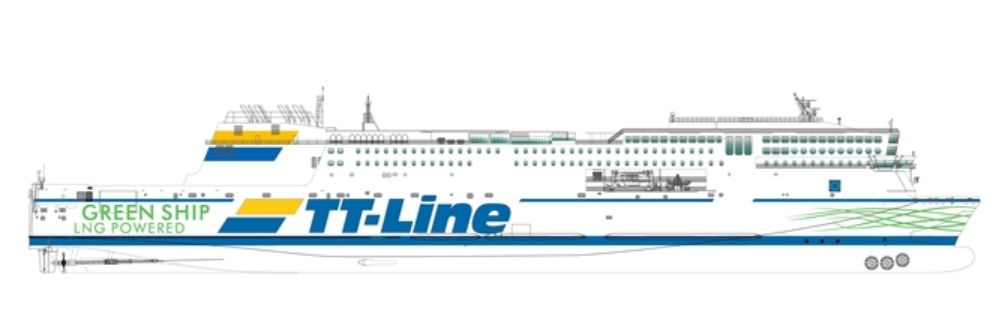
On February 11, Pino Spadafora, Vice President of Market Development at the classification society RINA, announced on social media that German ferry operator TT-Line had signed a contract with China Merchants Shipbuilding Industry Nanjing Jinling for the construction of a new generation of LNG hybrid RoPax ship.
The vessel will be classified by RINA, marking a new step forward in the long-term, mutually trusting partnership between TT-Line and RINA.
As previously reported, in December 2025, TT-Line signed a contract with China Merchants Shipbuilding Industry Nanjing Jinling for the construction of 1+1 new passenger ro-ro ships. This new contract signifies that the order for another option vessel has been officially finalized.
The new RoPax ship will continue the design concept of TT-Line’s previous liquefied natural gas (LNG) powered RoPax ships, the “Nils Holgersson” and the “Peter Pan”. The vessel will feature comprehensive upgrades in core performance and parameters, is approximately 240 meters long, and can carry 1,000 passengers. It will be equipped with environmentally friendly technologies such as an LNG hybrid propulsion system and shore power charging battery solutions, helping TT-Line achieve its local emissions reduction targets during ferry operations.
With its advanced LNG hybrid propulsion system, Bio-LNG capability, and shore power battery modules, the vessel solidifies TT-Line’s leading position in zero-emission and low-carbon ferry operations in the Baltic Sea.
In addition to innovations in the propulsion system, the project also introduces a more comfortable passenger experience, a brand-new cabin design concept, and more spacious outdoor areas, perfectly combining environmental performance with an excellent customer experience.
The collaboration between TT-Line and China Merchants Shipbuilding Industry Nanjing Jinling ensures that the project has a strong industrial and engineering foundation. The partnership began in 2018 when TT-Line launched its shipbuilding program outside of Europe for the first time, opening a new chapter in global cooperation.