


HD Korea Shipbuilding & Offshore Engineering (HD KSOE), the intermediate holding company for HD Hyundai Group’s shipbuilding business, plans to expand the production capacity of its shipyards in Vietnam and the Philippines. This move aims to leverage the cost advantages of Southeast Asian shipyards to secure more orders for low-value-added vessels such as bulk carriers and tankers—vessels previously “abandoned” by Korean shipbuilder—in order to counter the strong competitiveness of Chinese shipbuilder in the relevant vessel markets.
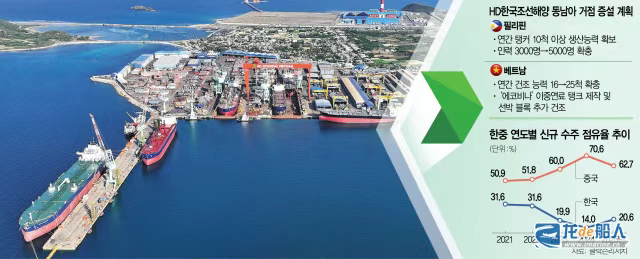
HD KSOE’s latest investment in Southeast Asia is through a recently established Singaporean subsidiary. Following the decision to merge HD Hyundai Heavy Industries and HD Hyundai Mipo, HD KSOE decided to establish the Singaporean investment subsidiary to coordinate its Southeast Asian business management. After completing registration in December 2025, the subsidiary is currently actively leading its Southeast Asian investments with a registered capital of 800 billion Korean won (approximately US$554 million).
Recently, HD KSOE unveiled a detailed plan at a management briefing for institutional investors to expand production capacity at its Vietnam and Philippines shipyards, with its Singapore subsidiary serving as the core entity.
Regarding Subic Shipyard in the Philippines, after successfully building and delivering the 115,000 DWT LR2 product tanker that began construction in September 2025, the shipyard will officially start undertaking orders, with the first batch of vessels expected to enter the dry dock in February or March 2026.
In the future, Subic Shipyard in the Philippines will expand its order intake and production capacity of 115,000 DWT LR2 product tankers to 10 vessels, and increase its workforce from 3,000 to 5,000. It also plans to expand its shipyard for the construction of military or civilian vessels.
Regarding shipyards in Vietnam, HD KSOE plans to significantly increase the annual production capacity of HD Hyundai Vietnam Shipbuilding from the current 16 vessels to 25 vessels. This capacity expansion aims to address the evolving market environment and shift its product mix from focusing on bulk carriers and oil tankers to a broader range of general commercial vessels.
It is noteworthy that while the industry had previously anticipated HD Hyundai Vietnam Shipbuilding’s capacity expansion to be around 20 vessels, HD KSOE plans to expand further at a scale exceeding expectations.
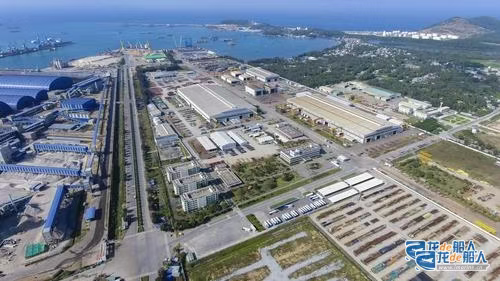
In Vietnam, in addition to the already well-established HD Hyundai Vietnam Shipbuilding, Doosan Vietnam (now renamed HD Hyundai EcoVina), which HD KSOE acquired from Doosan Energy for 290 billion won by the end of 2025, will provide supporting facilities for the Vietnam shipbuilding base.
Established in 2006, Doosan Vina covers an area of 110 hectares and primarily manufactures boilers, process equipment, port cranes, and liquefied natural gas (LNG) plant modules. Contrary to initial expectations that the acquisition would only involve supplying cranes, fuel tanks, and other equipment through this company, HD KSOE plans to invest further to enable it to build blocks, thus fully supporting its Southeast Asian shipbuilding base.
South Korean industry analysts note that HD KSOE’s large-scale investment in Southeast Asian shipbuilding bases is primarily aimed at actively countering the low-cost offensive from Chinese shipyards through a dual-track production system spanning domestic and overseas operations.
Currently, while South Korea’s shipbuilding industry holds a dominant position in the high-value-added vessel market, such as LNG carriers, Chinese shipyards possess core advantages and command the vast majority of market share in the broader commercial vessel market, including tankers, bulk carriers, and container vessels.
In light of this, South Korean shipbuilders are taking a two-pronged approach to secure more new ship orders: their domestic shipyards, equipped with the latest shipbuilding equipment, are focusing on building high-value-added vessels such as LNG carriers and gas carriers; while their Southeast Asian shipbuilding bases, where labor costs are lower, are actively undertaking low-value-added vessels such as bulk carriers, in order to narrow the overall market share gap with Chinese shipyards.