


According to a report by the international maritime media outlet gCaptain, the U.S. Coast Guard recently awarded an order to a Finnish shipyard for two polar-class icebreakers. This move not only breaks with the Coast Guard precedent by signing a shipbuilding contract with a foreign shipyard, but also starkly reveals that decades of neglect of the U.S. shipbuilding industry have rendered it incapable of building the specialized vessels it urgently needs.
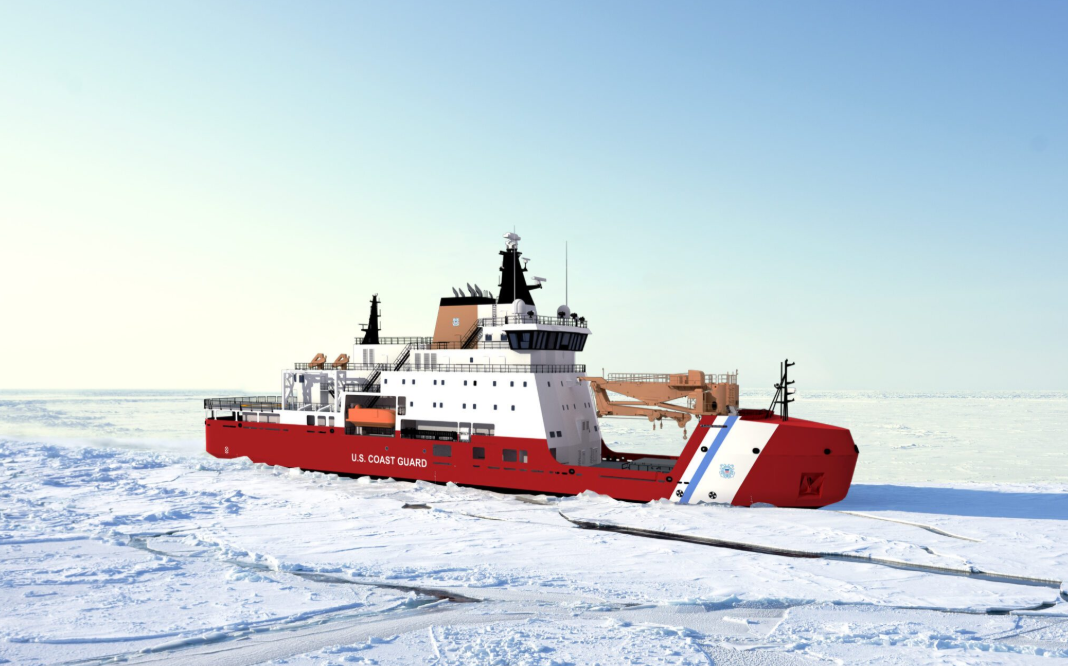
By the end of 2025, the U.S. Coast Guard awarded contracts for six new polar-class icebreakers to Finnish shipbuilder Rauma Marine Constructions (2 vessels) and Bollinger Shipyards, the largest private shipbuilder in the United States (4 vessels) . The Finnish yard will deliver the first vessel in 2028. The U.S. yard will build four vessels domestically using a Finnish-Canadian joint design concept, Finnish shipbuilding technology, and full-process guidance, with the first vessel scheduled for delivery in 2029.
This unprecedented cooperative model has laid bare the backward state of the U.S. shipbuilding industry. Previously, U.S. law mandated that vessels for the U.S. Coast Guard must be constructed by domestic shipyards. However, President Trump personally waived this requirement on national security grounds. The root cause lies in America’s fundamental lack of experience in rapidly designing and building modern icebreakers.
In recent years, the lack of experience in building large icebreakers by U.S. shipyards has become glaringly obvious. The U.S. Government Accountability Office (GAO) stated in its report on the “Polar Safety Icebreaker Project” that “in the past 50 years, no U.S. shipyard has ever built a similar polar safety icebreaker.”
The U.S.’s shipbuilding shortcomings are hard to hide.
Currently, the U.S. Coast Guard operates only three icebreakers capable of Arctic navigation. In contrast, Russia possesses 40 to 50 vessels, including eight giant nuclear-powered icebreakers. China currently has four to five polar research vessels actively operating in Arctic waters, with additional vessels of the same class under construction.
As the sole heavy-duty icebreaker in the U.S., the Polar Star has been in service for 49 years—far exceeding its 18-year design lifespan—with its operational status barely maintained through continuous emergency repairs. The Healy, which had served for 25 years, suffered a fire during a 2024 mission, forcing the termination of its operational deployment. The newest addition to the fleet, the Storis, was converted from a commercial oil rig support vessel to address the U.S. Coast Guard’s urgent need for a polar icebreaker.
The Arctic has long become a frontline security battleground for major powers, yet the U.S. polar fleet can only respond to challenges with this limited scale. What’s more, the progress of America’s domestic heavy icebreaker program is even more disheartening.
The first U.S. polar security icebreaker, constructed by Bollinger Shipyards, was originally scheduled for commissioning in 2024 but has now been delayed until at least 2030—a six-year setback. Regarding costs, the contract signed in 2019 valued the project at $746 million. Currently, the first vessel alone is estimated to cost $1.9 billion, with the total cost for all three vessels projected to exceed $5 billion.
Since the contract was signed in 2019, the U.S.’s first polar security icebreaker has undergone five years of development, yet its hull design is only 67% complete, with formal construction not even commenced. Relevant congressional committees have held multiple hearings to hold those responsible accountable, demanding explanations from the project team regarding the situation where “the project has been approved for six years, yet the final design remains undetermined.”
Finnish shipyard becomes top choice in the U.S. through technological prowess.
As progress on building U.S. polar security icebreakers stalls, Finnish shipyards—which have constructed the majority of the world’s modern icebreaker fleets—have emerged as potential partners for the United States.
In the icebreaker construction market, Finland possesses abundant icebreaker construction technology due to its geographical location. For example, the hulls of the Russian shallow-draft nuclear-powered icebreakers “Taymyr” and “Vaygach” were built by Finnish shipyards, and the reactors were then installed in Russia; the Chinese research vessel “Xuelong 2” was jointly designed by Aker Arctic Technology of Finland and Marine Design and Research Institute of China (MARIC) of China State Shipbuilding Corporation.
Rauma Marine Constructions, which secured orders for two new vessels, sits at the heart of a mature Arctic technology cluster and possesses decades of experience in constructing specialized vessels. The shipyard can deliver a medium-sized icebreaker within 36 months of contract signing—roughly half the estimated construction time for U.S.-based shipyards.
Not only that, but the design for the U.S. Coast Guard’s six polar security icebreakers was originally entrusted to a consortium involving Rauma Marine Constructions and Bollinger Shipyards.
This consortium also includes Canada’s Seaspan Shipyards and Finland’s Aker Arctic Technology, and will utilize a proven multi-purpose icebreaker design jointly developed by Seaspan Shipyards and Aker Arctic Technology. Therefore, this is an existing, production-ready design, rather than a project requiring U.S. shipyards to develop from scratch.
The unexpected contract award to the U.S. Coast Guard reflects both the decline of the American shipbuilding industry and a major victory for Finland’s industrial sector. Through this icebreaker order, Rauma Marine Constructions has secured not only a high-profile client but also long-term design support revenue. Finnish officials hailed the move as a “historic milestone” that will solidify Finland’s position within NATO’s Arctic strategy.
For the U.S. shipbuilding industry, awarding major shipbuilding contracts to overseas yards is an embarrassing yet unavoidable reality: decades of neglecting investment in shipbuilding development have inevitably come at a cost. Currently, U.S. merchant shipbuilding capacity accounts for only 0.1%-0.13% of the global total, with costs 3-4 times higher than East Asian shipyards. At a time when specialized naval vessel construction capabilities are urgently needed, the United States has no choice but to seek assistance from overseas shipyards.