


The LNG dual-fuel ferry “MV Glen Rosa”, which was originally scheduled to be “basically completed” in the first quarter of 2026 and to be finally accepted and delivered in the second quarter, has once again announced a delay in delivery.
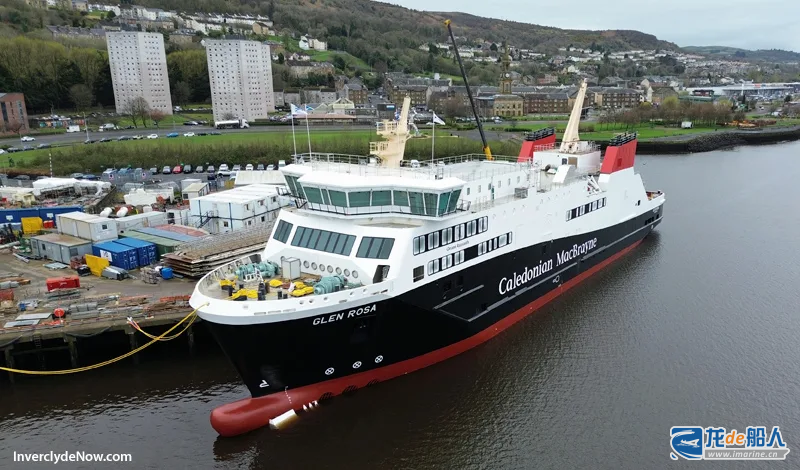
The delivery date for the LNG dual-fuel ferry “MV Glen Rosa,” built by Ferguson Shipyard, a subsidiary of the British state-owned shipbuilding company Ferguson Marine, has been delayed again. The latest confirmed delivery date is the fourth quarter of 2026, about six months later than the previously announced delivery date.
The MV Glen Rosa was ordered by CalMac, the Scottish archipelago ferry operator, in 2015 and was originally scheduled for delivery in July 2018. The first vessel in the same order, the MV Glen Sannox, was delivered in November 2024, marking a seven-year delay from its original delivery date.
Regarding the reason for the further delay in delivery, the report states that during the first dry-dock overhaul in August 2025, Ferguson shipyard discovered corrosion on the stern tube of the “MV Glen Rosa”, and the hull coating also showed signs of aging and peeling. To carry out the necessary repairs, the vessel needs to undergo a second dry-dock overhaul, and the earliest scheduled dry-dock overhaul time is the second half of 2026, meaning the delivery date will be postponed to the fourth quarter of 2026.
In response, Ferguson Marine CEO Graeme Thomson stated, “We deeply regrets the further delay in the delivery of the ‘MV Glen Rosa’ and fully recognizes the disruption caused. We extend our sincere apologies to all affected parties, especially the island communities that have patiently awaited the vessel’s commissioning. This vessel is always a complex undertaking, but we will fully committed to advancing the delivery process and will provide maximum transparency in disclosing current progress.”
Ferguson Marine also pointed out that some of the challenges encountered during the construction of the “MV Glen Rosa” were due to several operational aspects that urgently needed improvement. Currently, Ferguson shipyard has taken a number of measures to address the relevant operational issues and improve operational efficiency, including upgrading equipment, optimizing processes, and addressing the negative impact of insufficient investment.
Public records indicate that Ferguson Shipyard was established in 1903 with a 120-year history of development. It has built and delivered over 380 vessels. Including apprentices, the shipyard currently employs only 300 workers.
Successfully delivering the “MV Glen Rosa” is Ferguson Marine’s most important shipbuilding task at this stage. To expedite delivery, Ferguson Marine is addressing capacity gaps through strategic recruitment, optimizing its organizational structure, comprehensively reforming its planning and delivery functions, establishing a rigorous risk management system and improving reporting mechanisms, while also focusing on developing skills in key areas.
Additionally, Ferguson Shipyard will actively pursue new orders to mitigate the impending “zero-order backlog” situation after 2026, thereby supporting the company’s long-term sustainable development.
In an effort to save the century-old shipyard, multiple parties in the UK have called for “direct order placement at Ferguson” to help restore its reputation—specifically, the severe delays and massive cost overruns of the two dual-fuel ferries mentioned above. The local government has also pledged funding to install modern equipment such as new cutting machines and semi-automated panel production lines to improve shipbuilding efficiency.
However, the availability of local government funding hinges on Ferguson shipyard’s ability to However, the local government’s funding is based on the premise that Ferguson Shipbuilders can secure new orders. The extremely awkward situation is that if government funding is not provided, the shipyard lacks the capacity to take on new orders. Therefore, the shipyard is caught in a dilemma, with only 4% of the promised £14.2 million investment, or approximately £570,000, having been received.