

Recently, a replenishment ship built by the German shipyard Meyer Werft for the German Navy was successfully launched. The project was jointly undertaken by Neptun Werft and Papenburg shipyard, with the former typically responsible for building modules such as cruise ship engines and inland waterway cruise vessels.
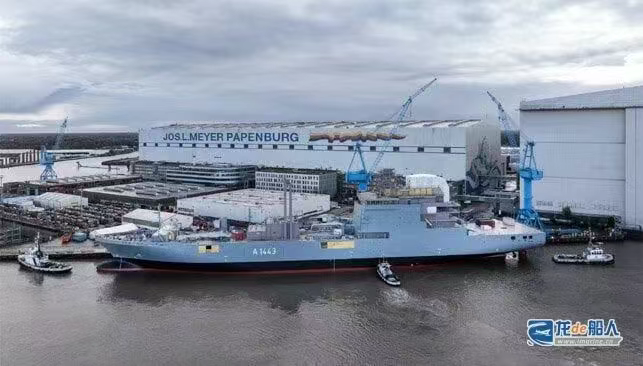
This replenishment ship measures 173 meters in length and is one of two identical vessels constructed through a collaboration between Meyer Werft and German naval shipbuilder Naval Vessels Lürssen (NVL). In mid-2021, the German government awarded the contract to prime contractor NVL, with Meyer Werft participating in the cooperative construction effort.
As the prime contractor, NVL is responsible for the ship platform’s military-specific components and combat systems, as well as a wide range of associated services to achieve operational readiness. Meyer Werft is responsible for the construction, sea trials, and delivery commissioning of both ships.
The first ship of the two replenishment ships began construction in June 2023, with its keel laid in August of the same year; the second ship began construction in February 2024, with the keel laid in April of the same year. Papenburg Shipyard is responsible for constructing hull sections including the superstructure and replenishment systems, which are then transported to Neptun Shipyard for final assembly. Upon delivery, these ships will replace the Ron-class replenishment ships commissioned in 1977.
This replenishment ship has a full load displacement of 20,000 tons and features a catamaran hull design capable of storing 13,000 cubic meters of diesel fuel. Its design enables simultaneous replenishment operations on both sides, allowing it to support two to three naval vessels at once. Another distinctive feature is its extensive modular container stowage capacity for transporting food and spare parts. It incorporates emergency support capabilities, with a direct passageway connecting the flight deck to the medical facility to facilitate lifesaving and rescue operations.
It is worth noting that Meyer Werft is renowned for constructing large cruise ships. The replenishment ship launched this time represents an order secured by the shipyard following the global pandemic, aimed at utilizing part of the shipyard’s idle capacity.
In recent years, Meyer Werft’s development has actually been rather challenging. While it currently maintains cruise ship orders secured before the pandemic, the company has been forced to slow down shipbuilding progress and adjust the timelines for some projects.
In March 2021, Meyer Werft secured its first post-pandemic order for a small cruise ship from Nippon Yusen Kaisha (NYK), though the outlook for the cruise industry remained uncertain at the time. It wasn’t until 2024 that the shipyard received multiple cruise ship orders, further expanding its order book.
Orders secured after 2024 include: two LNG dual-fuel cruise ships for Carnival Corporation; one Disney Wish-class cruise ship for Japan’s Oriental Land Company; four cruise ships for Disney Cruise Line; and river cruise vessels for Viking Cruises. Disney Cruise Line’s 2024 shipbuilding contract is reportedly “the most valuable order in Meyer Werft’s history.”
However, despite having a full order book at the Meyer Werft, the company still requires government support to maintain financial solvency, and the abundance of orders is one of the primary reasons for its cash shortage.
Typically, cruise ship owners pay only a 20% advance payment when ordering new vessels, with the remaining 80% of construction costs settled upon delivery. This means Meyer Werft must maintain sufficient capital reserves to cover upfront shipbuilding expenses. Consequently, the shipyard has faced severe financial difficulties in recent years, teetering on the brink of bankruptcy.
In order to save Meyer Werft, the German government proposed a rescue plan in September. The German federal government and the Lower Saxony state government, where Meyer Werft is located, jointly invested 400 million euros to acquire 80.8% of the shares of Meyer Werft, with the federal government and state government each investing approximately 200 million euros. In addition, Meyer Werft will also receive a loan guarantee worth 2 billion euros.
This also means that after the equity transaction is completed, Meyer Werft will become a German state-controlled enterprise. However, it is said that the validity period of the government guarantee is 2027, and the Meyer family has the right to repurchase shares before 2028. Subsequently, Meyer Werft announced that it had reached all necessary agreements with the government and banks and successfully survived the bankruptcy crisis.
As of now, Meyer Shipyard’s order book includes 10 cruise ships, 1 research vessel and 4 offshore conversion platform contracts, with a total value of 11 billion euros, and its delivery schedule has been scheduled until 2031.