


On December 3, *ST Songfa, the listed entity of Hengli Heavy Industries, issued an announcement stating that the construction contract for one Capesize bulk carrier of its subsidiary Hengli Shipbuilding (Dalian) Co., Ltd. (“Hengli Shipbuilding”) was recently signed and came into effect. The contract amount is approximately US$0.7-1 billion and is expected to be delivered in the fourth quarter of 2027.
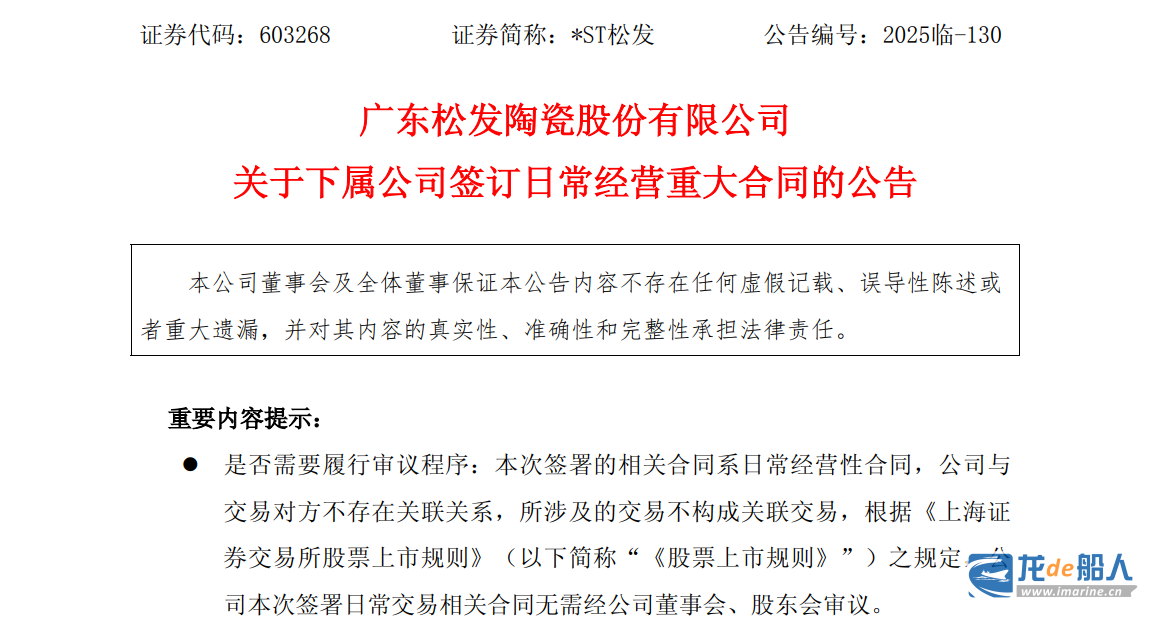
According to the announcement, the Capesize bulk carrier being acquired represent the core vessel type in the international dry bulk shipping market, offering significant economies of scale (180,000 DWT per vessel), robust endurance, and superior economic efficiency.
The vessel’s design deeply integrates route versatility with cargo adaptability, enabling efficient compatibility with loading/unloading facilities at major global bulk commodity ports. It fully meets transoceanic trunk line transportation demands for dry bulk cargoes such as iron ore and coal, serving as a benchmark vessel aligning with the global trend toward larger and greener bulk carrier fleets.
The successful signing and construction of this project fully demonstrates Hengli Shipbuilding’s mature technology and market competitiveness in the design and construction of mainstream large bulk carriers.
Prior to the announcement of this bulk carrier order, Hengli Heavy Industries also announced that it had signed effective contracts with Greek shipping giants MINERVA and LASKARIDIS for the construction of multiple LRII product tankers. By securing orders from the two Greek giants in one go, Hengli Heavy Industries has made another breakthrough in the high-end liquid cargo vessel market.
The LRII vessel, serving as the mainstay ship type in the international refined oil transportation market, boasts advantages such as large cargo capacity, strong port adaptability, and high operational efficiency. It is widely deployed on major routes including the Middle East, Europe, and the Asia-Pacific region. The LRII vessels contracted by Hengli Heavy Industries incorporate the latest green and eco-friendly design concepts to meet IMO Tier I emission standards. They combine low energy consumption, high safety, and excellent operational performance, aligning with the global shipping industry’s green transition trend.