


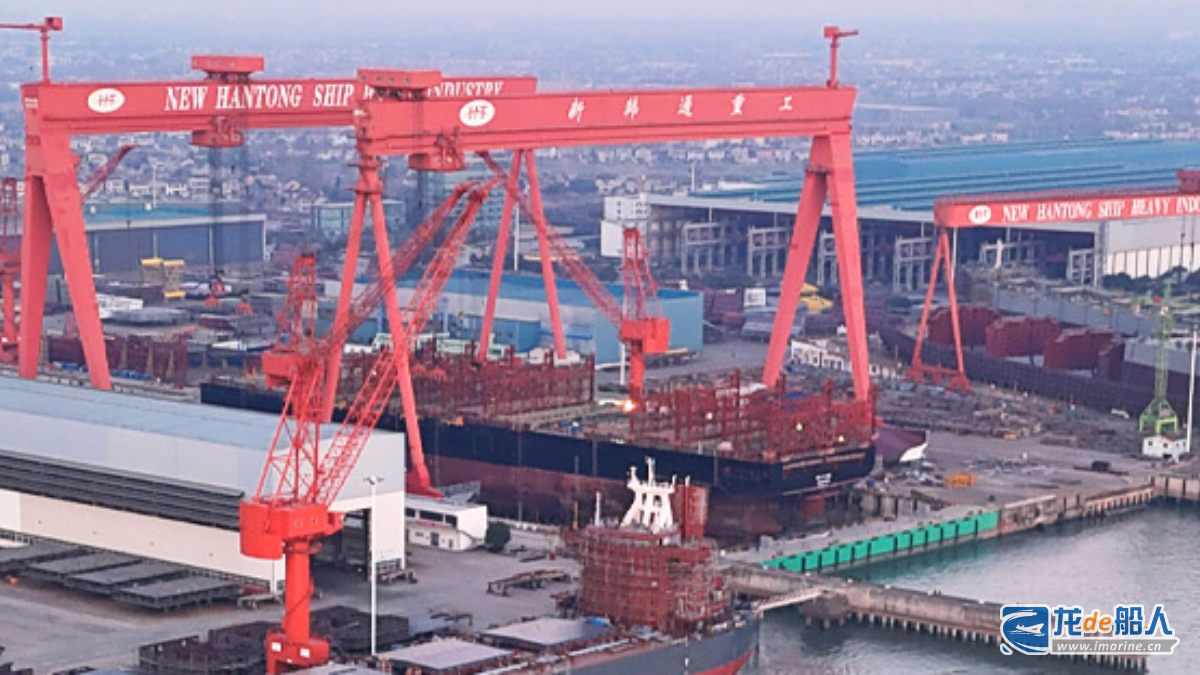
On November 29, Jiangsu Hantong Ship Heavy Industry Co., Ltd.(HT) announced that it had signed contracts for 19 new vessels of four types in November, covering VLCCs, Newcastlemax/Kamsarmax bulk carriers, and medium-sized container ships. However, the shipbuilder did not disclose specific shipowner information or the order size for each type of vessel, only revealing that the shipowners are from countries such as the United Kingdom, Japan, and Germany.
According to foreign media reports, the order of Jiangsu Hantong Ship Heavy Industry’s VLCCs in November came from British shipowner Zodiac Maritime.
With the announcement of Zodiac Maritime’s newbuilding project, Jiangsu Hantong Ship Heavy Industry has disclosed the ownership information of 13 VLCCs to date, with the remainder coming from Trafigura (10 vessels) and Switzerland’s Advantage Tankers (1 vessel).
This is reportedly the first collaboration between Jiangsu Hantong Ship Heavy Industry and Zodiac Maritime. Including these two VLCCs, the shipowner has publicly announced three shipbuilding contracts this year; the others are five 6000TEU container ships forChina Merchants Jinling Shipyard (Nanjing) and three 157,000 DWT Suezmax tankers for Samsung Heavy Industries. Samsung Heavy Industries’ order has been outsourced to Vietnam’s PVSM shipyard.
Zodiac Maritime, founded in 1976 and headquartered in London, operates a diversified fleet with a deadweight tonnage of over 20 million tons, encompassing container ships, bulk carriers, car carriers, tankers and liquefied petroleum gas carriers.
Since this summer, the VLCC sector has seen a renewed surge in new vessel orders. In recent weeks, Maran Tankers, Ray Car Carriers, and Eastern Pacific Shipping (EPS) have all placed orders for VLCCs, involving multiple shipyards in China and South Korea.
A recent Drewry report shows that soaring freight rates have triggered a surge in VLCC orders, with 27 vessels ordered so far in November. Statistics show that VLCC contracts signed from January to November this year totaled 58 vessels, compared to 68 vessels in the same period of 2024.