


Global Car Carriers (GCC)—a Norwegian car carrier owner affiliated with the world’s largest shipowner, Mediterranean Shipping Company (MSC)—has expanded its orderbook for Pure Car and Truck Carriers (PCTCs) to 20 vessels, all of which have been placed with Chinese shipyards.
According to the company’s fleet list, GCC has ordered an additional eight 8,600-CEU (Car Equivalent Unit) PCTCs. This brings its total orderbook to 20 vessels—comprising sixteen 8,600-CEU and four 7,000-CEU PCTCs—all featuring LNG dual-fuel designs. Scheduled for delivery between 2028 and 2030, the total investment exceeds US$2 billion.
This batch of new vessels has been contracted to four Chinese shipyards: China Merchants Industry Weihai Shipyard (six 8,600 CEU PCTCs and two 7,000 CEU PCTCs, scheduled for delivery between 2028 and 2030); China Merchants Jinling Shipyard (six 8,600 CEU PCTCs, scheduled for 2028–2029); Guangzhou Shipyard International (two 8,600CEU PCTCs and two 7,000 CEU PCTCs, scheduled for 2028–2029); and Mawei Shipyard (two 8,600CEU PCTCs, scheduled for 2030).
As early as July 2026, Global Car Carriers announced orders for an initial batch of 12 new vessels, comprising two 7,000 CEU PCTCs and two 8,600 CEU PCTCs from China Merchants Industry Weihai Shipyard; six 8,600 CEU PCTCs from China Merchants Jinling Shipyard; and two 7,000 CEU PCTCs from Guangzhou Shipyard International (GSI).
A comparison shows that the eight newly added vessels include: two 8,600 CEU PCTCs built by Mawei Shipyard, four 8,600 CEU PCTCs built by China Merchants Industry Weihai Shipyard, and two 8,600 CEU PCTCs built by Guangzhou Shipyard International.
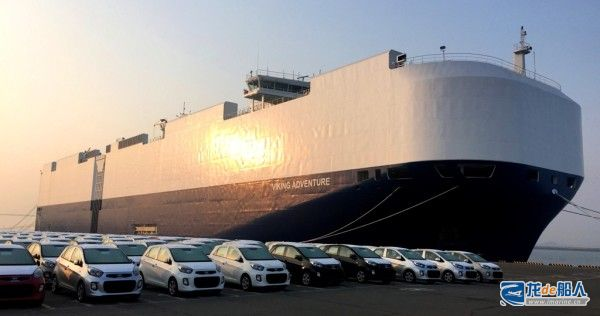
According to reports, both the 8,600 CEU PCTC and the 7,000 CEU PCTC were designed by the Shanghai Ship Research and Design Institute (SDARI).
The 8,600 CEU vessel is SDARI’s second-generation LNG/battery hybrid PCTC. With a length of 199.95 meters and a beam of 38 meters, it is equipped with an Everllence B&W 6S60ME-C10.7-GI-EcoEGR dual-fuel main engine and a 500 kWh energy storage battery. The vessel includes provisions for future conversion to ammonia fuel and meets NOx Tier III emission standards and EEDI Phase 3 energy efficiency requirements. The vessel is also equipped with an 11 kV high-voltage shore power system to enable zero emissions in port. This vessel type has been specifically optimized for electric vehicles and hydrogen-fueled vehicles, enhancing both transport safety and loading efficiency.
The 7,000 CEU vessel is an energy-efficient, LNG-dual-fuel ocean-going PCTC developed and designed by SDARI, with a total length of 199.9 meters and a beam of 38 meters. The vessel is equipped with an Everllence B&W 6S60ME-C10.5-GI-EcoEGR dual-fuel main engine, which meets NOx Tier III environmental standards in both gas and oil modes; It features an S-shaped bulbous bow to optimize energy efficiency and is equipped with a shore power connection to enable zero emissions in port. This vessel design also includes four heavy-load decks and four elevating car decks, allowing for flexible loading of both heavy-duty vehicles and standard passenger cars.
According to information on its official website, Global Car Carriers is the world’s third-largest owner of car carriers and currently operates 21 PCTCs, with capacities ranging from 2,000 CEU to 7,000 CEU. Global Car Carriers, formerly known as Gram Car Carriers, was acquired by Mediterranean Shipping Company in 2024 for $700 million and subsequently renamed (though its abbreviation remains unchanged).
In addition to Global Car Carriers, other car carrier owners recently placing bulk orders with Chinese shipyards include Norway’s Höegh Autoliners and Israel’s Ray Car Carriers; these orders involve 9,100-CEU “Aurora-class” vessels (6 firm + 4 + 4 options) at China Merchants Heavy Industry (Jiangsu) and 8,200-CEU vessels (10 firm + 4 options) at Guangzhou Shipyard International, respectively. Notably, Höegh Autoliners’ order with GSI marks the first time the owner has placed an order with a Chinese shipyard, breaking a twenty-year practice of building exclusively with South Korea’s Hyundai Heavy Industries.
Overall, driven by growing demand for Chinese auto exports, the car carrier market has heated up significantly this year. According to Clarksons data, global shipowners have placed orders for more than 70 new vessels this year, compared to fewer than 10 for the entire year of 2025. Nearly all of the new vessels announced this year have been built by Chinese shipyards.
Overall, driven by growing demand for Chinese auto exports, the car carrier market has heated up significantly this year. According to Clarksons data, global shipowners have placed orders for more than 70 new vessels this year, compared to fewer than 10 for the entire year of 2025. Nearly all of the new vessels announced this year have been built by Chinese shipyards.