


Good news has arrived from the Port of Santa Cruz de Tenerife, Spain: the bulk carrier “Ocean Crown” has entered a 22,000 floating dry dock—constructed by China’s Huarun Dadong Dockyard —marking the successful completion of the facility’s first docking operation. This milestone signifies that the large-scale floating dry dock is now officially in operation, filling a gap in the Canary Islands’ capacity for dry-dock repairs on Panamax-sized vessels.
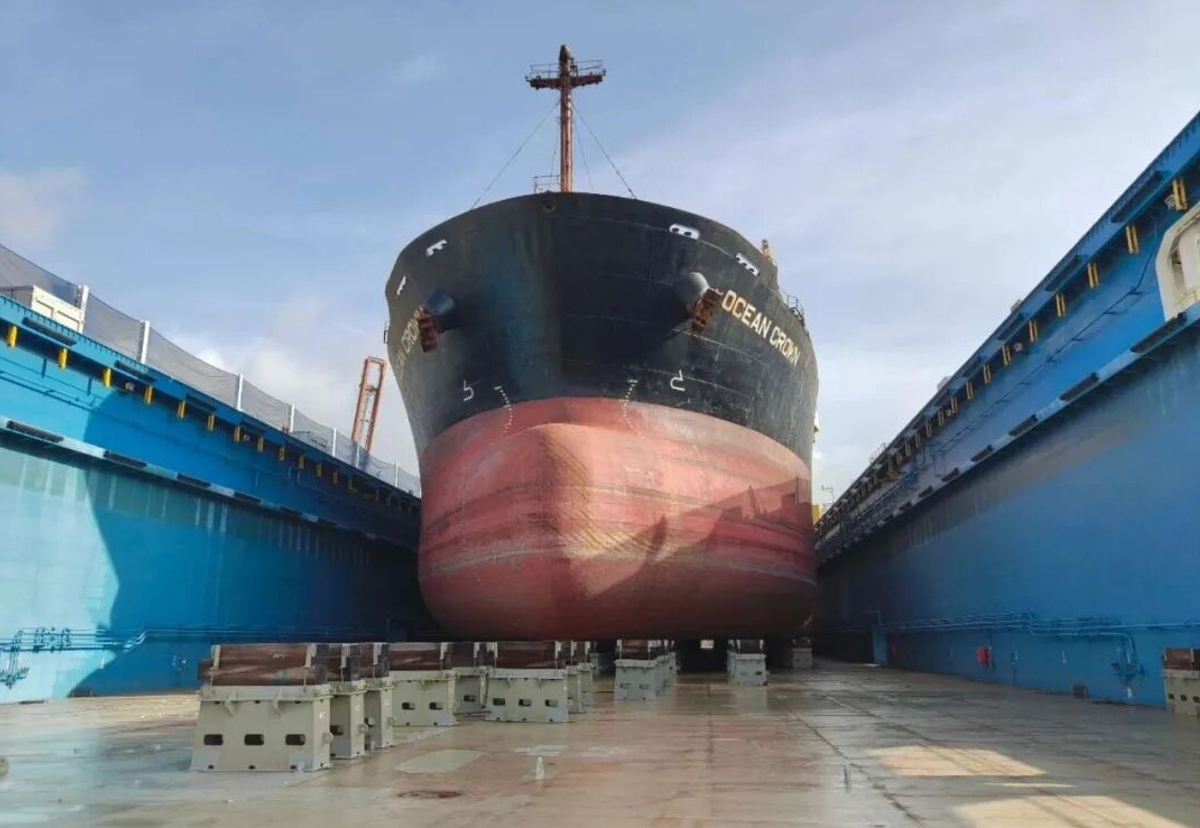
The floating drydock, named Hidramar Ultra, has a total length of 240 meters, a width of 48 meters, a pontoon height of 4.7 meters, and a lifting capacity of 22,000 tons. Classified by LR, it is capable of performing drydock repairs on mainstream vessel types such as Panamax bulk carriers, container ships, and small- to medium-sized oil tankers, and serves as a core piece of equipment at the Tenerife Shipyard.
On November 14, 2024, a contract for the construction of a 22,000-ton lifting capacity floating dry dock, signed between the Spanish Hidramar Group and China’s Huarun Dadong Dockyard, officially came into effect. Construction of the floating dry dock project commenced on January 22, 2025. Subsequent milestones included: the start of assembly in the dry dock on August 10; the completion of the pontoon hull structure on August 13; the formation of the main dock-wall structure on August 16; the full completion of the main hull on August 20; the successful conclusion of all structural and compartment tightness tests on August 29; and the completion of underwater works and external hull coating on September 4. A naming ceremony was held on November 26. By December 30, the integration of the floating dry dock’s main structure and core equipment had reached a critical functional milestone, establishing the facility’s essential operational capabilities.
The initial real-world docking operation of the vessel “Ocean Crown” demonstrated that the entire submerging, lifting, and raising process proceeded smoothly and steadily, with all performance indicators meeting the required standards. Once the floating dock is fully operational, the Port of Tenerife will become a key hub for ship repairs in the central Atlantic. Vessels transiting along routes between Europe, Africa, and the Americas will be able to undergo dry-dock repairs nearby—without needing to detour to ports in Northern Europe or West Africa—thereby significantly reducing both operational costs and downtime for shipowners.