


Following the signing of contracts for six 4,600 TEU container ships on July 28, Hengli Heavy Industries has announced orders for another six vessels, maintaining its strong order-winning momentum.
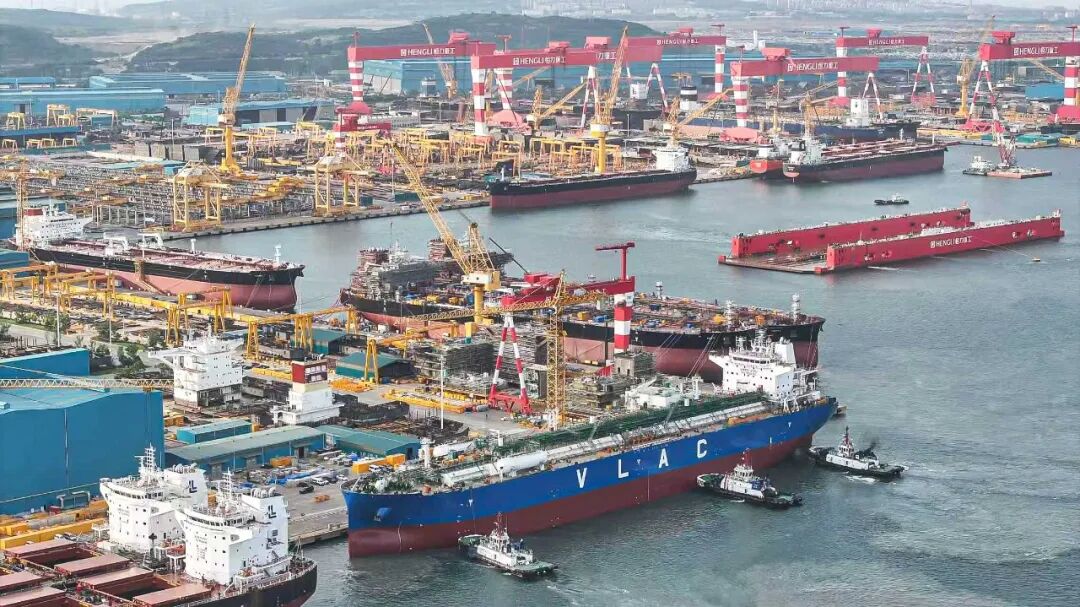
Hengli Group announced that, within the span of a single week, Hengli Heavy Industries finalized construction contracts with three renowned international shipowners for six Very Large Ammonia Carriers (VLACs)—comprising four 93,000 cbm vessels and two 88,000 cbm vessels. This achievement marks another milestone breakthrough for the company in the high-value-added gas carrier sector.
It is worth noting that reports circulated in the market a few days ago indicating that three Greek shipowners—Dynacom, Capital, and Evalend Shipping—had placed orders for VLACs with Hengli Heavy Industries, with a total of eight vessels initially reported. Although Hengli Heavy Industries did not disclose the identities of the shipowners in this instance, the order—confirmed at six vessels—most likely corresponds to the newbuilds mentioned in those market reports.
Hengli Heavy Industries has achieved a significant breakthrough in the construction of VLACs. On June 23, 2026, the company’s first 93,000 cbm VLAC was successfully launched; it was the world’s first VLAC to be built on a slipway and successfully launched, thereby breaking the industry’s long-standing convention that large gas carriers must be built in dry docks.
In the first half of 2026, Hengli Heavy Industries secured orders for 207 vessels—comprising 49 bulk carriers, 56 container ships, 94 oil tankers, and 8 VLACs—setting dual records for the volume and diversity of vessel types ordered at a single shipyard; notably, this marked the first time VLACs were included in the company’s order portfolio.
The latest batch of contracts for six VLACs represents not merely an increase in order volume, but a strategic breakthrough for Hengli Heavy Industries in the high-value vessel sector; it also signals an accelerating shift in the company’s order book structure—moving beyond traditional container ships, bulk carriers, and oil tankers to expand into high-value segments such as gas carriers.