


Recently, the simultaneous construction of seven vessels at Xiangshui Wanlong Heavy Industry has attracted widespread attention. Seven vessels of varied types and deadweight tonnages are under block fabrication on different slipways. The production chain is tightly scheduled, enabling full release of production capacity.
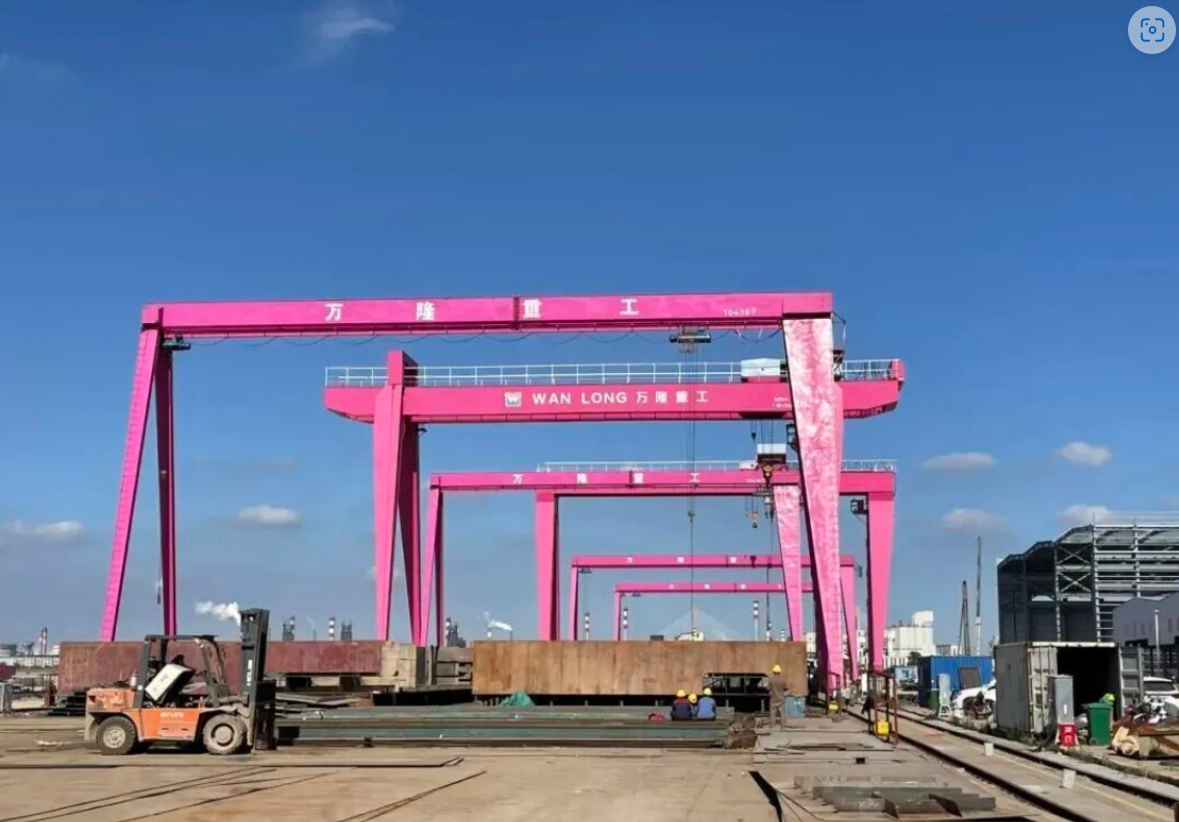
Reportedly, five of the vessels currently under construction have reached the critical stage of hull assembly on the slipway, with the first completed vessel scheduled for official launch in mid-July. The combined deadweight tonnage of all vessels currently under construction exceeds 500,000 tonnes. The range of vessel types is diverse, including 211,000-DWT very large bulk carriers and various container ships with capacities of 2,680 TEU and 3,300 TEU.
According to publicly available information, Xiangshui Wanlong Heavy Industry was established on October 22, 2024, through the restructuring and upgrading of the former Sanjia Shipbuilding Heavy Industry. With a registered capital of RMB 100.18 million, the company specializes in the manufacture of high-end vessels such as dual-fuel bulk carriers and container ships, while also engaging in offshore engineering equipment manufacturing and ship repair services.
Xiangshui Wanlong Heavy Industry adopted a development model of simultaneously constructing facilities, purchasing equipment, and securing orders, and successfully secured bulk shipbuilding contracts from domestic and international shipping companies even before the project was fully completed.
As a key regional shipbuilding project, Xiangshui Wanlong Heavy Industry has attracted a total investment exceeding RMB 1.7 billion (approximately $251 million). The project entails the construction of one 80,000-ton class berth and one 50,000-ton class berth, alongside five large shipbuilding slipways and two outfitting quays, all equipped with heavy-duty machinery such as gantry cranes with capacities ranging from 200 to 600 tons. Additionally, the facility will feature a coating workshop compliant with international PSPC standards, a semi-automated block assembly workshop, and advanced equipment—including laser cutting and automatic welding systems—collectively forming a modern, technologically advanced, and fully equipped shipyard.
To secure large-scale orders, Xiangshui Wanlong Heavy Industry introduced flat-section assembly lines and fully automated splicing and welding equipment. These measures significantly reduced the time required for hull block fabrication, cutting the construction period for some vessels by a full third and enabling the entire process—from the start of construction to delivery—to be completed in as little as ten months.
To date, Xiangshui Wanlong Heavy Industry’s order backlog has exceeded 1 billion yuan (approximately $147 million). The company plans to begin construction on more than ten vessels in the near future, and its total steel consumption for this year is expected to reach 150,000 metric tons, with production schedules fully booked for the next several years.
Once Xiangshui Wanlong Heavy Industry reaches full production capacity, its annual shipbuilding capacity will surge to 1 million deadweight tons, with annual output value expected to exceed 5 billion yuan. The project is projected to create more than 2,000 jobs and drive coordinated revenue growth across upstream and downstream supporting industries—including steel, marine electromechanical equipment, marine coatings, and shipping logistics—effectively revitalizing the real economy in coastal counties and expanding employment and income opportunities for the local population.
According to previous reports, Xiangshui Wanlong Heavy Industry also plans to move forward with the second phase of its drydock project. This phase will focus on the construction of two 100,000-ton drydocks, the development of an industrial internet platform, and the intelligent upgrading of equipment, as the company continues to advance toward green, low-carbon, and smart manufacturing.