


Anna Angelicoussis’s Greek shipping company, Alpha Bulkers, has ordered two Capesize bulk carriers from a Chinese private shipyard.
Greek media reports, citing shipbrokers and market sources, indicate that Alpha Bulkers has ordered two Capesize bulk carriers from Hengli Heavy Industries. Hengli Heavy Industries reportedly offers more attractive delivery times compared to other major Chinese shipyards.
Specific details of the order have not been disclosed. Hengli Heavy Industries announced on April 30th that it had taken delivery of 18 new vessels in April, including eight 181,000 DWT Capesize bulk carriers. It is currently unclear whether these are included in this order.
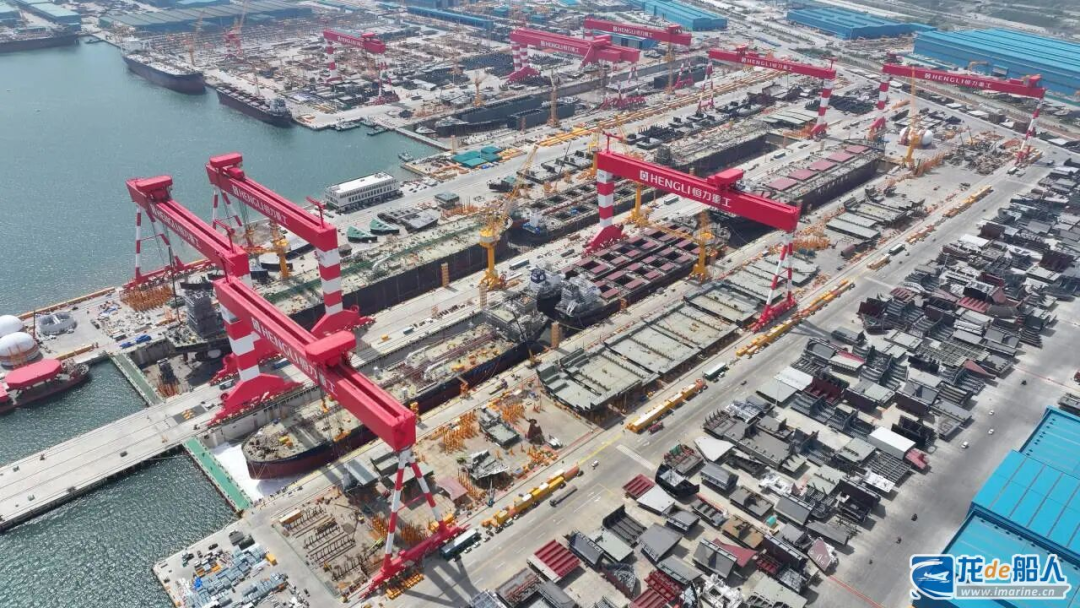
As a true “dark horse” in the shipbuilding industry, Hengli Heavy Industries held a new ship order backlog of 284 vessels, valued at US$27.513 billion, as of March 31, 2026. This backlog covers mainstream vessel types including bulk carriers, container ships, and tankers, with container ships and tankers, which have relatively higher added value, accounting for over 60% of the orders. Including the 18 new vessels signed in April 2026, Hengli Heavy Industries currently has an order backlog exceeding 300 vessels. So far in 2026, Hengli Heavy Industries’ new ship order volume has already surpassed its 2025 order level.
Due to strong market demand and a continuous increase in orders, Hengli Heavy Industries’ existing core ship slots, block workshops, final assembly sites and outfitting workshops are all operating at full capacity. The core ship slots production schedule covers the next 3-4 years. To this end, Hengli Heavy Industries’ listed entity, Songfa Co., Ltd., plans to raise 7 billion yuan to expand its production capacity.
Hengli Heavy Industries currently has 10 slots for vessels under 200,000 deadweight tons and 8 slots for vessels over 200,000 deadweight tons; typically, each vessel occupies a slot for 3 to 4 months. If the proposed investment project is successfully implemented, Hengli Heavy Industries’ total number of berths will increase to 22, including 10 slots capable of simultaneously building vessels of less than 200,000 deadweight tons and 12 slots capable of simultaneously building vessels of 200,000 deadweight tons or more.
On the shipowner side, Alpha Bulkers currently operates 33 bulk carriers, 10 of which are Capesize and Newcastle vessels. The company is currently modernizing its Capesize fleet and recently sold the oldest Capesize bulk carrier in its fleet, the “Antonis Angelicoussis,” which was subsequently renamed and is now operated by a new owner.
Currently, the most recently delivered Capesize bulk carriers in Alpha Bulkers’ fleet were delivered in 2016, totaling four vessels; the remaining 11 vessels of the same type were all delivered between 2008 and 2011, making them relatively older.
In 2025, Alpha Bulkers garnered significant attention for launching a newbuilding program for 11 container ships, marking the company’s official entry into the container shipping sector. In the bulk carrier sector, the company’s most recent deliveries were two Ultramax bulk carriers that joined the fleet in 2025.
Looking at the market as a whole, new orders for Cape-size bulk carriers have shown strong growth in recent months, with Greek shipowners leading the way.
For example, international bulk carrier owner Safe Bulkers recently purchased one 182,000 DWT bulk carrier from a Japanese shipyard and acquired three 82,000 DWT bulk carriers from the same Japanese shipyard to expand its Kamsarmax-class order backlog. Greek shipowners such as Enesel and Neda Maritime have also placed orders for Capesize bulk carriers with Hengli Heavy Industries.
Data from Xclusiv Shipbrokers shows that 26 Capesize/Newcastle bulk carriers were ordered in the first quarter of 2026, compared to just 13 during the same period last year. Of these, 12 were ordered by Greek shipowners, whereas Greek shipowners were virtually absent from this segment last year. As of the end of April, the ratio of Cape-size bulk carrier orders to the fleet size (measured in deadweight tonnage) had approached 15%.