


On April 25, China Merchants Energy Shipping (CMES) issued an “Announcement on Related-Party Transactions Regarding the Proposed Construction of 8,200-TEU and 1,800-TEU Container Ships by a Wholly-Owned Subsidiary,” announcing plans to invest over 3.8 billion yuan (approximately $556 million) to order eight container ships of two types.
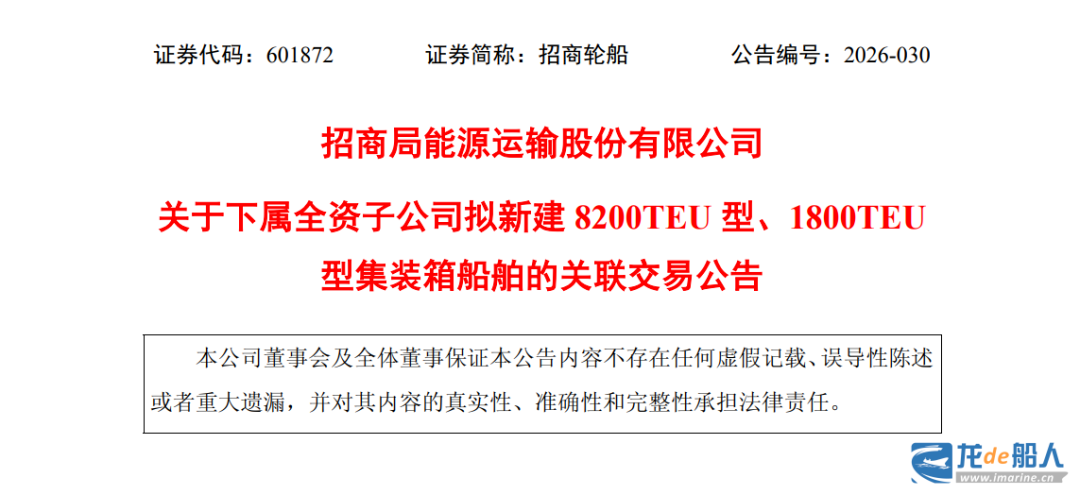
According to the announcement, CMES plans to sign a Shipbuilding Contract with a subsidiary of its affiliated party, China Merchants Shipbuilding Industry Group Co., Ltd. (CMI), through a ship-specific company established by its wholly-owned subsidiary. The contract covers the construction of four new 8,200 TEU methanol-ready container ships and four new 1,800 TEU container ships. The total investment for the project is expected to not exceed 3.814 billion yuan, with delivery scheduled for 2028.
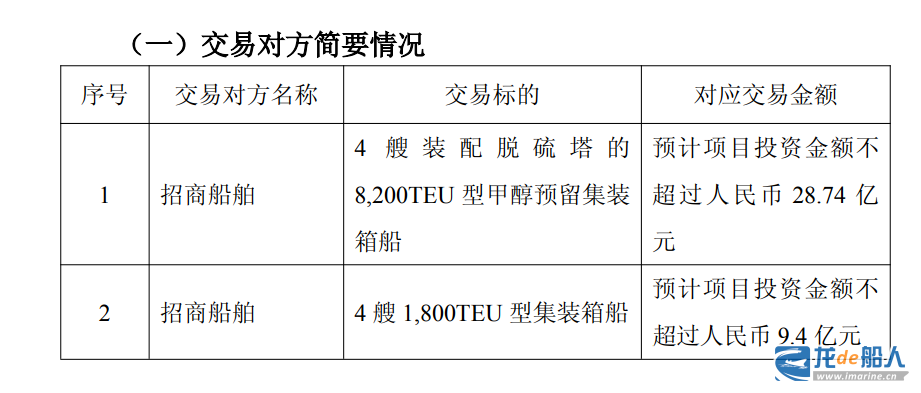
Specifically, the four 8,200 TEU methanol-ready container ships are equipped with desulfurization towers, with an estimated investment of no more than 2.874 billion yuan (approximately $420 million); the investment for the four 1,800 TEU container ships will not exceed 940 million yuan (approximately $138 million). These new vessels will be built by two yards under the CMI.
CMES stated that this transaction is a necessary step in the company’s efforts to optimize the structure of its container fleet and upgrade capacity on its routes. Once the vessels are delivered and put into service in stages starting in 2028, they will be used to upgrade capacity and optimize the structure of existing routes, thereby enhancing loading capacity and operational efficiency, and strengthening the competitiveness and service capabilities of the company’s container shipping business.
In addition to container ships, CMES recently placed an order for 10 conventional-fuel Very Large Crude Carriers (VLCCs) through its wholly-owned subsidiary, Associated Maritime Company (Hong Kong) Limited (AMCL), with Dalian Shipbuilding Industry Corporation (DSIC), a subsidiary of China State Shipbuilding Corporation (CSSC). The total contract value is approximately 8.566 billion yuan (equivalent to approximately $1.253 billion). These VLCCs feature a dual-fuel-ready design and are equipped with desulfurization scrubbers and shaft-driven generators. Delivery is expected between 2028 and 2030.
On the same day, CMES released its “First Quarter Report for 2026.” During the reporting period, CMES generated operating revenue of approximately 8.556 billion yuan (approximately $1.252 billion), representing a year-over-year increase of 52.92%; operating profit reached approximately 3.223 billion yuan (approximately $472 million), up 216.4% year-over-year; Net profit attributable to shareholders of the listed company was approximately RMB 2.763 billion (approximately $404 million), a year-over-year increase of 219.31%; net profit attributable to shareholders of the listed company, excluding non-recurring gains and losses, was approximately RMB 2.756 billion (approximately $403 million), a year-over-year increase of approximately 223.1%.
In addition, CMES announced that it has agreed to have its wholly-owned subsidiaries lease three and two newly built 84,500 DWT mult-ipurpose vessels from China Merchants Bank Financial Leasing Co., Ltd. (CMB Financial Leasing) and China Merchants Group Financial Leasing Co., Ltd. (CMG Financial Leasing), respectively. The lease terms are for three years, with four consecutive three-year renewal options for the lessee. The total lease rent for the five vessels over three years amounts to approximately 721 million yuan (approximately $105 million).
CMES stated that the chartering of these 84,500 DWT newly built multi-purpose vessels represents a significant step in implementing the company’s fleet development plan. This move will help enhance the fleet’s sustainable profitability by leveraging the vessels’ COA and strong cargo adaptability, thereby facilitating the transformation and upgrading of the general cargo fleet. Once the vessels are delivered and put into service, they will be used to upgrade capacity and optimize the structure of existing routes, thereby increasing loading capacity and operational efficiency, and strengthening the fleet’s market competitiveness and ability to serve customers.