


On March 31, the first of a series of 10,800 CEU LNG-fueled dual-fuel car carriers (PCTCs) being built by CSSC Guangzhou Shipyard International (GSI) for South Korea’s HMM set sail for sea trials. This is currently the first 10,000 CEU class dual-fuel PCTC under construction worldwide.
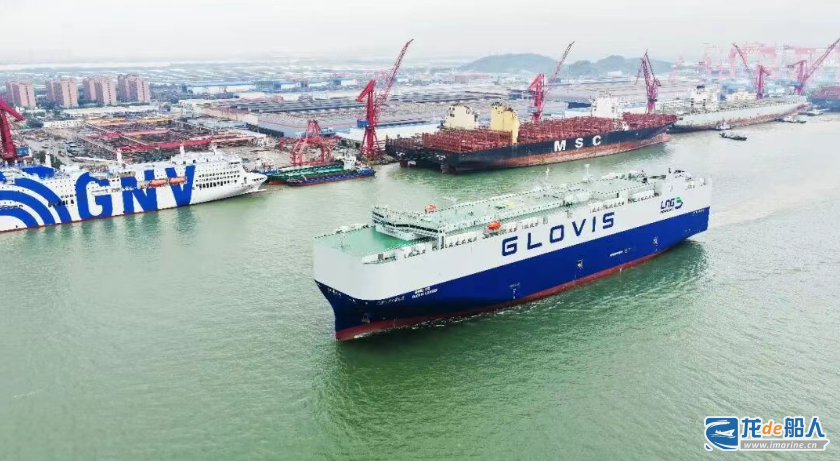
The vessel has an overall length of 230 meters, a beam of 40 meters, and a structural draft of 10.5 meters, with a speed of approximately 19 knots, striking a perfect balance between high-efficiency transport and stable navigation. Its 14-deck garage design allows for the flexible loading of a diverse range of vehicles, including electric cars, hydrogen-powered vehicles, and heavy-duty trucks, with a maximum capacity of 10,800 vehicles. Based on a standard vehicle length of 5 meters, if all loaded vehicles were lined up end-to-end, the total length would exceed 50 kilometers.
In addition, the vessel is equipped with a dual-fuel propulsion system that runs on both fuel oil and LNG, and features shaft generators that generate electricity while the vessel is underway, thereby achieving energy savings and reduced emissions. Designed by the Shanghai Research and Design Institute of Shipbuilding, the vessel boasts outstanding environmental performance and complies with the International Maritime Organization’s Tier III emission standards.
It is understood that PCTCs are high-tech, high-value-added vessel types that are difficult to build and require advanced technology. First, these vessels require extensive use of thin plates in their construction, and Guangzhou Shipyard International has successfully overcome the challenge of controlling deformation in thin plates. Second, they feature a large number of roll-on/roll-off (RoRo) systems and a high degree of mechanization; in the past, most of these RoRo systems relied on imports, but now they have all been successfully localized.