


Recently, the natural gas dual-fuel medium-speed engine control system (CP-ICESML450A), independently developed and designed by China Shipbuilding Power Engineering Institute Co., Ltd. (CSPI), a subsidiary of CSSC Power (Group) Corporation Ltd. (CPGC), and manufactured by Anqing Marine Electric Device, successfully passed the type apprval of othe China Classification Society (CCS) and simultaneously completed cybersecurity certification and software testing. The methanol dual-fuel engine control system (CP-SESML320A), developed based on the same platform, also passed the aforementioned cybersecurity certification and software testing.
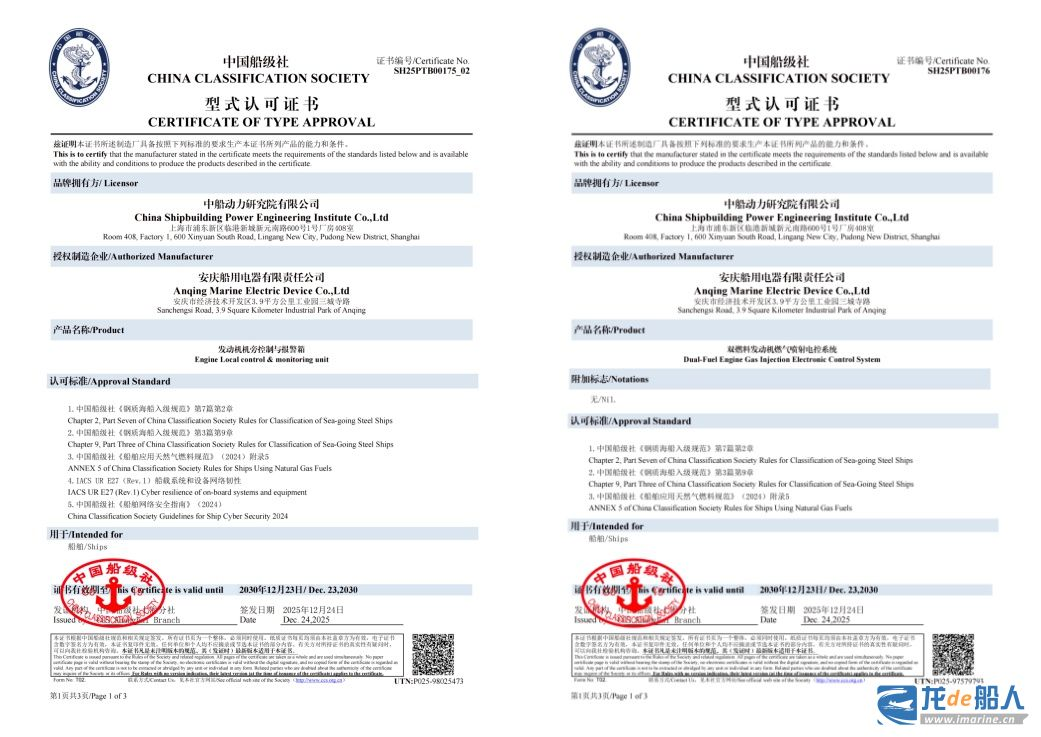
This dual certification signifies that the standardized medium-speed engine dual-fuel autonomous electronic control system fully meets the requirements of international maritime regulations and stringent marine environments in terms of electrical architecture, integrated hardware and software design, and comprehensive network protection. It fills the gap in China’s product range of autonomous electronic control systems for high-power medium-speed engines, breaks through the long-standing reliance on foreign technology in this field, and provides authoritative access qualifications and safety guarantees for subsequent shipboard applications.
It is understood that the electronically controlled system approved in this type certification is applicable to medium-speed engines powered by diesel, LNG, and new fuels such as methanol. It has already been successfully adapted to China’s largest 450-bore dual-fuel medium-speed engine and has achieved breakthrough orders. Additionally, the ML320DM-PFI methanol dual-fuel engine equipped with the same proprietary electronic control system is scheduled to complete its first unit delivery in 2026.
This series of milestone advancements demonstrates CPGC’s comprehensive self-reliance and control capabilities across the entire chain of ship propulsion core control systems: breakthroughs spanning the entire process from design and R&D to testing, validation, certification, and authorization. This fundamentally enhances the resilience and safety margin of the industrial chain. The large-scale application of this indigenous electronic control system not only solidifies the industrial foundation for the autonomous and secure development of marine propulsion systems but also provides robust industrial support for enhancing international competitiveness.