


Kawasaki Heavy Industries, Japan’s second-largest defense contractor and a major manufacturing conglomerate, has once again apologized for its engine data falsification scandal. Japan’s Ministry of Defense has imposed disciplinary measures on Kawasaki Heavy Industries in response to the data falsification scandal.
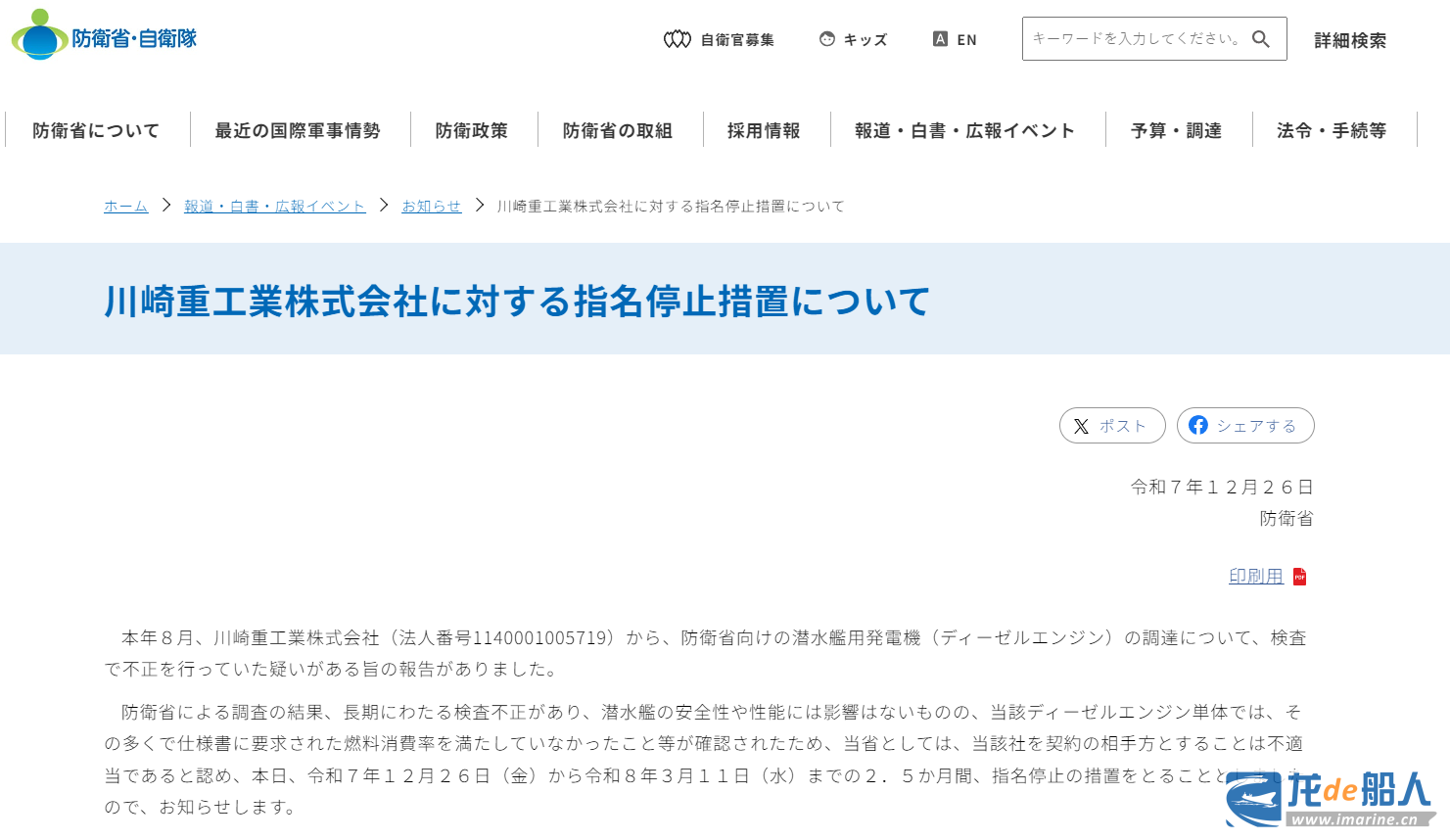
On December 26, the Japan Ministry of Defense issued an announcement regarding the Kawasaki Heavy Industries data falsification scandal: Kawasaki Heavy Industries will be barred from participating in bidding processes for a period of two and a half months, from December 26, 2025, to March 11, 2026. On the same day, Kawasaki Heavy Industries released a supplementary investigation report and follow-up preventive measures regarding the “submarine repair case and marine engine inspection falsification incident” (hereinafter referred to as the “Supplementary Investigation Report”), and apologized again for both scandals.
In June this year, a special investigative committee composed of third-party lawyers discovered that Kawasaki Heavy Industries may have falsified fuel efficiency performance test data for submarine engines supplied to the Japan Maritime Self-Defense Force. Kawasaki Heavy Industries reported the matter to the Japanese Ministry of Defense in August.
The Japanese Ministry of Defense has confirmed through its investigation that Kawasaki Heavy Industries did engage in long-term falsification of inspection data. While this did not affect the safety or performance of the submarines, most of the involved diesel engines failed to meet technical specification requirements for metrics such as fuel consumption rates. In light of this, the Ministry of Defense has determined that Kawasaki Heavy Industries is unsuitable as a contracting party and has decided to prohibit the company from participating in future bids.
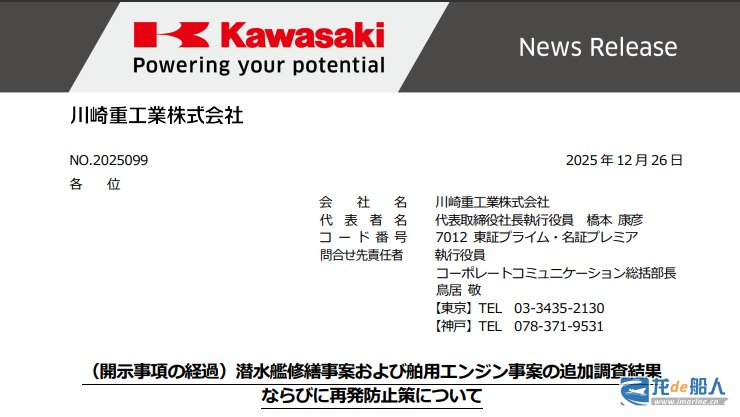
According to the Supplementary Investigation Report, Kawasaki Heavy Industries admitted to falsifying relevant data during land-based testing of submarine engine fuel efficiency because, in most cases, the actual test data from submarine engine trials failed to meet the specifications outlined in the Japanese Ministry of Defense’s technical requirements. To ensure timely delivery, Kawasaki Heavy Industries recorded target values rather than actual fuel consumption rates on the submarine engine land test result sheets and submitted the falsified data to the Japanese Ministry of Defense. Multiple departments participated in the data concealment.
Kawasaki Heavy Industries admitted in its Supplementary Investigation Report that the falsification of submarine engine data spanned 33 years (1988-2021), involving 66 engines. Notably, beyond tampering with submarine engine test data, the company also acknowledged in the report that it had inflated budgets, a practice that similarly persisted for at least 30 years.
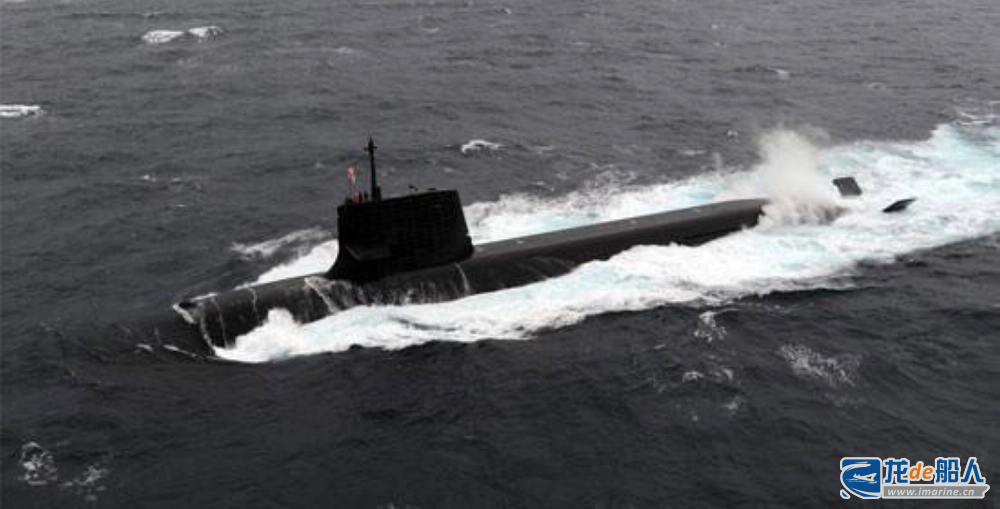
According to the Japan Ministry of Defense, all 24 active submarines in the Japan Maritime Self-Defense Force (excluding the most recently delivered vessel) are equipped with engines developed by Kawasaki Heavy Industries. Data falsification issues have been identified in the remaining 23 submarines.
Regarding the commercial marine engine data falsification incident, Kawasaki Heavy Industries confirmed in August 2024 that improper practices involving the long-term tampering of marine engine test data to meet relevant requirements had occurred, affecting a total of 673 commercial marine engines.
Kawasaki Heavy Industries has admitted to improper conduct involving the falsification of test data for commercial marine engines during workshop trial runs, including nitrogen oxide emission tests. Specifically, during workshop trial run testing, the manufacturer modified testing equipment and falsified data in order to keep fuel consumption rates within the permissible range specified by customer requirements and to reduce data variability.
While banning Kawasaki Heavy Industries from bidding for government contracts for the next two and a half months, in another scandal, the Japanese Ministry of Defense discovered that 11 Maritime Self-Defense Force personnel had received personal items unrelated to their job duties through Kawasaki Heavy Industries, and the personnel involved have been suspended or had their salaries reduced.
The Japan Ministry of Defense stated that the total value of the involved gifts amounted to approximately 1.16 million yen, including items such as game consoles, golf bags, and watches. These gifts were generated through fictitious transactions created by Kawasaki Heavy Industries and its contractors under a ship repair contract.
As Japan’s second-largest defense contractor after Mitsubishi Heavy Industries, Kawasaki Heavy Industries was barred from bidding for two and a half months due to falsified data on submarine and merchant ship engines—a punishment that underscores the severity of the incident. Coupled with a bribery scandal, Japanese media reports indicate this will deal a severe blow to the company.
Kawasaki Heavy Industries President Yasuhiko Hashimoto stated in a declaration: “We take this matter extremely seriously and will strive to rebuild trust by implementing preventive measures. The company is considering disciplinary action against the employees involved.”
In addition to Kawasaki Heavy Industries, IHI Corporation and Hitachi Zosen Corporation were also implicated in data fabrication scandals in 2024. The falsification incidents involving these three manufacturers encompassed thousands of marine engines.
According to IHI Corporation’s internal investigation, more than half of the company’s engines failed to meet specification standards. The company acknowledged that data had been falsified for 86% of the nearly 4,900 marine engines shipped at the time.
Two subsidiaries of Hitachi Zosen Corporation have also been confirmed to have falsified fuel efficiency data for large marine engines, involving a total of 1,364 engines. According to an internal investigation by Hitachi Zosen Corporation, its subsidiaries Hitachi Zosen Marine Engine and IMEX have been found to have improperly altered fuel consumption rates in “workshop trial test results” submitted to customers since 1999. Of the 1,366 engines investigated (mostly for non-Japanese flag vessels), only two were found to be free of data falsification.